3. AWS DevOps vs Azure DevOps vs Google Cloud DevOps – Which Is Right for You?
The three major cloud platforms each have mature DevOps tooling ecosystems – and the right choice depends on your existing infrastructure, your team’s familiarity, your compliance requirements, and the specific services your application needs.
AWS DevOps services
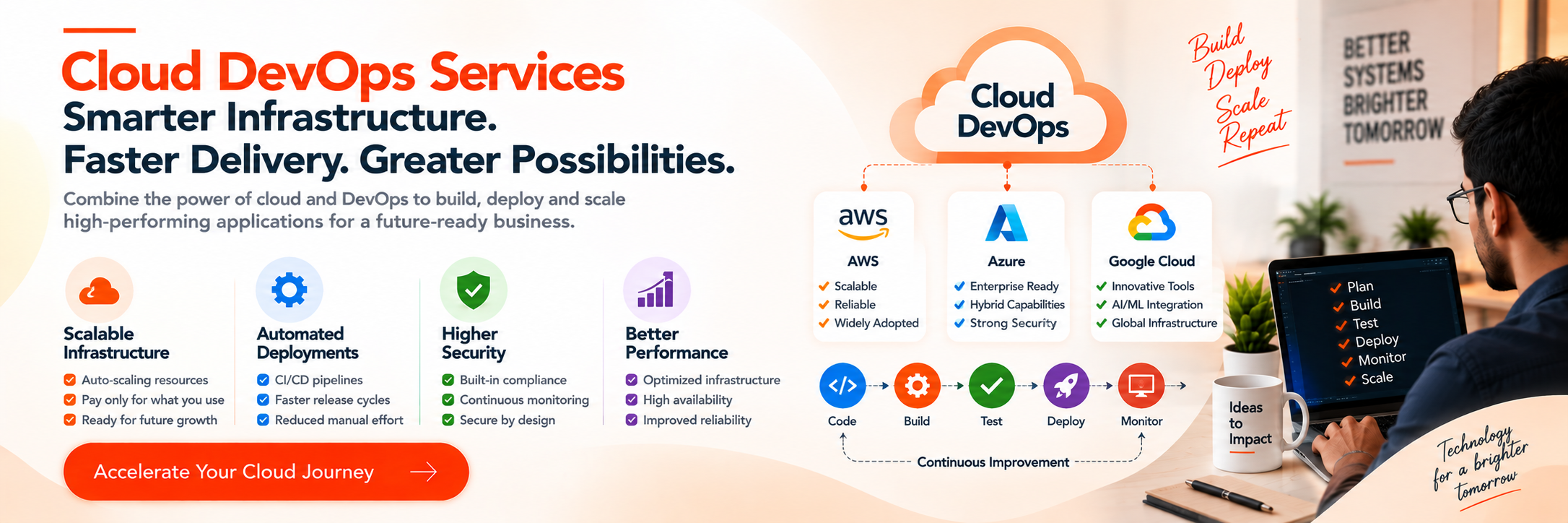
AWS has the most mature and comprehensive DevOps tooling ecosystem of the three major platforms. CodeCommit for source control, CodeBuild for build automation, CodeDeploy for deployment management, and CodePipeline for end-to-end CI/CD orchestration form a native AWS DevOps stack that integrates tightly with the rest of the AWS service ecosystem. For organisations already invested in AWS infrastructure, building cloud DevOps practices natively on AWS tooling offers the tightest integration and the most granular control over the deployment pipeline.
AWS is also the platform of choice for organisations with significant machine learning, data engineering, or IoT requirements – where the breadth of AWS managed services provides capabilities that the other platforms do not yet match.
Azure DevOps services
Azure DevOps – Microsoft’s cloud DevOps platform – is the natural choice for organisations in the Microsoft ecosystem. If your engineering team uses Visual Studio, if your organisation runs Microsoft 365, or if your applications depend on .NET frameworks or SQL Server, Azure’s native integration across all of these reduces friction significantly. Azure Pipelines provides enterprise-grade CI/CD with native integration across GitHub, Bitbucket, and Azure Repos. Azure Kubernetes Service provides managed Kubernetes with tight integration into Azure’s identity and security services.
For enterprise organisations with existing Microsoft licensing and governance frameworks, Azure DevOps services frequently offer the lowest total friction for adoption.
Google Cloud DevOps
Google Cloud is the platform of choice for organisations with significant Kubernetes requirements – Kubernetes was originally developed at Google, and Google Kubernetes Engine remains the most mature managed Kubernetes service available. Google Cloud Build and Cloud Deploy provide a native CI/CD stack that integrates cleanly with GKE and the rest of the Google Cloud service ecosystem.
For organisations building data-intensive applications or using BigQuery, Vertex AI, or other Google Cloud data and ML services, building cloud DevOps practices natively on Google Cloud minimises the integration complexity between the data platform and the application deployment pipeline.
4. Cloud Native DevOps – Building Applications That Are Born in the Cloud
Cloud native DevOps is a different discipline from cloud migration DevOps. Where cloud migration takes existing applications and moves them to cloud infrastructure, cloud native development starts from the assumption that the application will live entirely in the cloud – and designs every architectural decision around that assumption from the beginning.
Cloud native applications are built as microservices — small, independently deployable services that each handle a specific business capability and communicate through well-defined APIs. They are containerised from day one, designed for horizontal scaling, and built with the assumption that individual components will fail and the system needs to continue operating anyway. They use managed cloud services for databases, message queues, caching, and other infrastructure concerns – allowing engineering teams to focus on business logic rather than operational overhead.
Why cloud native changes the DevOps conversation
When an application is cloud native from the start, the DevOps implementation is simpler and more powerful than retrofitting DevOps onto an existing application. There are no legacy deployment processes to work around. The application is already containerised, already designed for automated scaling, and already built with the monitoring hooks that observability tools need. The CI/CD pipeline can be designed alongside the application architecture rather than adapted to fit it afterwards.
For organisations starting new product development in 2025, cloud native DevOps is not a premium option – it is the standard approach that produces the most maintainable, scalable, and operationally efficient applications. Ahom’s
DevOps services in India team approaches every new build with cloud native principles as the default starting point – recommending departures from that default only when specific legacy integration requirements or compliance constraints make them necessary.
5. How Ahom Technologies Delivers Cloud DevOps Services for Global Clients
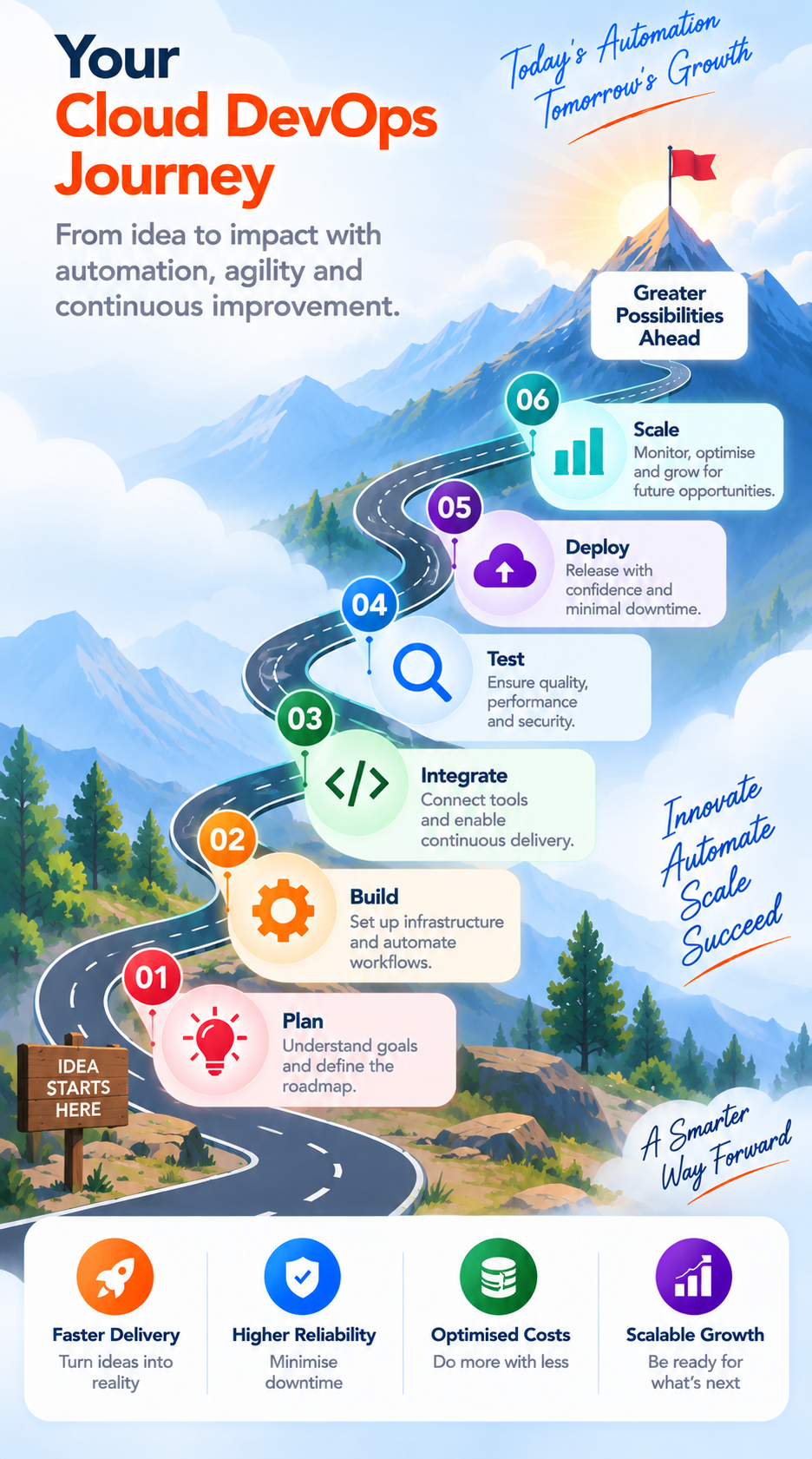
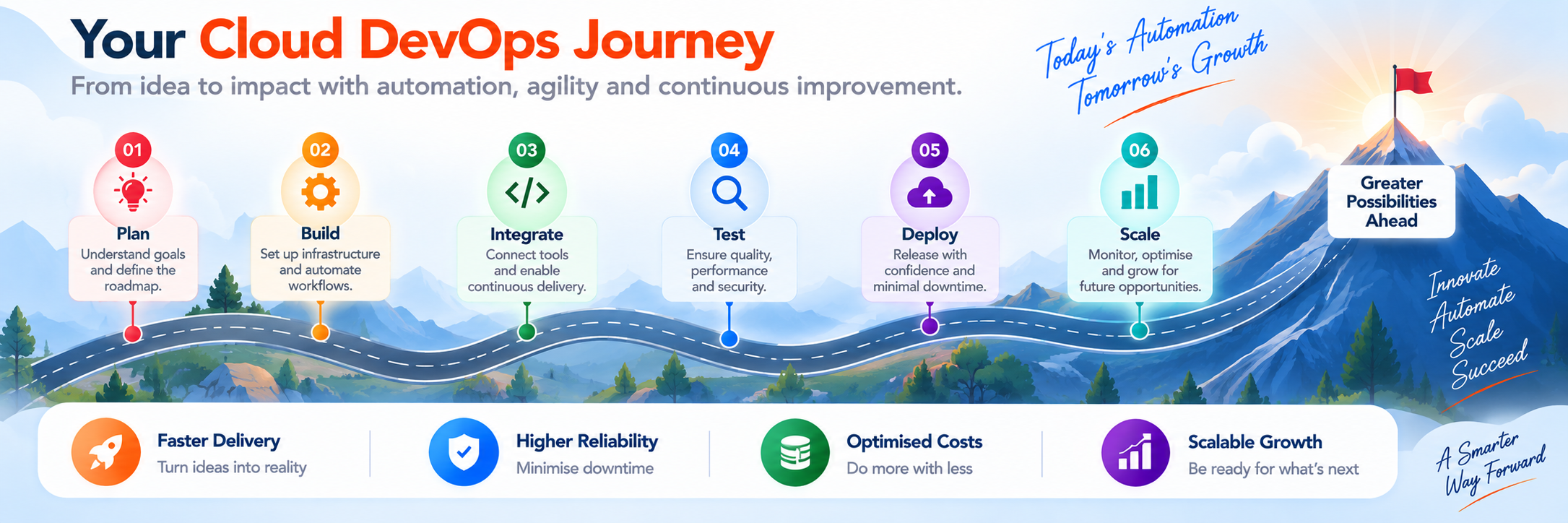
Ahom Technologies has been delivering cloud DevOps services for clients across India, the USA, UK, UAE, and Canada for over a decade. Our cloud DevOps practice is not a recent addition to our service portfolio – it has been built through hundreds of real engagements across healthcare, fintech, e-commerce, logistics, EdTech, and SaaS.
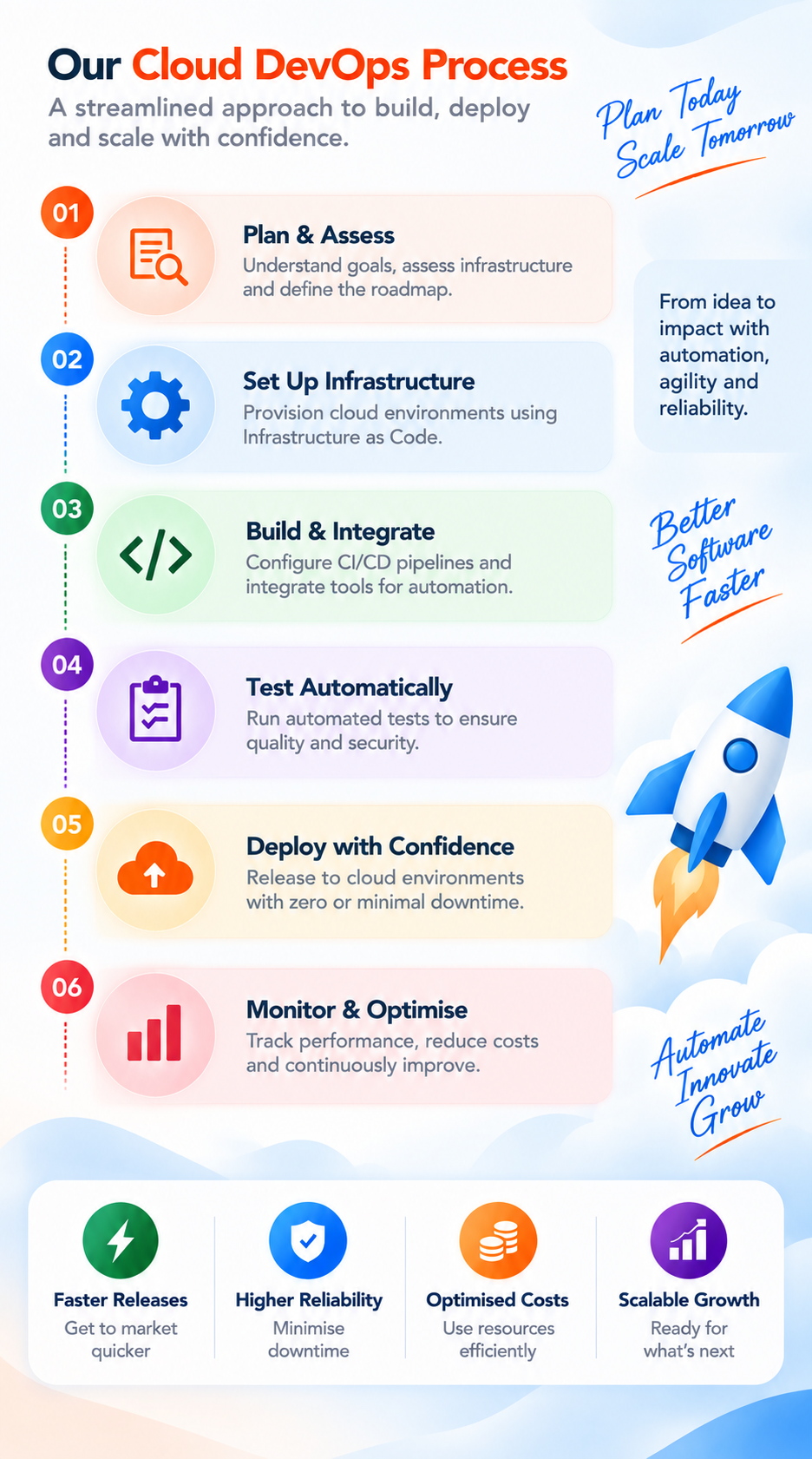
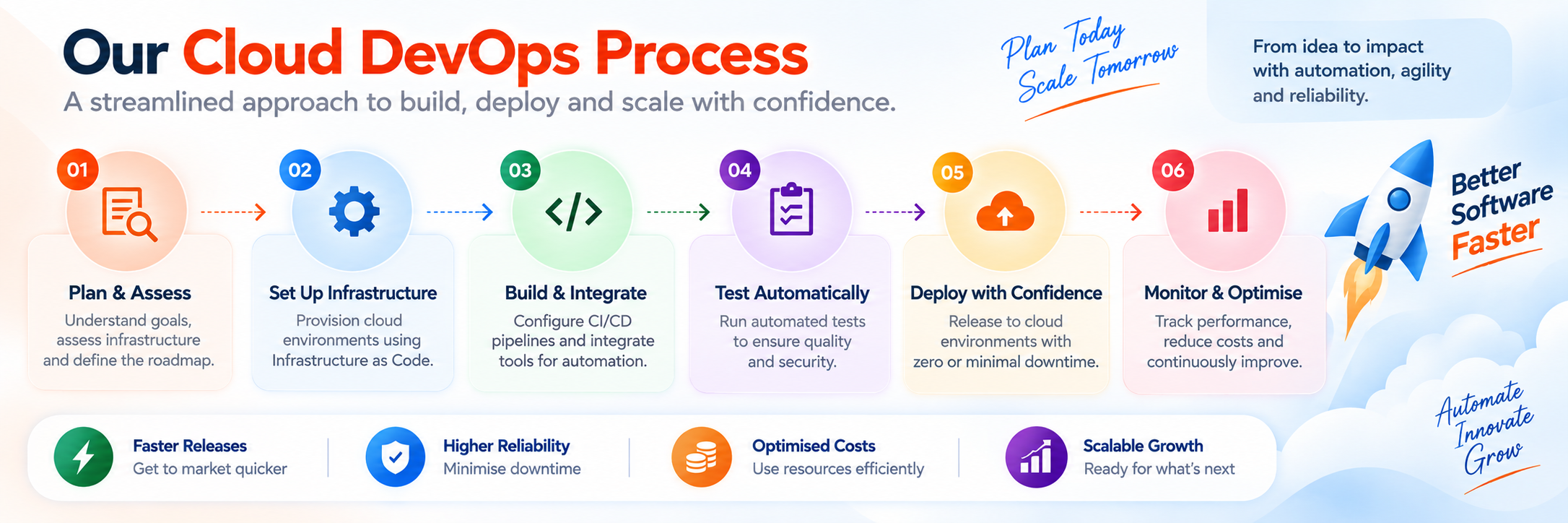
Every Ahom cloud DevOps engagement begins with a cloud readiness assessment – mapping your current infrastructure, your application architecture, your deployment process, and your team’s operational capabilities against the target state. This assessment produces a prioritised roadmap that identifies the highest-impact improvements first and sequences subsequent work in a way that builds on each previous step rather than creating parallel workstreams that compete for the same engineering attention.
What a typical Ahom cloud DevOps engagement looks like
The assessment and roadmap phase takes one to two weeks. Infrastructure provisioning – setting up the cloud environment, configuring networking and security, establishing the IaC codebase in Terraform – takes two to four weeks depending on complexity. CI/CD pipeline implementation – designing the pipeline stages, configuring build environments, setting up deployment automation and environment promotion logic – takes two to three weeks running in parallel with infrastructure work. Monitoring and observability setup – Prometheus, Grafana, log aggregation, alerting rules – runs alongside deployment pipeline implementation.
By week six to eight of a standard engagement, most clients have a fully automated cloud DevOps environment in production – with Infrastructure as Code managing their cloud resources, CI/CD pipelines automating their deployment process, and monitoring giving their team real-time visibility into system health.
Post-engagement support
After the initial implementation, Ahom provides structured post-engagement support – covering platform updates, security patch management, pipeline maintenance, cost optimisation reviews, and incident response. This is not an optional add-on. It is a standard part of how every cloud DevOps engagement is structured – because cloud DevOps environments require ongoing attention to remain secure, cost-effective, and performant as the applications and teams around them evolve.
Our full
DevOps services portfolio covers everything from initial cloud strategy through to long-term managed cloud operations – with cloud DevOps sitting at the centre of how Ahom connects application development, infrastructure management, and operational reliability into a single coherent engineering practice.

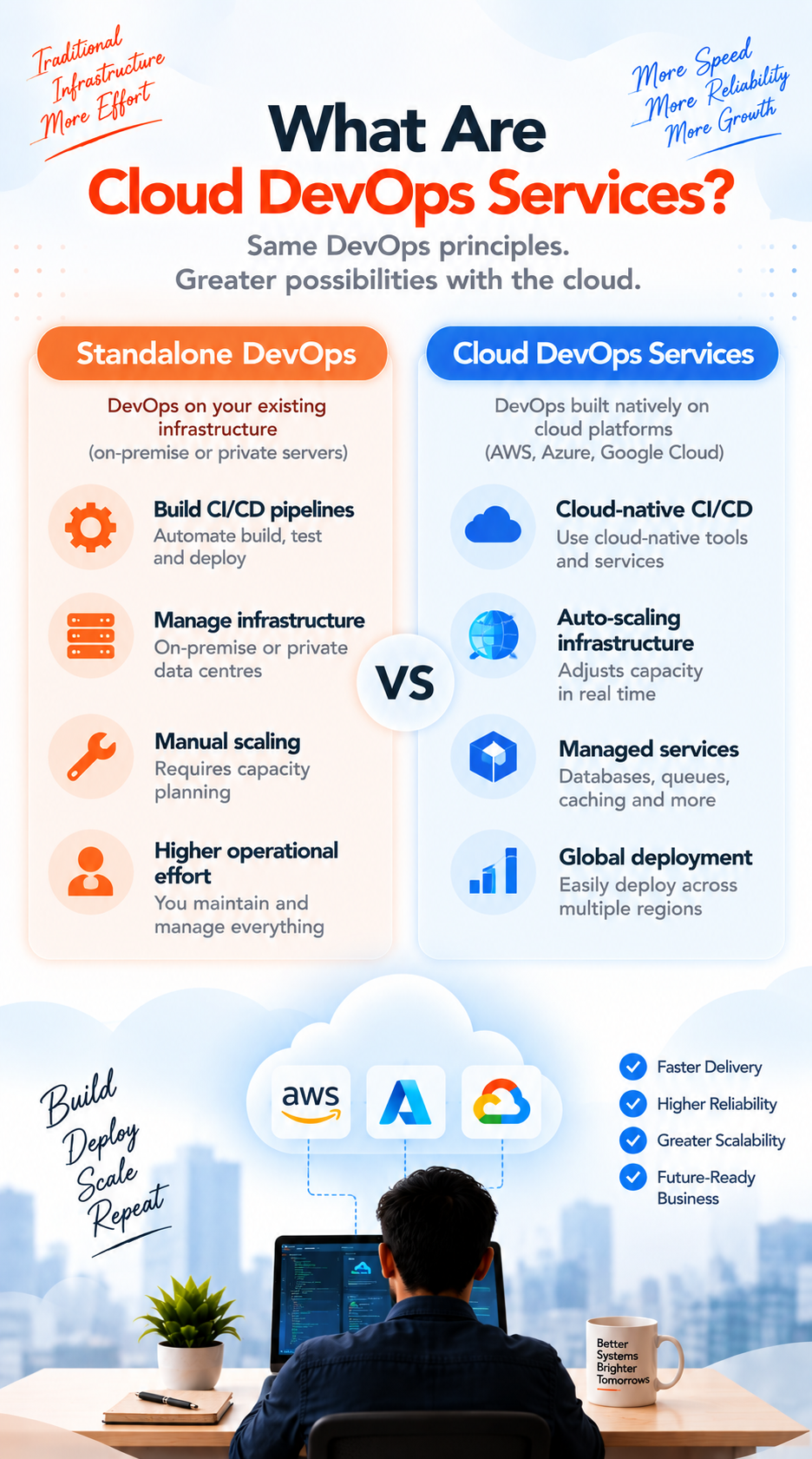
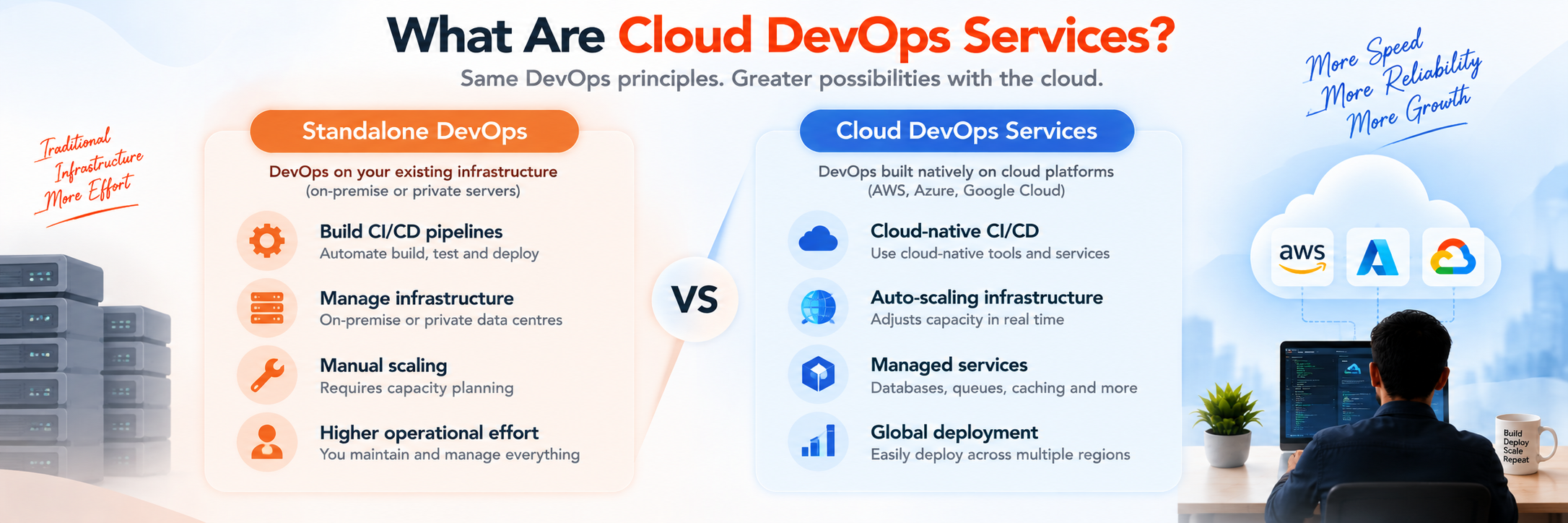 Standalone DevOps – building CI/CD pipelines, automating testing, implementing Infrastructure as Code – can be done on any infrastructure, including on-premise servers and private data centres. Cloud DevOps services take that same discipline and build it natively on cloud platforms – using the specific tools, services, and scaling capabilities that AWS, Azure, and Google Cloud provide to make automation faster, more reliable, and more cost-effective.
The difference is not just where the infrastructure lives. It is how the infrastructure behaves.
Standalone DevOps – building CI/CD pipelines, automating testing, implementing Infrastructure as Code – can be done on any infrastructure, including on-premise servers and private data centres. Cloud DevOps services take that same discipline and build it natively on cloud platforms – using the specific tools, services, and scaling capabilities that AWS, Azure, and Google Cloud provide to make automation faster, more reliable, and more cost-effective.
The difference is not just where the infrastructure lives. It is how the infrastructure behaves.
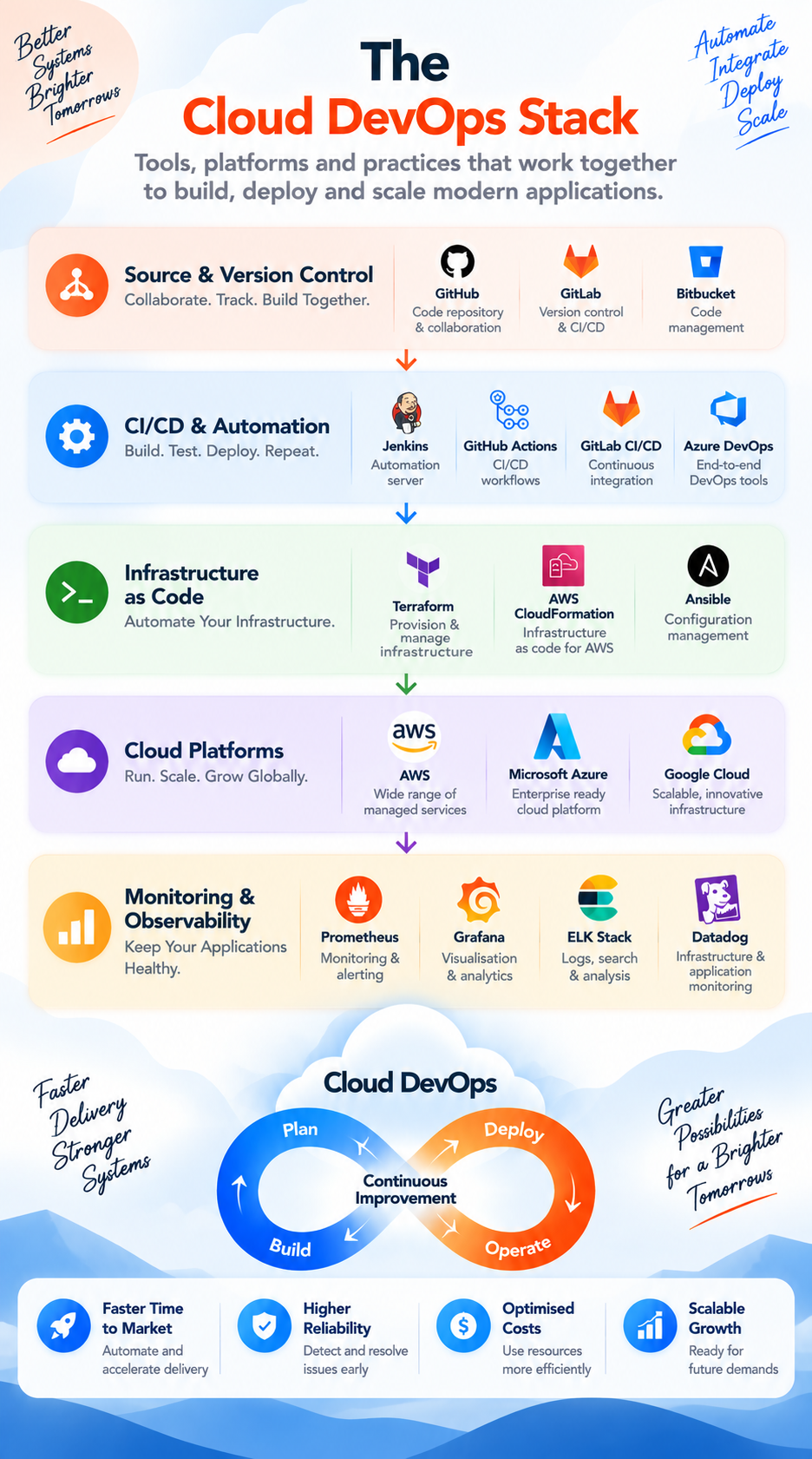
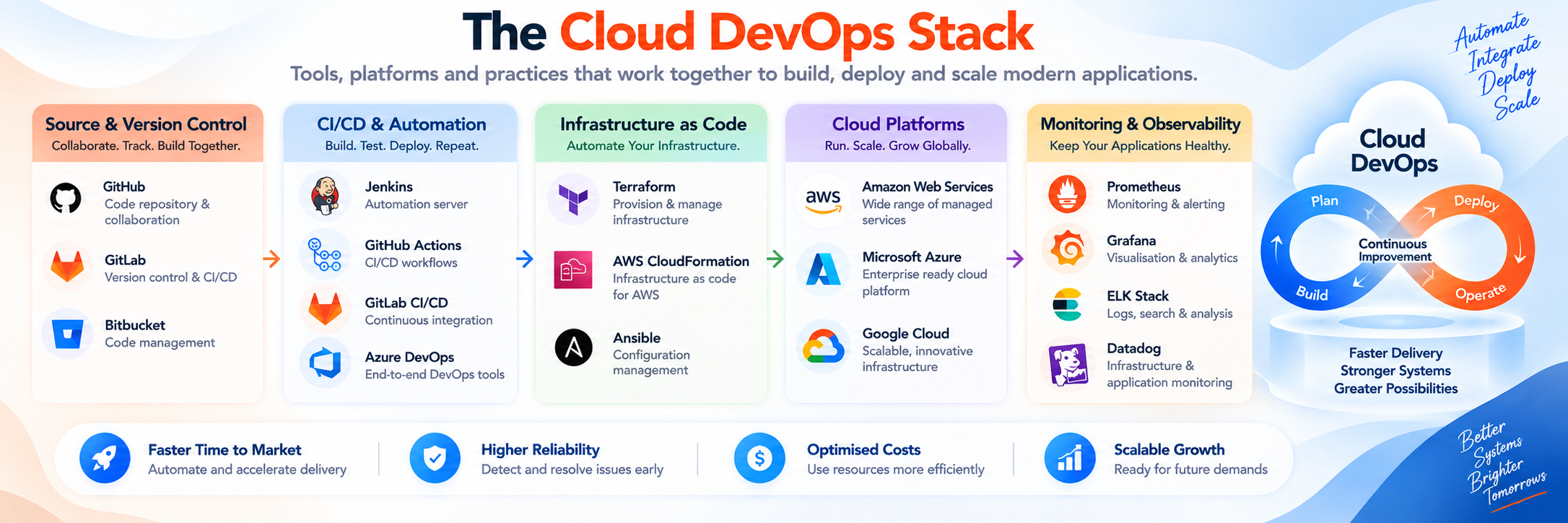 Understanding the specific tools and practices that define a mature cloud DevOps implementation helps you evaluate whether a provider you are considering is genuinely operating at that level – or describing a more basic capability in more sophisticated language.