

Node.js Development Company in Gurgaon Building Scalable Backend Applications with Ahom Technologies
Gurgaon has quietly become one of India’s most significant technology hubs. What started as a corporate satellite city has evolved into a dense ecosystem of enterprise software companies, high-growth startups, and digital transformation specialists – all competing for the same pool of backend engineering talent. Finding a Node.js development company in Gurgaon that combines genuine technical depth with reliable delivery is harder than the number of available options suggests.
Node.js has become the backbone of modern web application development. Its non-blocking, event-driven architecture makes it uniquely suited for applications that need to handle high concurrency, real-time data, and API-heavy architectures at scale. For businesses building the kind of digital products that compete – fast, scalable, and deeply integrated – Node.js is frequently the right engineering choice. The question is whether the company you choose to build with it is the right one too.
This guide covers what serious Node.js development actually involves, what to look for in a Gurgaon-based Node.js partner, and how Ahom Technologies approaches every Node.js engagement we take on.
1. What Node.js Development Actually Involves at a Production Level
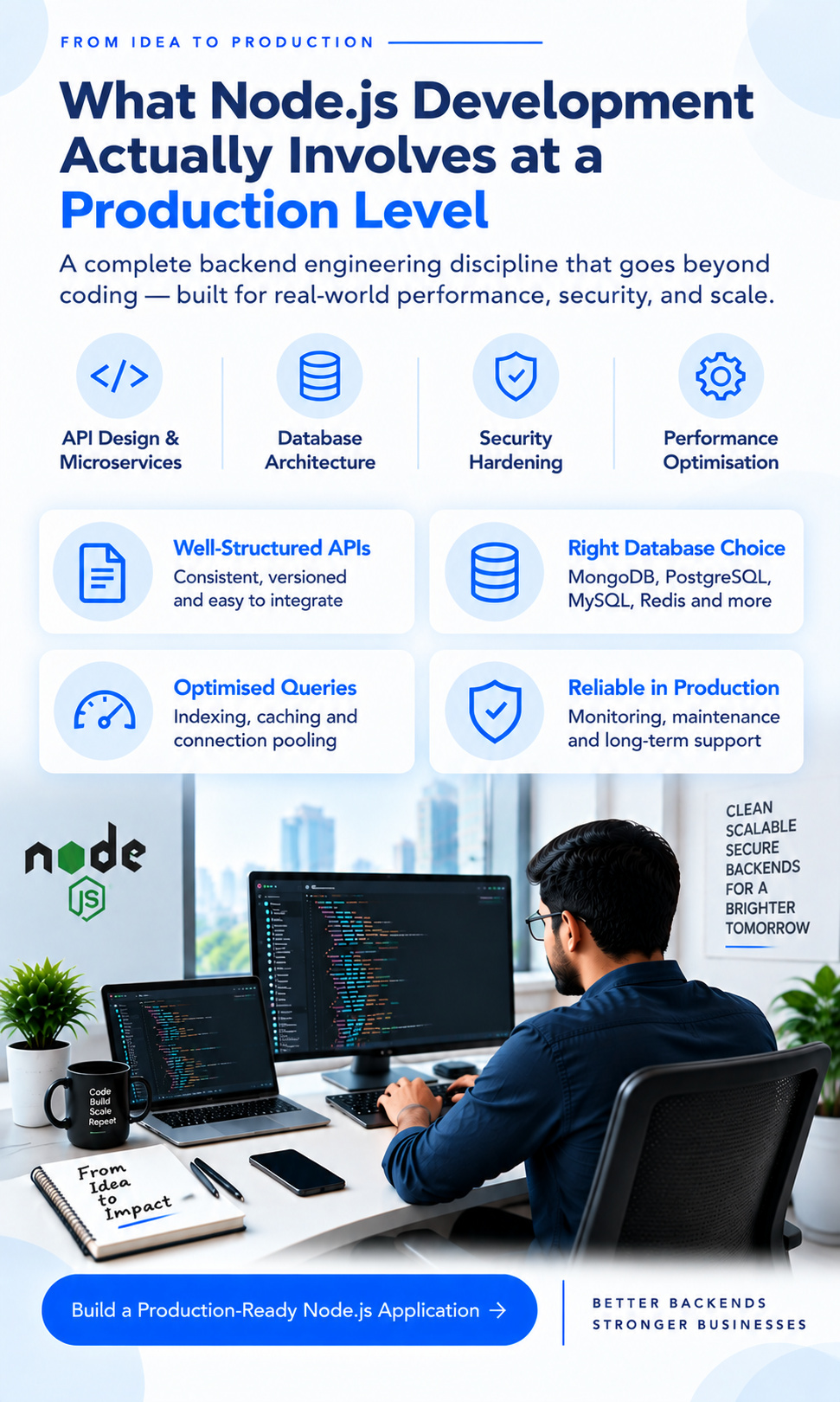
Node.js development is not simply writing JavaScript on the server. At a production level, it is a full backend engineering discipline covering API design, database architecture, authentication systems, performance optimisation, security hardening, and the infrastructure that keeps applications running reliably under real-world load.
A serious Node.js development company in Gurgaon manages this complete backend lifecycle – from the initial architecture decisions that determine how well the system scales, through to the monitoring and maintenance that keeps it performing after launch.
API design and microservices architecture
Node.js is particularly well-suited for building RESTful APIs and microservices – and the quality of API design has a direct impact on every other part of the system that depends on it. A well-designed Node.js API is consistent, predictable, properly versioned, and documented in a way that makes integration straightforward for frontend teams, mobile teams, and third-party partners. Poor API design creates compounding problems – frontend teams work around inconsistencies, integrations break unexpectedly when the API evolves, and performance issues that were avoidable at the design stage become expensive to fix after the fact.
At Ahom Technologies, API design is a dedicated phase of every Node.js engagement – with endpoint structure, request and response schemas, error handling conventions, and versioning strategy all defined and reviewed before implementation begins. This upfront investment in API quality is one of the things that prevents the most common and most costly Node.js development problems.
Database architecture and query optimisation
The choice of database – and how it is structured and queried – has more impact on Node.js application performance than almost any other single factor. MongoDB, PostgreSQL, MySQL, Redis – each has strengths that make it the right choice for specific data patterns and access requirements. Experienced Node.js engineers understand these trade-offs and make database choices based on your application’s specific data model rather than on familiarity or convenience.
Beyond the initial choice, query optimisation – proper indexing, efficient aggregation pipelines, connection pooling, and caching strategies – determines how well a Node.js application performs as data volumes grow and concurrent users increase. This is an area where the gap between experienced and inexperienced Node.js development companies becomes very visible very quickly in production environments.
2. Why Gurgaon Is the Right Location for Node.js Development
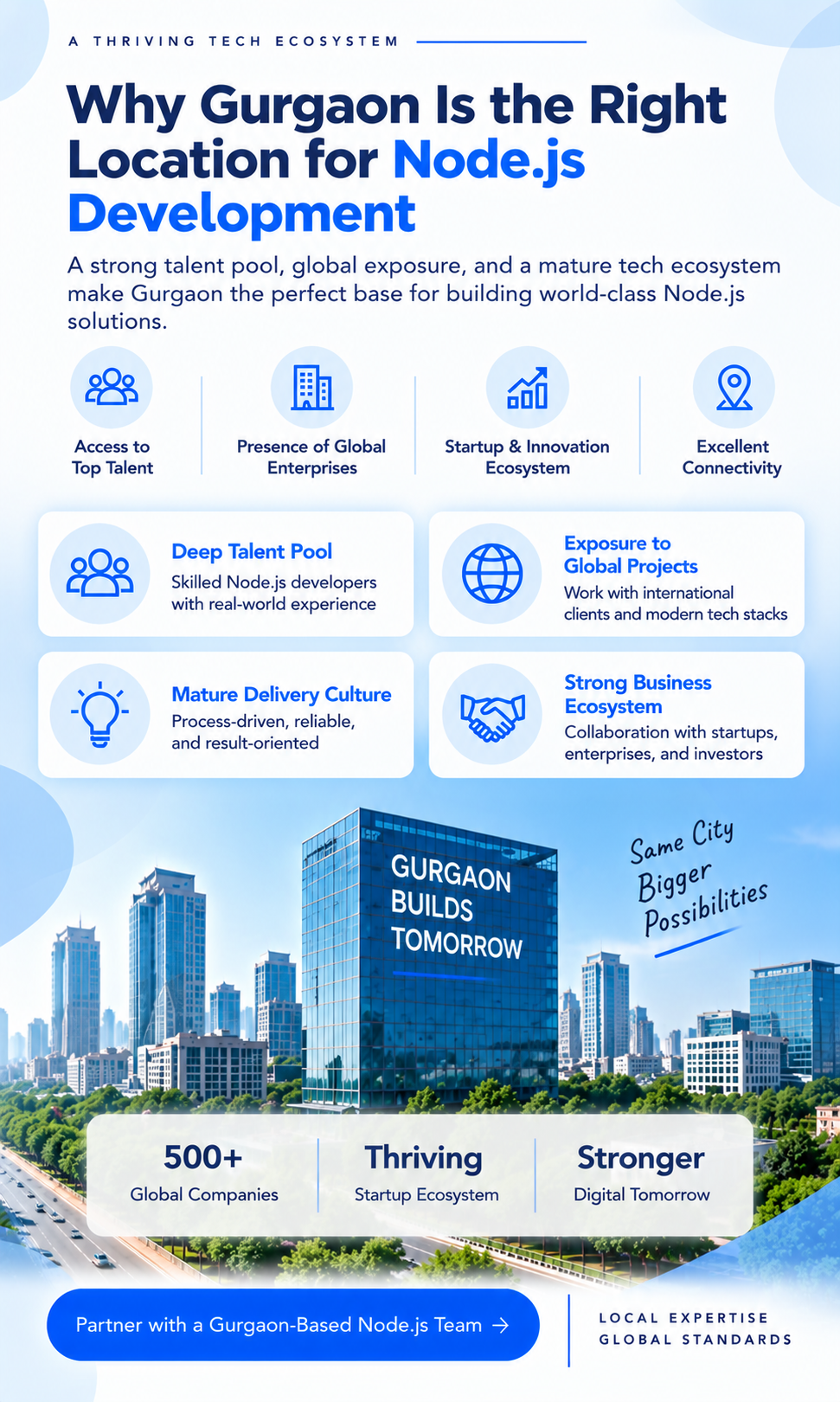

Gurgaon’s technology ecosystem has matured significantly over the past decade. The city is home to a concentration of enterprise technology companies, global capability centres, and product startups that has created both a deep talent pool and a delivery culture shaped by sophisticated client expectations.
For businesses looking for a Node.js development company in Gurgaon specifically, this ecosystem maturity translates into practical advantages. The Node.js engineering talent available in Gurgaon has been shaped by exposure to enterprise-grade projects – applications handling real transaction volumes, real concurrent user loads, and real integration complexity with existing enterprise systems.
Enterprise delivery culture
Gurgaon’s technology companies have been delivering software to large enterprises – Indian corporates, multinational companies, and government bodies – for long enough that a professional delivery culture has become the norm rather than the exception. Formal project management, documented deliverables, structured QA processes, and professional contractual frameworks are standard expectations in the Gurgaon market rather than premium features.
For businesses that need a Node.js development company capable of operating within enterprise procurement and governance frameworks, Gurgaon-based companies have typically been doing this for long enough to do it smoothly rather than awkwardly.
Accessibility for Delhi NCR clients
For businesses based in Delhi, Noida, Faridabad, or elsewhere in the National Capital Region, working with a Gurgaon-based Node.js development company offers the practical advantage of accessible in-person collaboration when it matters. Discovery workshops, architecture reviews, and sprint demos can happen face-to-face at the moments in a project where in-person conversation produces better outcomes than video calls. Ahom Technologies’ Gurgaon headquarters makes this straightforward for Delhi NCR clients who want that option without the logistical overhead of coordinating with a remote team.
3. The Node.js Technology Stack Ahom Builds With
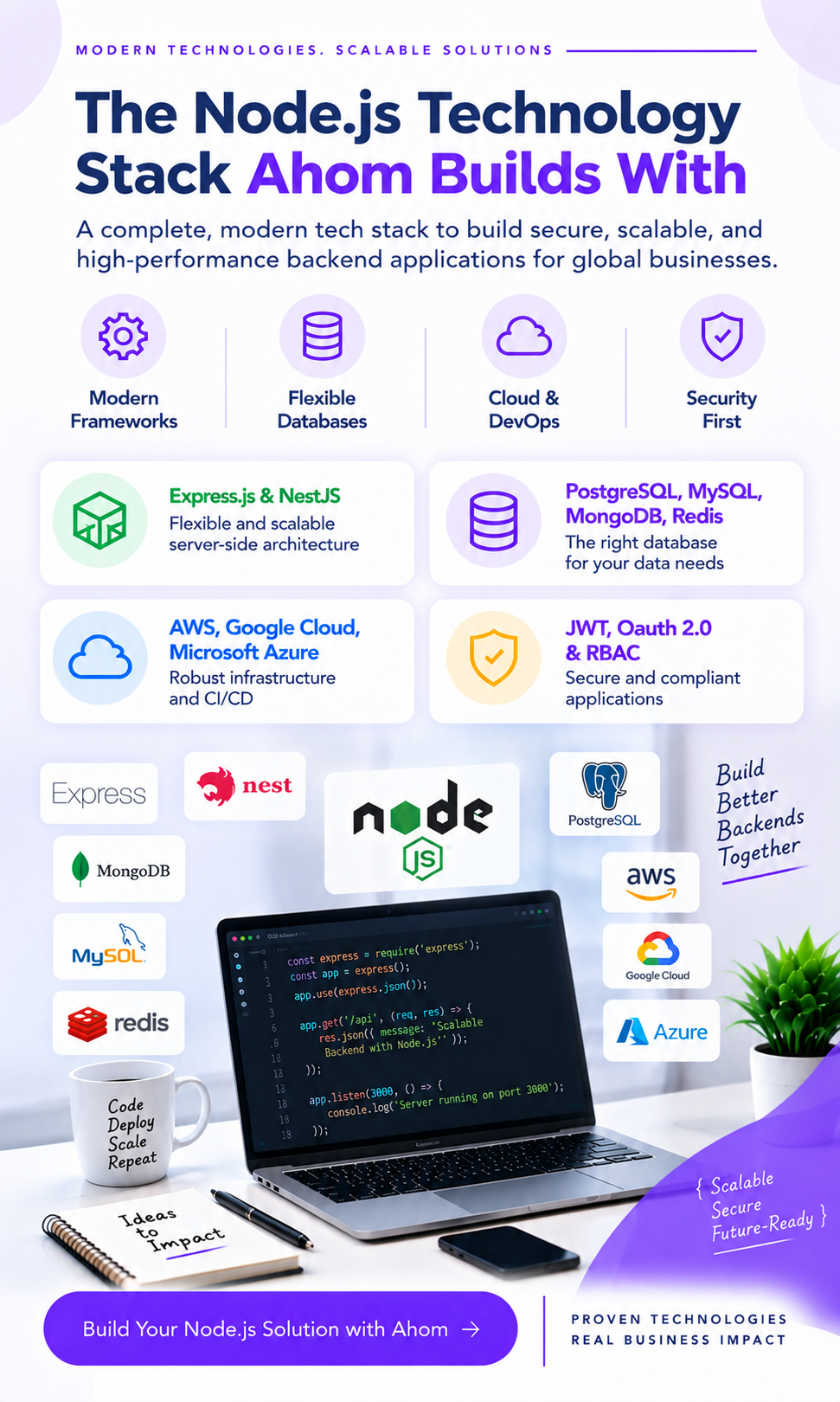
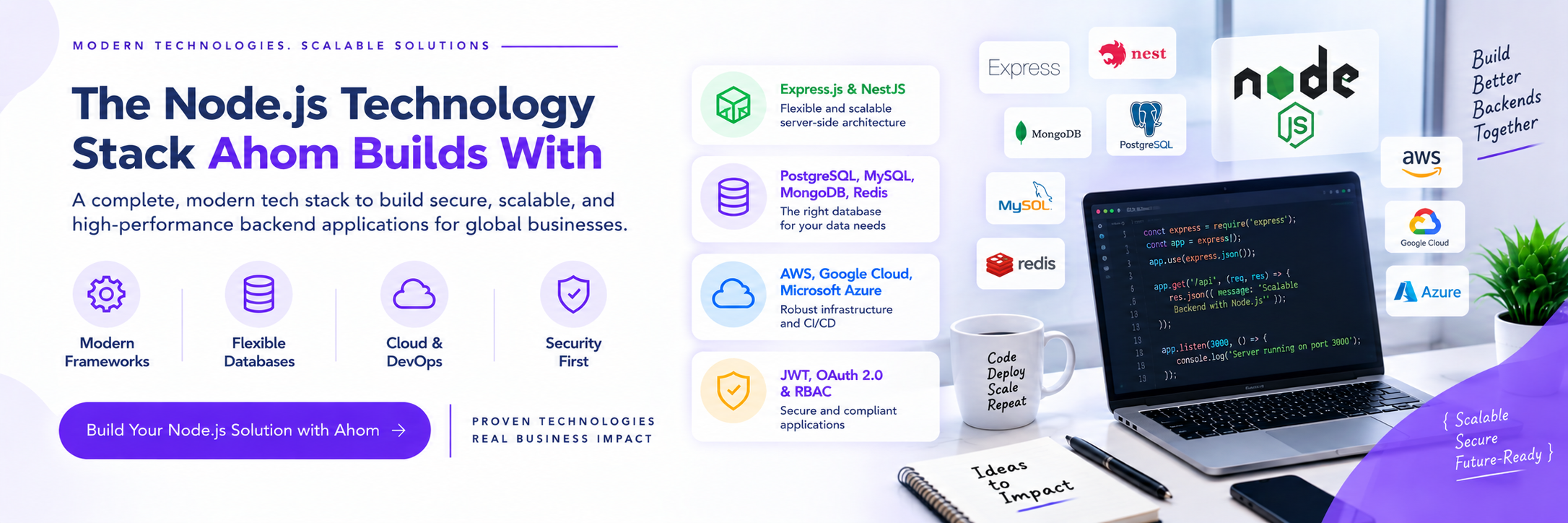
Modern Node.js development extends well beyond the runtime itself. The frameworks, libraries, databases, and infrastructure tools that surround Node.js have matured significantly, and the depth of a development company’s ecosystem knowledge is as important as their core Node.js capability. Ahom Technologies builds across the complete modern Node.js stack – producing backend systems that are production-ready, scalable, and maintainable over the long term.
Express.js and NestJS for server-side architecture
Express.js remains the most widely used Node.js framework – lightweight, flexible, and well-understood across the developer community. For projects where a more structured, opinionated architecture is appropriate – particularly enterprise applications and complex API backends – NestJS provides the TypeScript-first, modular architecture that makes large Node.js codebases manageable as they grow. Ahom’s Node.js engineers work across both frameworks, recommending the right choice based on your application’s complexity and your team’s long-term maintenance requirements.
Database integration across SQL and NoSQL
Ahom’s Node.js team integrates with the full range of modern databases – PostgreSQL and MySQL for relational data requirements, MongoDB for document-based data models, Redis for caching and session management, and Elasticsearch for full-text search at scale. Database selection is made during the technical discovery phase based on your specific data model and access patterns – not on which database the development team is most familiar with.
Cloud infrastructure and DevOps
Node.js applications deployed to production need robust cloud infrastructure, monitoring, and deployment automation. Ahom’s Node.js deployments run on AWS, Google Cloud, and Microsoft Azure – with Docker containerisation, Kubernetes orchestration for applications that need horizontal scaling, and CI/CD pipelines that automate testing and deployment. Infrastructure-as-code ensures environments are reproducible and deployments are consistent across development, staging, and production.
Security and authentication
Backend security in Node.js applications covers JWT and OAuth 2.0 authentication, role-based access control, input validation and sanitisation, rate limiting, and protection against the common vulnerability patterns that Node.js applications are exposed to. Ahom treats security as an architectural discipline – embedded from the first design decision rather than added as a layer at the end of the development cycle.
4. How Ahom Technologies Delivers Node.js Development in Gurgaon
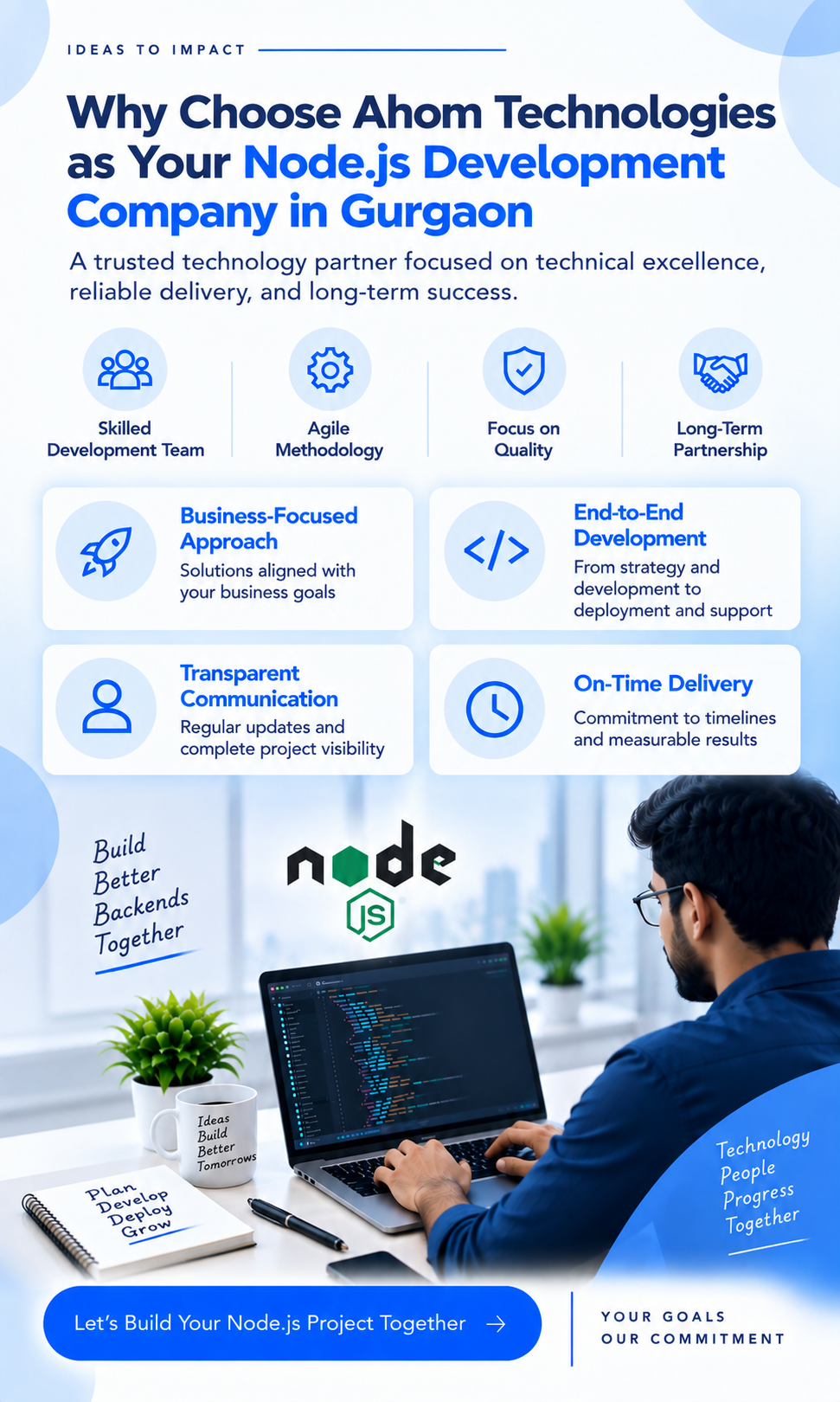
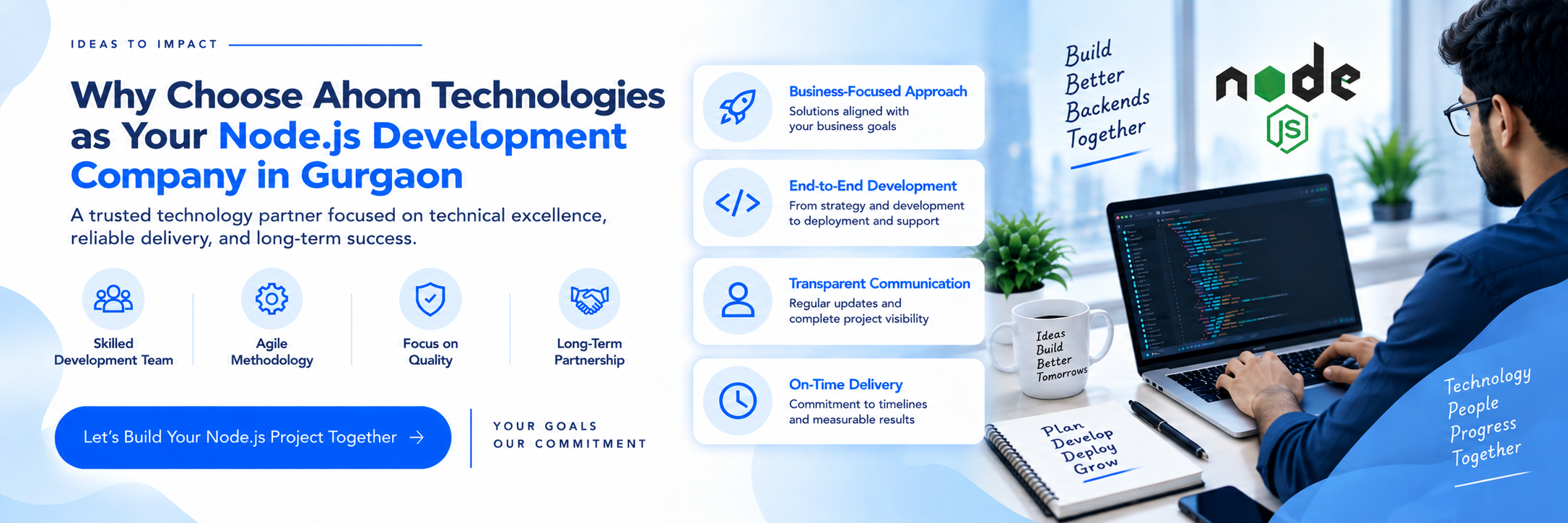
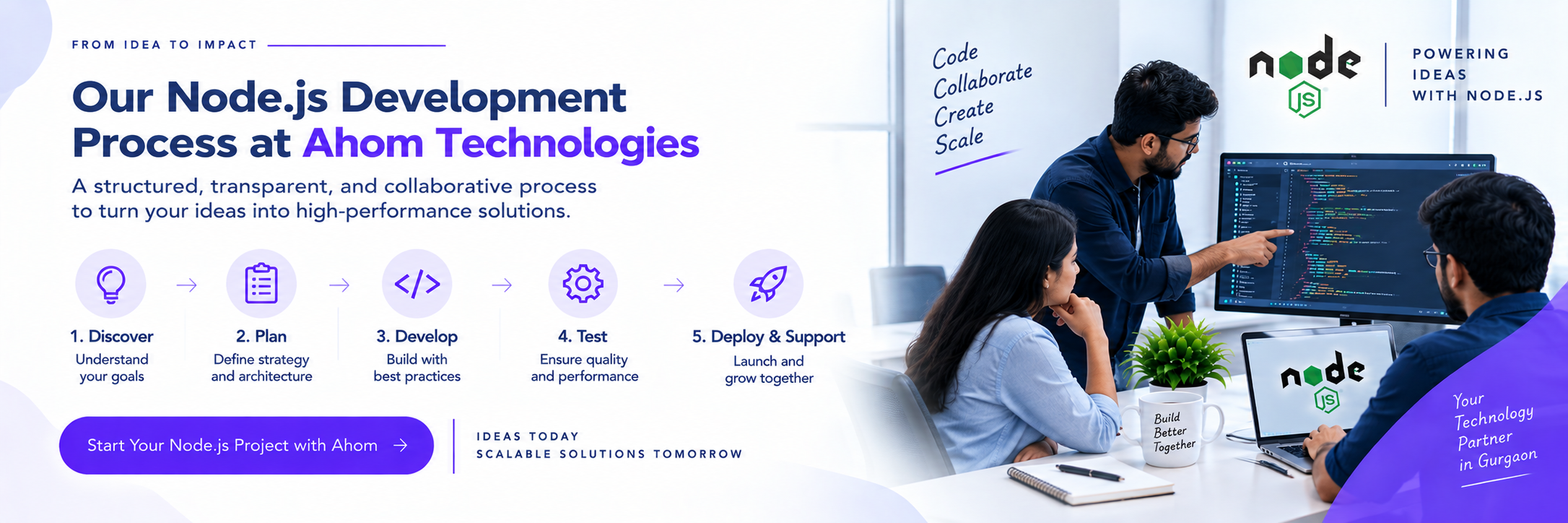
Ahom Technologies has been building Node.js backend systems for clients across India and globally for over a decade. The process we follow has been refined across hundreds of backend engagements and is designed to produce systems that perform in production – not just in a controlled development environment.
Technical discovery before architecture
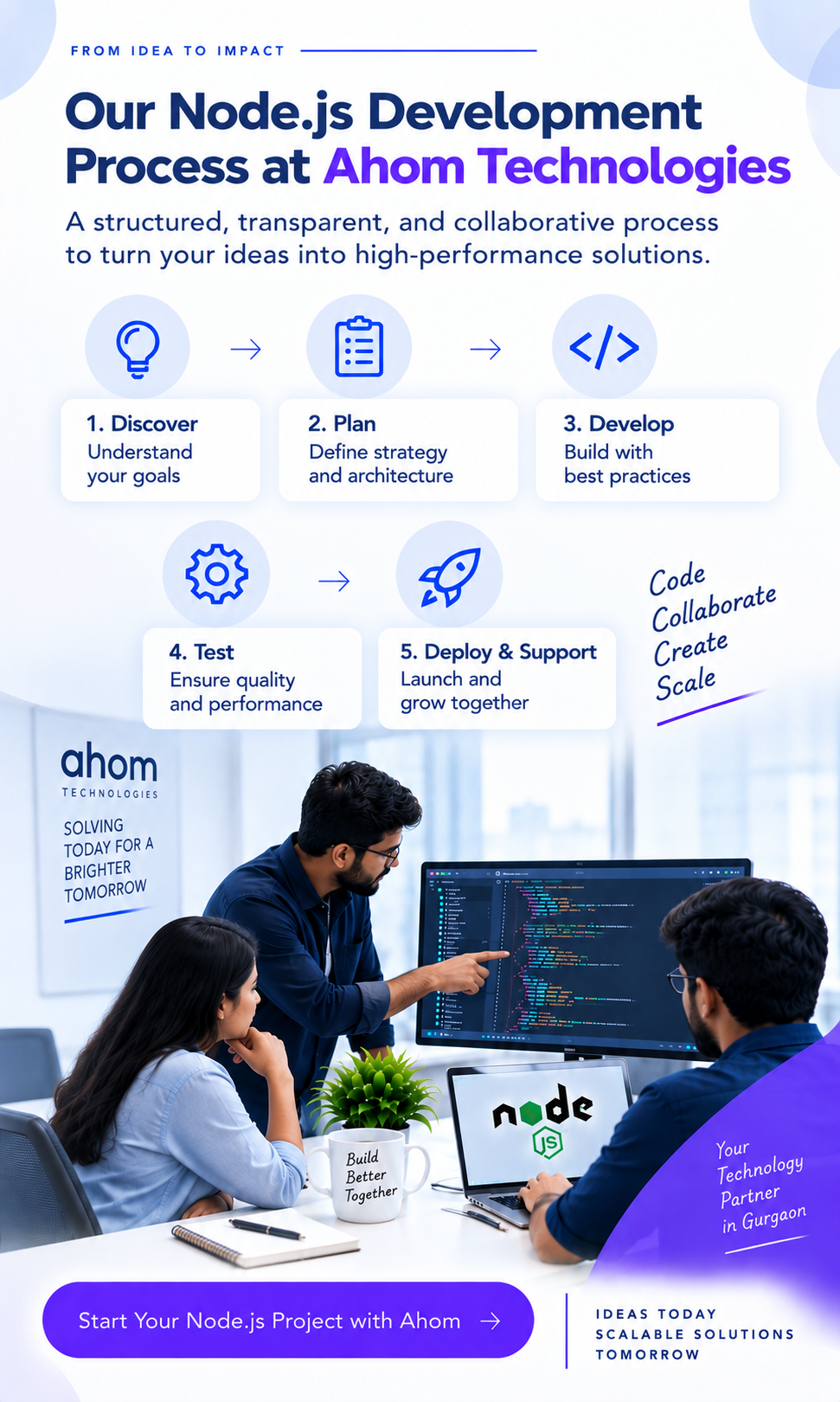
Every Ahom Node.js engagement begins with a structured technical discovery phase. Our senior backend engineers work with your team to understand your application’s data model, your expected concurrency and throughput requirements, your integration landscape, and your performance targets. These inputs shape every architecture decision that follows – from the framework choice and database selection to the API design strategy and the infrastructure provisioning model.
This discovery investment prevents the most expensive category of Node.js development problems – the ones that emerge when fundamental architecture decisions were made implicitly at the beginning and need to be reconsidered expensively in the middle of a project.
Agile sprints with working software every cycle
Node.js development at Ahom runs in agile sprints of one to two weeks, with working backend functionality delivered at the end of every cycle. API endpoints are documented and testable from the first sprint, which means frontend teams and mobile teams can begin integration work without waiting for the backend to be fully complete. This parallel development capability significantly compresses overall project timelines for full-stack products.
Performance testing under realistic conditions
Node.js performance – event loop management, memory usage, connection pool behaviour, and response time under concurrent load – is validated against realistic conditions before deployment. Ahom runs load testing on every Node.js application prior to production release, with performance metrics documented and benchmarked against the targets established during discovery. Applications that pass load testing in a controlled environment but fail in production are a common and avoidable outcome – one that Ahom’s performance testing discipline is specifically designed to prevent.
5. Industries Where Ahom Delivers Node.js Development Services
Node.js is particularly well-suited for applications where high concurrency, real-time data, and API-heavy architectures are defining requirements. Ahom Technologies has delivered Node.js backend systems across the industries where these requirements are most demanding – and that cross-sector experience shapes the quality of every technical decision our team makes.
Fintech and payment systems
Fintech applications place the highest demands on Node.js backend systems – real-time transaction processing, concurrent user sessions, and the absolute reliability that financial applications require. Ahom has built Node.js backends for payment processing systems, digital banking APIs, investment platform backends, and financial data aggregation services – each engineered with the security-first architecture and performance characteristics that financial applications demand. Our fintech Node.js work covers PCI-compliant payment handling, encrypted data storage, and fraud detection logic embedded at the API layer.
E-commerce and marketplace platforms
High-traffic e-commerce backends face the Node.js concurrency challenge at its most demanding – thousands of simultaneous product browsing sessions, concurrent cart operations, and transaction processing during peak traffic events. Ahom has built Node.js backends for e-commerce platforms handling significant daily transaction volumes – with the caching strategies, database optimisation, and horizontal scaling architecture that competitive e-commerce performance requires.
Real-time applications and chat platforms
Node.js’s event-driven architecture makes it the natural choice for real-time applications – chat systems, live notification platforms, collaborative tools, and real-time dashboards. Ahom has built WebSocket-based real-time systems for communication platforms, live event tracking applications, and operational dashboards that update continuously without page refresh. The combination of Node.js’s non-blocking I/O and WebSocket technology produces real-time experiences that feel genuinely instantaneous to end users.
Healthcare and logistics platforms
Healthcare and logistics applications share a common Node.js requirement – high reliability with complex integration landscapes. Healthcare platforms need to integrate reliably with patient management systems, diagnostic equipment APIs, and pharmacy management software. Logistics platforms need real-time synchronisation with fleet tracking systems, warehouse management software, and third-party delivery provider APIs. Ahom’s Node.js experience across both sectors provides the integration depth and reliability engineering that these demanding environments require.