
Here is the uncomfortable truth about software testing companies in India: most of them will tell you exactly what you want to hear during the sales conversation. Comprehensive coverage. Experienced testers. Automation-first approach. Seamless integration into your development workflow. The claims are consistent across the market – and almost impossible to verify until the engagement is already underway and the problems have already started.
The businesses that find genuinely capable software testing partners are not the ones that asked the best questions during the proposal stage. They are the ones that looked in the right places – at the actual evidence of delivery quality rather than the surface presentation of capability. Test reports from real projects. Defect metrics from live engagements. Specific, detailed answers to questions about methodology rather than polished responses about company values.
This guide gives you the framework to do that evaluation properly – understanding what a genuine software testing company in India looks like from the inside, what separates the best from the rest, and what questions surface the truth before you have signed anything.
1. What a Genuine Software Testing Company in India Actually Does
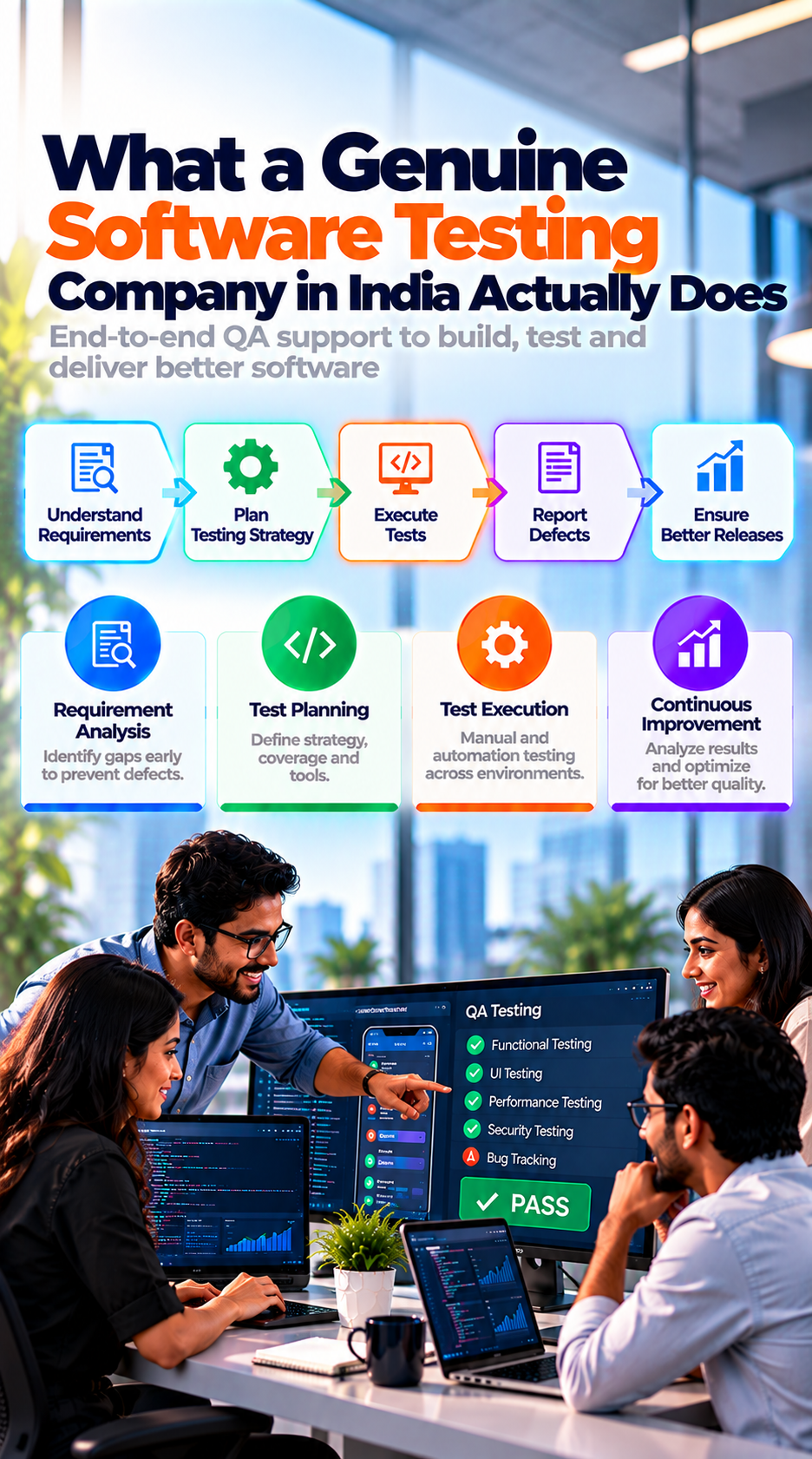
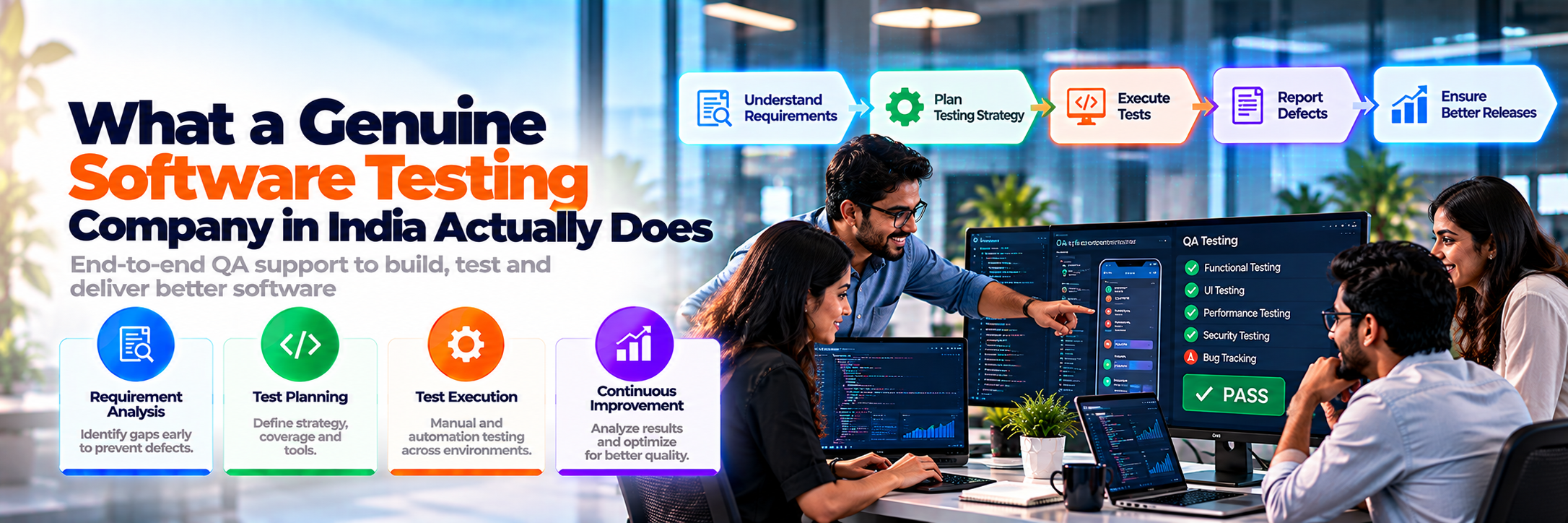
A genuine software testing company manages the complete quality assurance lifecycle – not just the execution of predefined test cases at the end of a development cycle. The distinction matters enormously in practice, and it is one of the most reliable early signals of whether a company is operating at a professional level or performing a superficial version of quality assurance that produces coverage numbers without genuine quality confidence.
Full-cycle testing vs isolated QA
Full-cycle testing means quality assurance is involved from the beginning of a development engagement – participating in requirements review to identify ambiguities that will produce defects, contributing to design decisions that affect testability, building the test strategy in parallel with the development plan rather than after it is complete, and running automated regression suites throughout every sprint rather than manual testing at the end of every release.
Isolated QA – where a testing team receives a build at the end of development and checks it against a requirements document – finds defects late, when they are most expensive to fix, and produces a testing process that is perpetually catching up with development rather than running alongside it. Most testing companies in India offer isolated QA. Genuine software testing companies offer full-cycle quality assurance – and the difference in defect cost and delivery confidence is substantial.
The difference between a testing company and a testing team
A testing team executes test cases. A testing company brings a testing strategy – a deliberate approach to coverage priorities, risk assessment, tool selection, and the balance between manual and automated testing that is specific to your application rather than generic to every project. The testing strategy is what determines whether the testing effort is focused on the areas where defects matter most or distributed evenly across the application regardless of risk. Companies that bring a strategy rather than just execution are the ones whose work translates into genuine quality improvement rather than just a longer test execution log.
2. The Criteria That Separate the Best Software Testing Companies in India
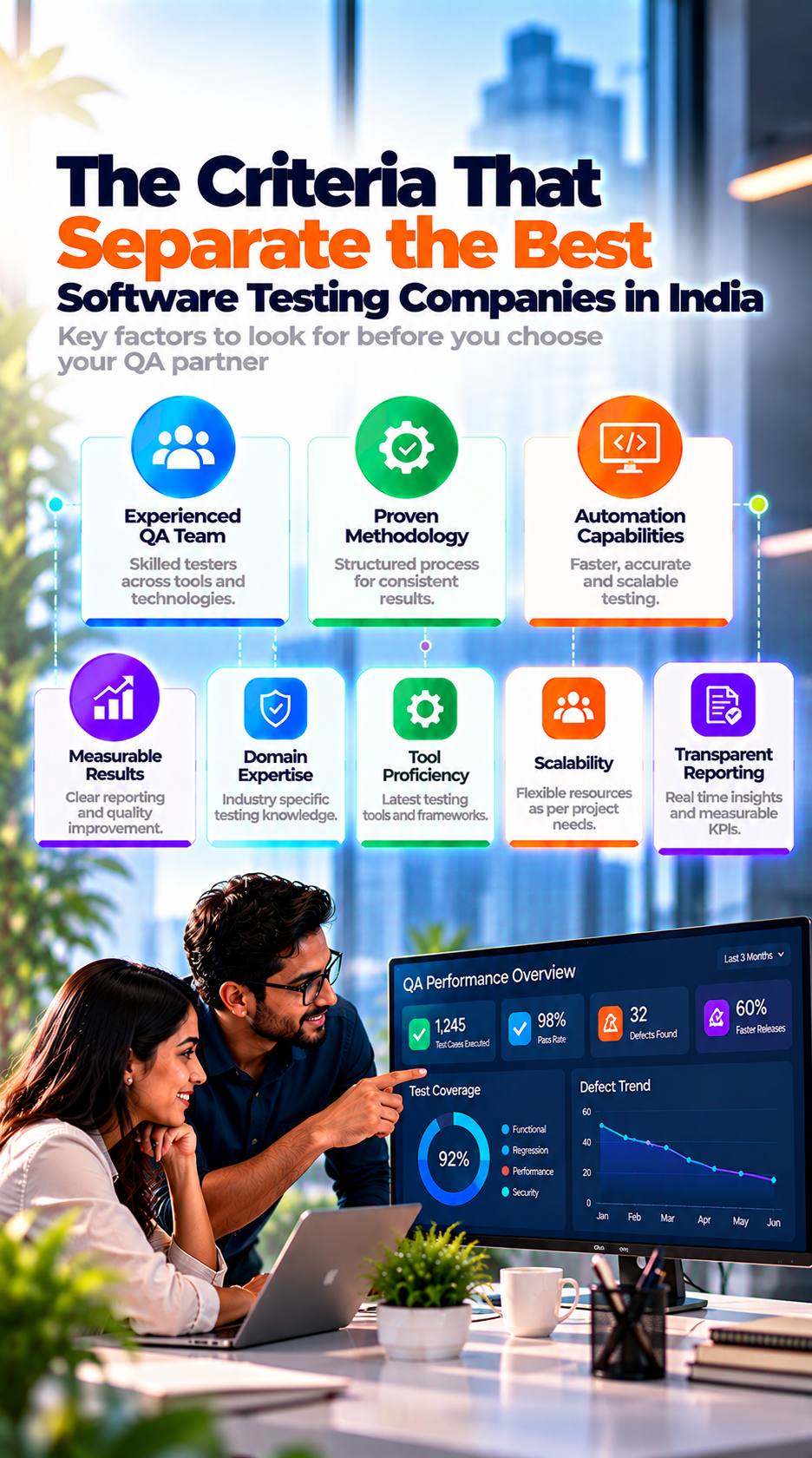
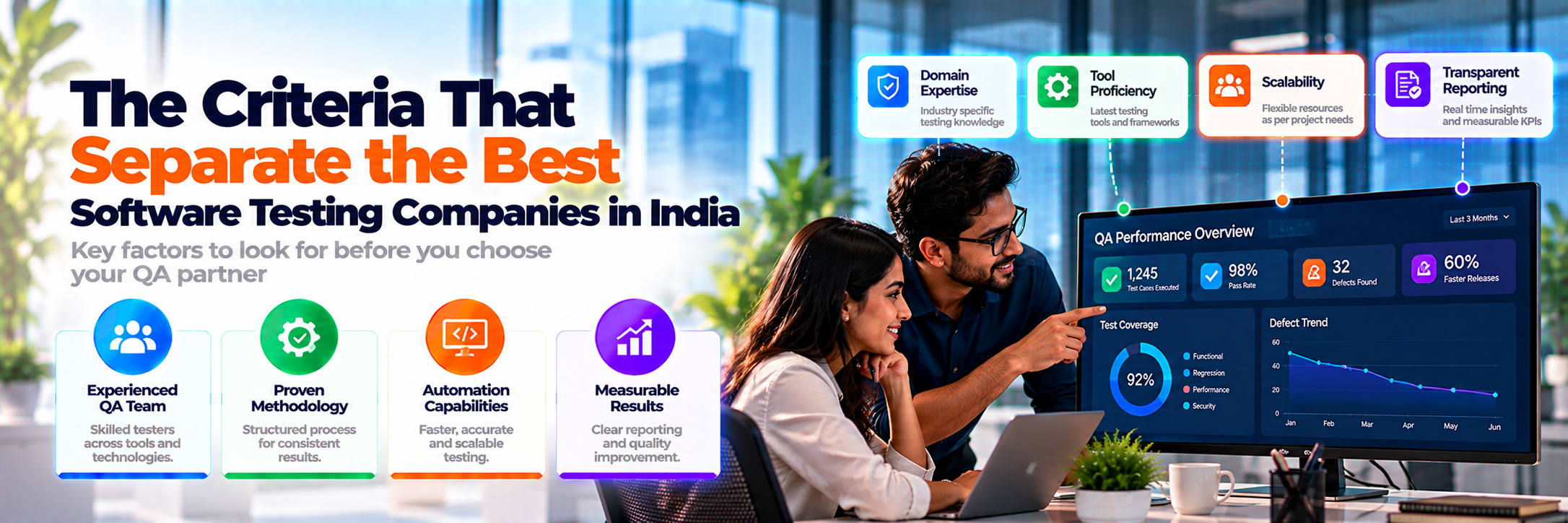
The evaluation criteria that reliably separate genuinely capable software testing companies from those that perform capability well in presentations are not the ones that appear on most evaluation checklists. Here is what actually matters.
A testing strategy that starts with your product, not a template
A serious software testing company cannot tell you their testing approach before they understand your application. Any company that sends a detailed testing proposal within forty-eight hours of a first conversation – complete with test plan, coverage scope, and tool recommendations – is filling in a template rather than designing a strategy. Real test strategy requires understanding your application architecture, your highest-risk functionality, your release cadence, your existing coverage gaps, and your team’s current testing maturity.
The quality of the discovery questions a testing company asks before proposing anything is one of the most reliable early indicators of how they will approach the actual engagement. Companies that ask specific, insightful questions about your application are the ones that will design specific, appropriate testing approaches for it.
Automation depth and framework maturity
Claiming to offer automation testing and actually delivering a mature, maintainable automation framework are very different things. Ask any software testing company you are evaluating to describe their automation framework architecture – specifically the pattern they use for test organisation, how they manage element locators in web automation, how they handle test data, and how they integrate the automation suite with CI/CD pipelines. Companies with genuine automation depth give you specific, technical answers. Companies without it give you tool names and general descriptions of what automation does.
Domain experience that shapes testing decisions
A software testing company that has tested healthcare applications understands the regulatory compliance requirements, data sensitivity classifications, and clinical workflow edge cases that shape what needs to be tested and how. A company without that experience will test the application against the requirements document – and miss the domain-specific risk areas that the requirements document did not think to mention. Domain experience is not a differentiator that shows up in a company’s marketing. It shows up in the specific questions their test leads ask during requirements review.
Transparent defect reporting and metrics
The reporting a testing company produces tells you more about how they think about quality than almost anything else. Defect counts are a starting point. What matters more is defect severity distribution – are they finding the bugs that matter or accumulating a long tail of low-severity cosmetic issues? Test coverage metrics – what percentage of critical user journeys have automated regression coverage? Defect escape rate – how many defects are being found by users in production that testing did not catch? Companies that track and report these metrics seriously are the ones genuinely invested in quality outcomes rather than testing activity.
3. Questions to Ask a Software Testing Company Before You Hire Them
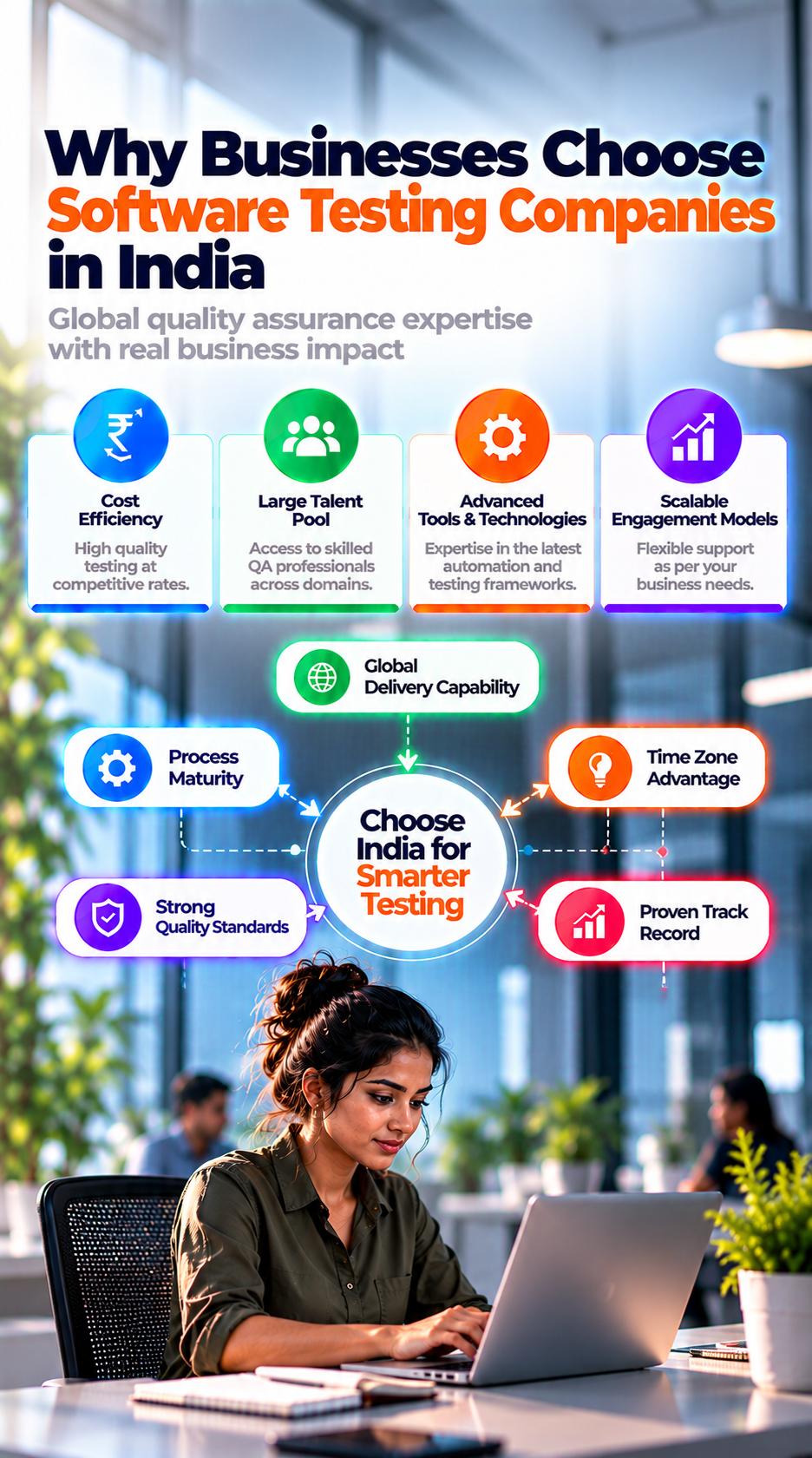
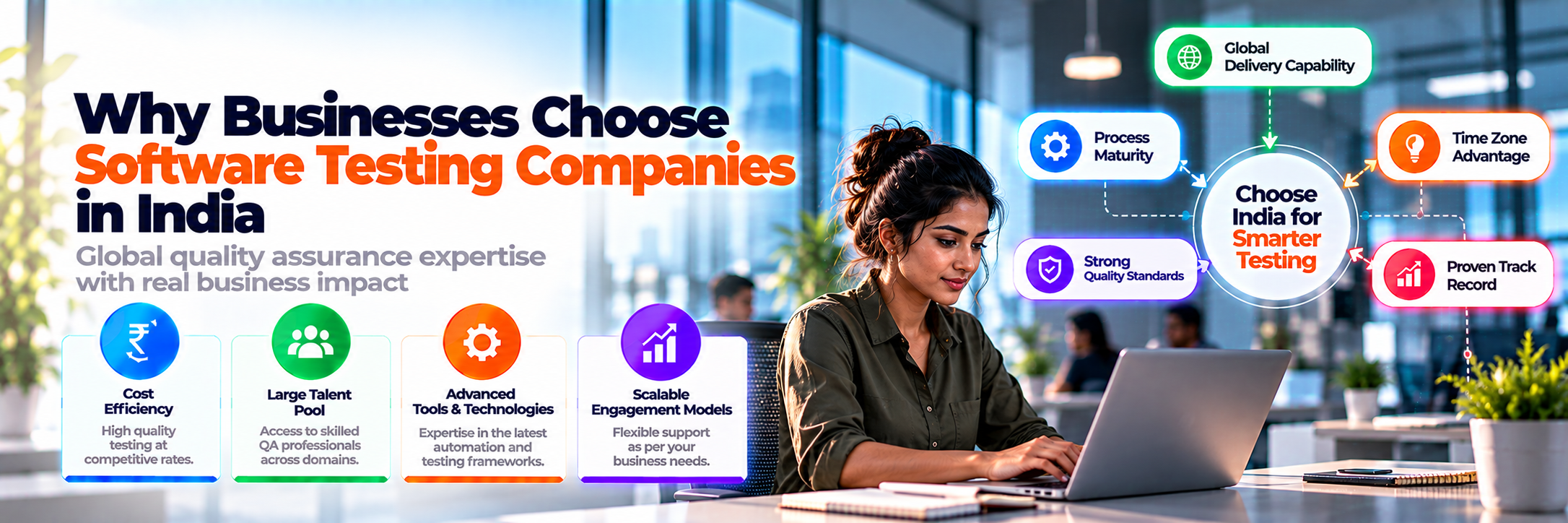
A structured set of questions asked before you commit will surface the truth about a testing company’s capability far more reliably than a review of their portfolio page or a conversation about their values. These are the questions that matter.
What does your test coverage strategy look like for a project like mine?
The answer to this question reveals immediately whether a company approaches testing strategically or procedurally. A strategic answer describes how they identify the highest-risk areas of your specific application, how they balance automated and manual coverage based on your release cadence and risk profile, and how they prioritise test development to maximise coverage confidence within your available timeline. A procedural answer describes the types of testing they do and the tools they use – which tells you about their capability but nothing about how they would apply it to your situation.
How do you integrate testing into an agile development workflow?
Testing that starts after development is complete is testing that will always be under time pressure and will always find defects too late to fix efficiently. Ask how the testing company participates in sprint planning, how they manage the testing workload across a two-week sprint, and how they handle the inevitable situation where development delivers functionality later than expected. Companies that have genuinely integrated testing into agile delivery have clear, practiced answers to these questions. Companies that treat agile as a buzzword and still operate in a test-at-the-end model do not.
What does your defect reporting process look like?
Ask to see a sample defect report from a previous engagement – anonymised if necessary. The quality of defect documentation – reproducibility steps, environment details, severity assessment, and the clarity of the description – tells you about the team’s professional discipline. Defect reports that developers cannot reproduce efficiently because the documentation is incomplete are testing output that creates friction rather than resolving it.
Who specifically will be testing my product?
The experience level and domain knowledge of the specific engineers assigned to your project matters far more than the company’s aggregate capability claims. Ask for the names and backgrounds of the test lead and the engineers who will work on your project. Ask whether the same team stays on your engagement throughout or whether resource assignment changes between sprints. Continuity matters in testing – testers who understand the application’s history and known defect patterns are significantly more effective than testers approaching it fresh on every engagement.
4. Red Flags That Tell You a Testing Company Is Not What It Claims

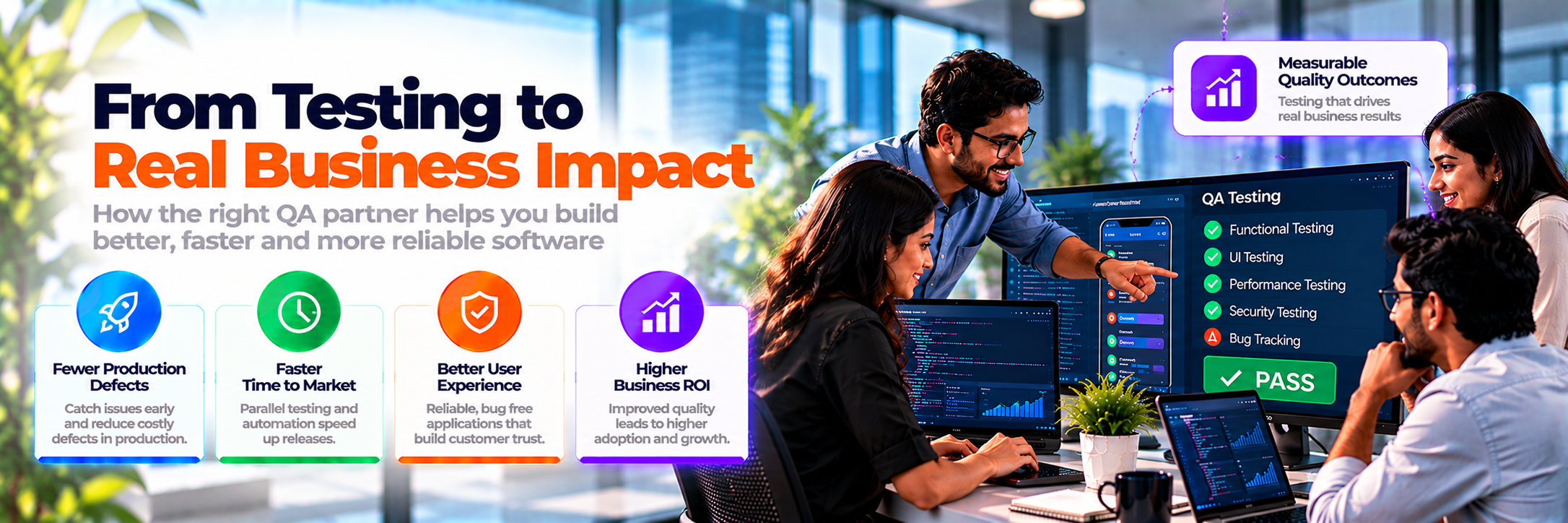
Knowing what bad looks like is as valuable as knowing what good looks like – especially in a market where surface presentation is consistently better than underlying delivery.
They cannot describe their test strategy before seeing a requirement
A testing company that jumps straight to a detailed proposal before spending meaningful time understanding your application is not designing a testing strategy. It is filling in a template. Real test strategy requires real discovery – and any company that skips the discovery is producing output that fits a generic client rather than your specific situation.
Automation is promised but never demonstrated
Ask to see a real automation framework from a previous project – not a demonstration environment built for sales purposes. If a testing company cannot show you a live, working automation suite that is running against a real application in CI/CD, treat their automation claims with significant scepticism. The gap between claiming to deliver automation and actually delivering a maintainable, CI/CD-integrated automation framework is wide enough that many companies claim the former without having achieved the latter.
No metrics or reporting transparency
A testing company that cannot tell you specifically how they measure the quality and coverage of their testing work is not thinking seriously about quality outcomes. Ask what metrics they track, how they report defect severity distribution, what their defect escape rate is across recent engagements, and how they measure test coverage progress. The inability to answer these questions specifically indicates a team that tracks testing activity but not testing effectiveness.
Testing starts only after development is complete
If a software testing company describes a process where they receive a completed build from the development team and then test it – rather than participating in development sprints from the beginning – they are describing isolated QA rather than integrated quality assurance. The cost of finding a defect in post-development testing is significantly higher than finding it during development. Companies that only test after the fact are adding testing activity without capturing the quality improvement that early involvement produces.
5. Why Ahom Technologies Earns Its Place Among India’s Leading Testing Companies
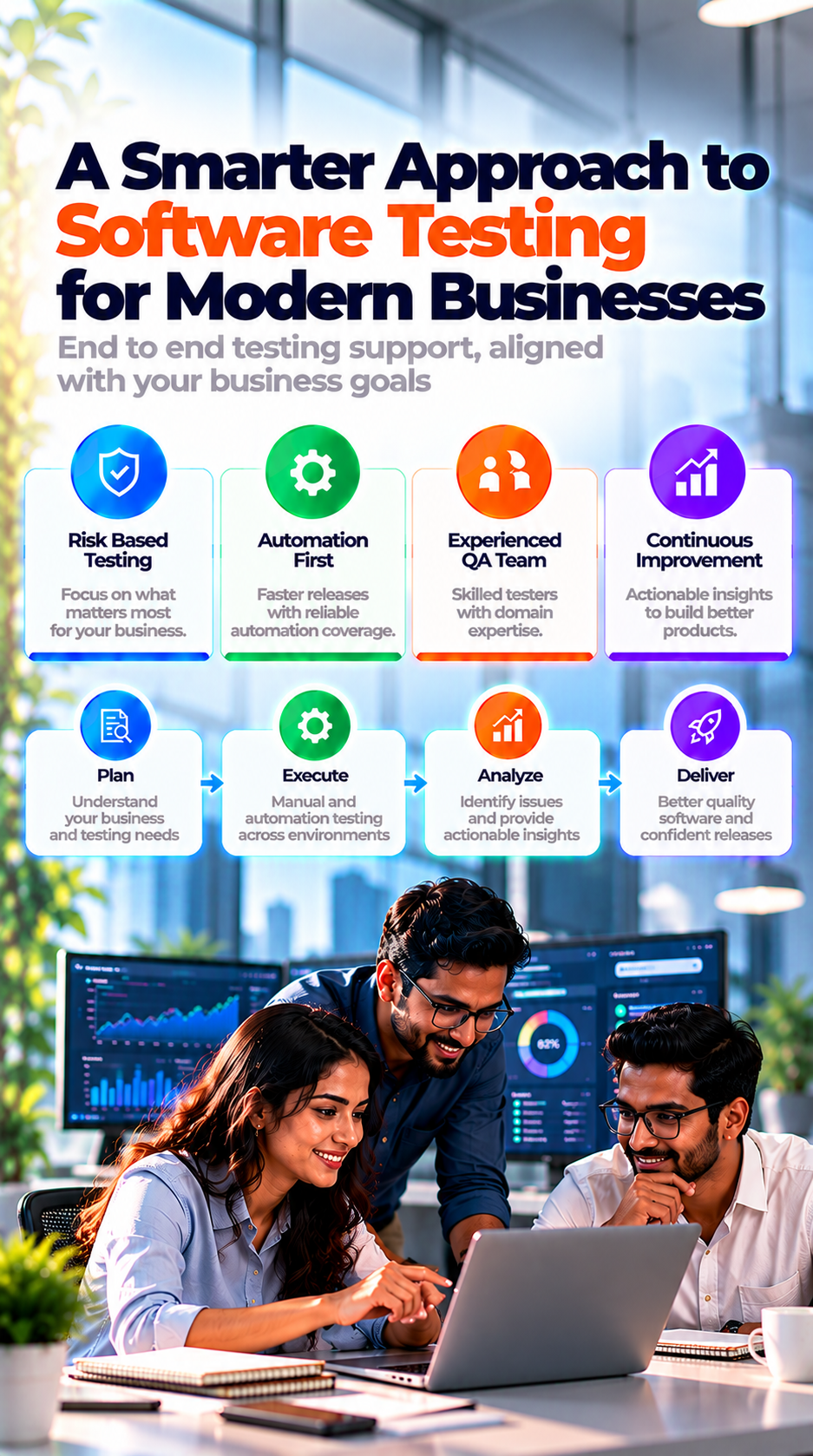
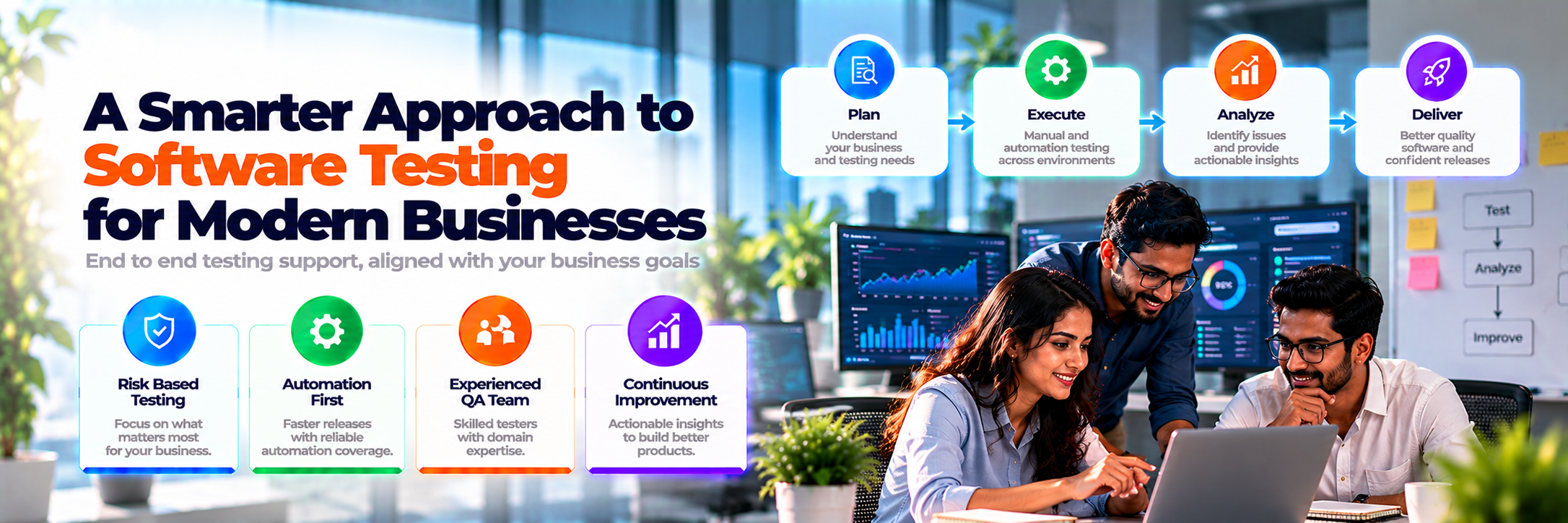
Ahom Technologies has been delivering software testing and quality assurance services for clients across India, the USA, UK, UAE, and Canada for over a decade. Our testing practice has been shaped by the accumulated experience of real production environments across healthcare, fintech, e-commerce, logistics, EdTech, and SaaS – each sector bringing its own compliance requirements, user behaviour patterns, and domain-specific risk areas that shape how we approach testing for clients in those verticals.
Testing embedded throughout the development lifecycle
Ahom’s QA engineers participate in sprint planning, requirements review, and design discussions from the beginning of every development engagement – not as observers but as active contributors who identify testability issues, flag ambiguous requirements, and build the test strategy in parallel with the development plan. By the time the first sprint delivers functionality, the test strategy is ready, the automation framework is scaffolded, and the first automated tests are running against the application. This integration is what prevents the late-stage defect discovery that makes testing feel like a bottleneck rather than an accelerator.
Automation-first approach with manual testing where it matters
Ahom approaches every testing engagement with automation as the default for regression coverage – building and maintaining CI/CD-integrated automation frameworks that run on every commit and provide continuous deployment confidence. Manual testing resources are directed at exploratory testing, usability evaluation, and the domain-specific edge cases that require human judgment rather than repeating scenarios that automation handles reliably. This combination produces higher coverage and better defect detection than either approach alone.
Cross-industry testing experience
The domain knowledge Ahom’s testing teams bring to each sector shapes testing decisions that a generic testing approach would miss. Healthcare testing that understands clinical workflow edge cases. Fintech testing that understands transaction state management and reconciliation scenarios. E-commerce testing that understands inventory race conditions and payment gateway failure modes. This domain depth is built from years of testing real production applications in each sector – not from reading requirements documents and testing against them in isolation.
Transparent reporting and measurable quality metrics
Every Ahom testing engagement includes structured reporting – defect severity distribution, test coverage progress, automation coverage percentage, defect escape rate, and sprint-by-sprint quality trend data. These metrics are shared with clients regularly – not as a formality but as the basis for continuous improvement conversations about where testing effort should be directed and where the coverage gaps that most need addressing currently sit.
Our QA automation services provide the automation framework capability that makes continuous testing at modern release frequencies possible. Our broader software testing services cover the complete quality assurance lifecycle – from test strategy design through automated and manual testing, security testing, performance testing, and the ongoing maintenance that keeps testing effective as the application evolves. And for organisations that need testing capability integrated into a broader offshore software development engagement, Ahom provides both under the same accountable partnership rather than requiring separate vendor relationships for development and quality assurance.
For businesses that want to understand how Ahom’s testing approach connects to the broader DevOps services pipeline – particularly the CI/CD integration that makes automated testing continuous – our DevOps practice works directly alongside the testing team to ensure that the automation suite and the deployment pipeline are designed as a single system rather than two separately managed components.