3. Questions to Ask Any DevOps Company in India Before You Sign
A structured set of questions asked before you commit separates companies that hold up under scrutiny from those that present well but deliver inconsistently. These are the questions that surface the truth rather than the pitch.
Can you walk me through a production incident you managed and how you resolved it?
This is the single most revealing question you can ask a DevOps company. Every team that has operated real production environments has dealt with incidents – service outages, pipeline failures, infrastructure drift, security breaches. A team with genuine operational experience gives you a specific, detailed answer – what happened, how they detected it, what the immediate response was, how long recovery took, and what changes were made afterwards to prevent recurrence.
A team without that experience gives you a generic description of incident response procedures rather than a real story.
Who specifically will work on my engagement?
Confirm the names and experience levels of the engineers, architects, and project manager who will actually work on your engagement. Ask whether those same people will be your point of contact throughout – from assessment through to post-launch support. The gap between the people who win the work and the people who do it is where most DevOps engagements go wrong.
How do you structure post-engagement support?
Ask specifically – not generally. What is covered? What are the response time commitments for different incident severity levels? How are platform updates and dependency upgrades managed? Who is the point of contact at 2am when something breaks in production? A DevOps company that cannot answer these questions specifically does not have a post-engagement support model – it has a vague intention that will not hold up when you actually need it.
Can you show me infrastructure code from a previous engagement?
Reviewing actual Terraform code, CI/CD pipeline configurations, or Kubernetes manifests from a previous client engagement – anonymised where necessary – is the most direct way to assess code quality and architectural maturity. A DevOps company confident in its work will find a way to show you representative examples. One that cannot is not confident in its output – and you should ask bade1424-7917-472d-b2e2-d4585f6497f1why.
How do you handle cloud cost management?
Cloud costs are one of the most common sources of unpleasant surprises in DevOps engagements. Ask how the company approaches cloud cost visibility, what tagging and resource management standards they apply, how they detect cost anomalies, and what their process is for right-sizing infrastructure as usage patterns become clear. A DevOps company that does not address cost management as a standard part of the engagement is leaving a significant operational risk unmanaged.
The
Cloud Native Computing Foundation – the organisation behind Kubernetes and many of the core tools in the modern DevOps stack – publishes detailed guidance on cloud native best practices that is worth reading alongside any DevOps partner evaluation.
4. Red Flags That Tell You a DevOps Company Is Not What It Claims
Knowing what bad looks like is as valuable as knowing what good looks like – especially in a market as crowded and inconsistently labelled as DevOps services in India.
They cannot name specific tools and explain why
Any DevOps company that cannot clearly explain why they chose a specific tool for a specific purpose – and what the alternatives were and why they were not chosen – is not making deliberate technical decisions. Deliberate technical decisions are what produce reliable, maintainable DevOps environments. The absence of deliberate decision-making is what produces environments that work initially and accumulate problems over time.
Their proposal arrives before they have asked meaningful questions
A DevOps proposal that arrives within forty-eight hours of a first conversation is not based on a genuine assessment of your situation. It is a template with your name on it. Real DevOps engagements require real discovery – understanding your application architecture, your team’s current capabilities, your deployment frequency and reliability, your cloud infrastructure, and your specific operational challenges. Companies that skip this produce solutions that fit a generic client rather than your specific situation.
They describe DevOps as a project rather than a practice
If a DevOps company describes its engagement in terms of deliverables and completion dates – “we will set up your pipeline and hand it over by week eight” – that is a signal they are treating DevOps as a project rather than a practice. DevOps is not a project. It is a continuous operational discipline that requires ongoing attention, refinement, and maintenance. Companies that frame it as a project are planning to hand over and move on – which is not what you need.
They have no verifiable production references
Ask for references from clients whose production DevOps environments they currently maintain. Not past clients who were happy at the end of a project. Current clients whose production systems they are actively operating and supporting right now. A DevOps company with genuine ongoing operational relationships will have these references. One without them is telling you something important about the durability of their client relationships.
5. Why Ahom Technologies Is a Trusted DevOps Company in India
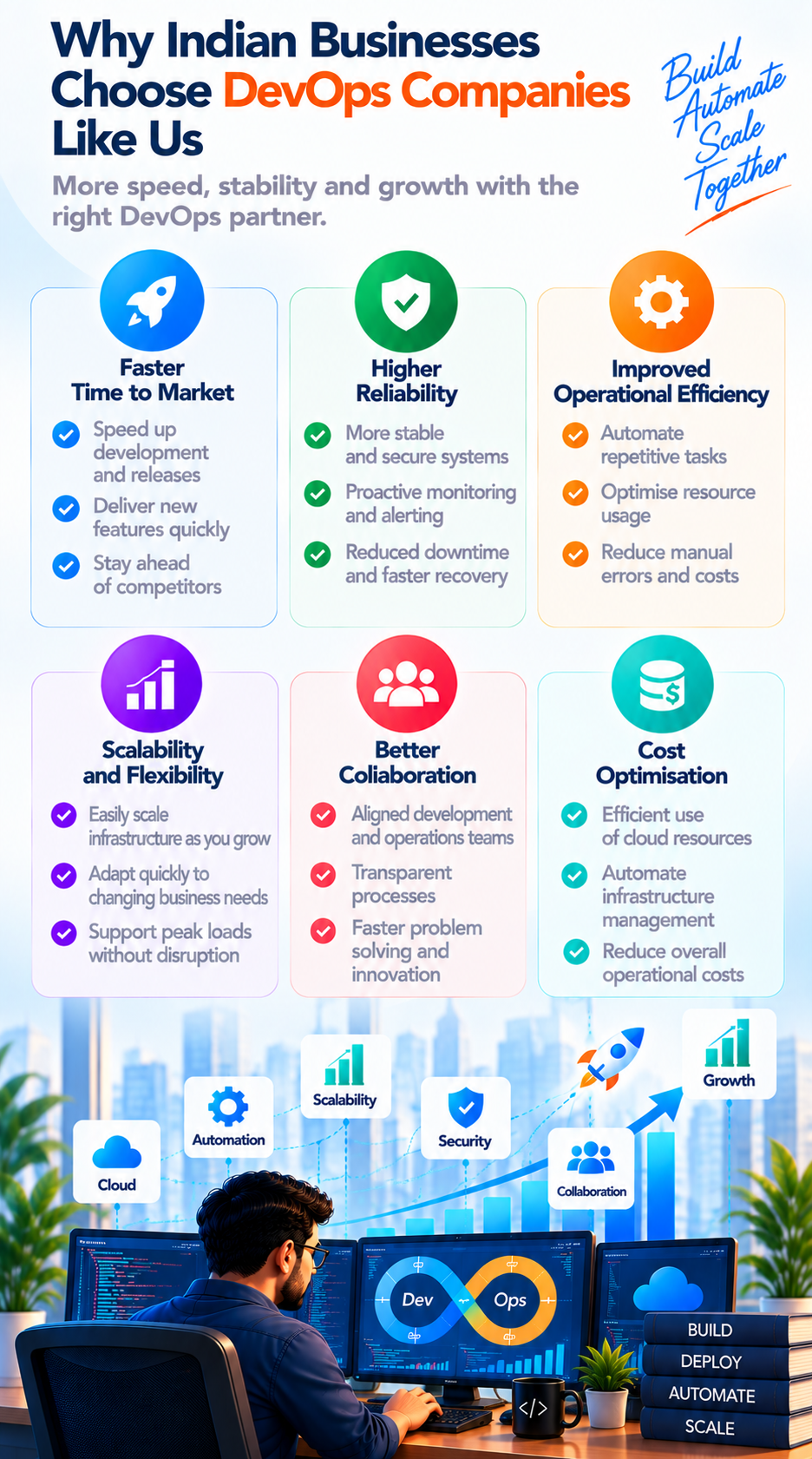
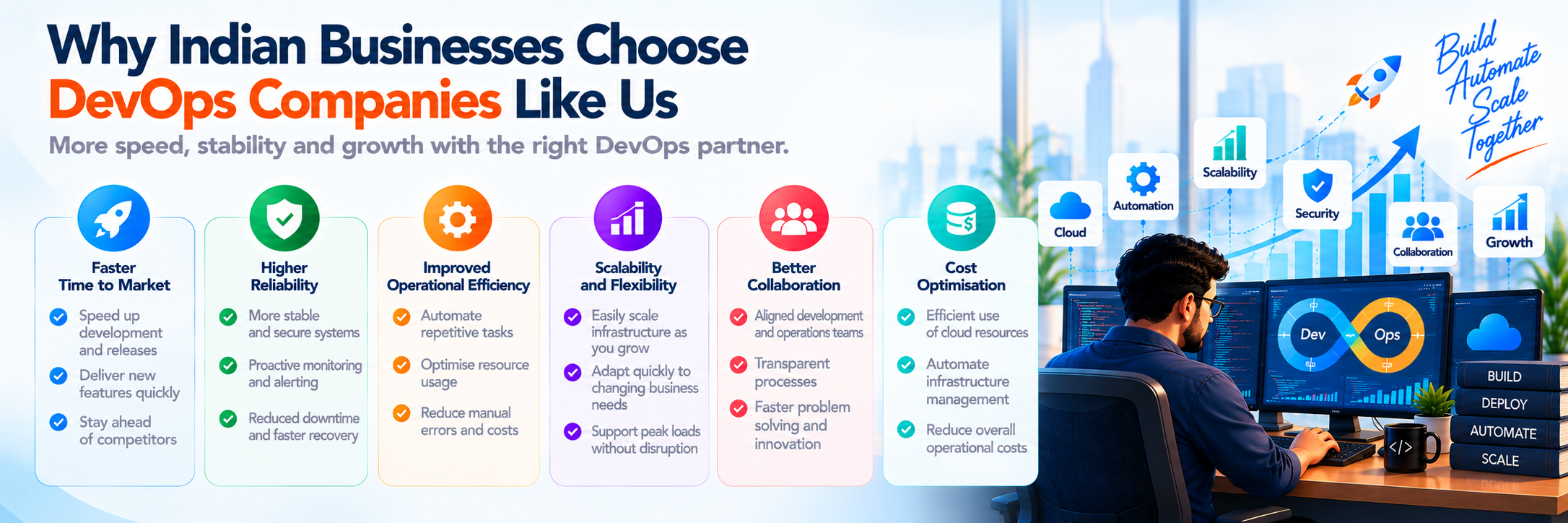
Ahom Technologies has been operating as a DevOps company in India for over a decade – long enough to have built and maintained production environments across healthcare, fintech, e-commerce, logistics, EdTech, and SaaS. That cross-industry operational experience is what shapes how our team approaches every new engagement – with the benefit of having seen what works and what fails across environments of very different sizes, architectures, and operational requirements.
Every Ahom DevOps engagement begins with a genuine assessment – not a template. Our senior DevOps engineers map your current deployment process, your application architecture, your cloud infrastructure, and your team’s operational maturity before making a single tool recommendation. The roadmap that comes out of that assessment is prioritised by impact – addressing the highest-risk areas first rather than implementing the most technically interesting solutions.
The same team throughout
At Ahom Technologies, the engineers who assess your environment are the engineers who implement the solutions and the engineers who provide ongoing support. There is no handoff between assessment, implementation, and operations – because the institutional knowledge accumulated during assessment is exactly what makes implementation decisions better and support faster. Your dedicated point of contact remains consistent from the first discovery call to the ongoing operational support arrangement.
Post-engagement support as standard
Every Ahom DevOps engagement includes structured post-engagement support – covering platform updates, security patch management, cost optimisation reviews, pipeline maintenance, and incident response with documented SLAs. This is not an optional add-on. It is how we structure every engagement from the beginning – because DevOps environments that are implemented well and then left without ongoing attention are environments that gradually drift from the state they were designed to maintain.
Full-stack DevOps capability
Ahom’s DevOps practice covers the complete stack – CI/CD pipeline design and implementation, Infrastructure as Code with Terraform, containerisation with Docker and Kubernetes, cloud platform management across AWS, Azure, and Google Cloud, monitoring and observability with Prometheus and Grafana, and security integration across every stage of the pipeline. Our
cloud DevOps services connect cloud infrastructure management and application deployment automation into a single coherent engineering practice rather than two separately managed workstreams.
For businesses evaluating broader
DevOps services in India – including CI/CD implementation, automation, and Infrastructure as Code – Ahom provides a single accountable partner across the complete DevOps lifecycle. And for organisations considering
offshore software development alongside their DevOps investment, both capabilities are available through the same engagement structure.
Our
DevOps services page covers the full scope of what Ahom delivers – from initial assessment through to long-term managed operations – for businesses that want to understand the complete picture before starting a conversation.

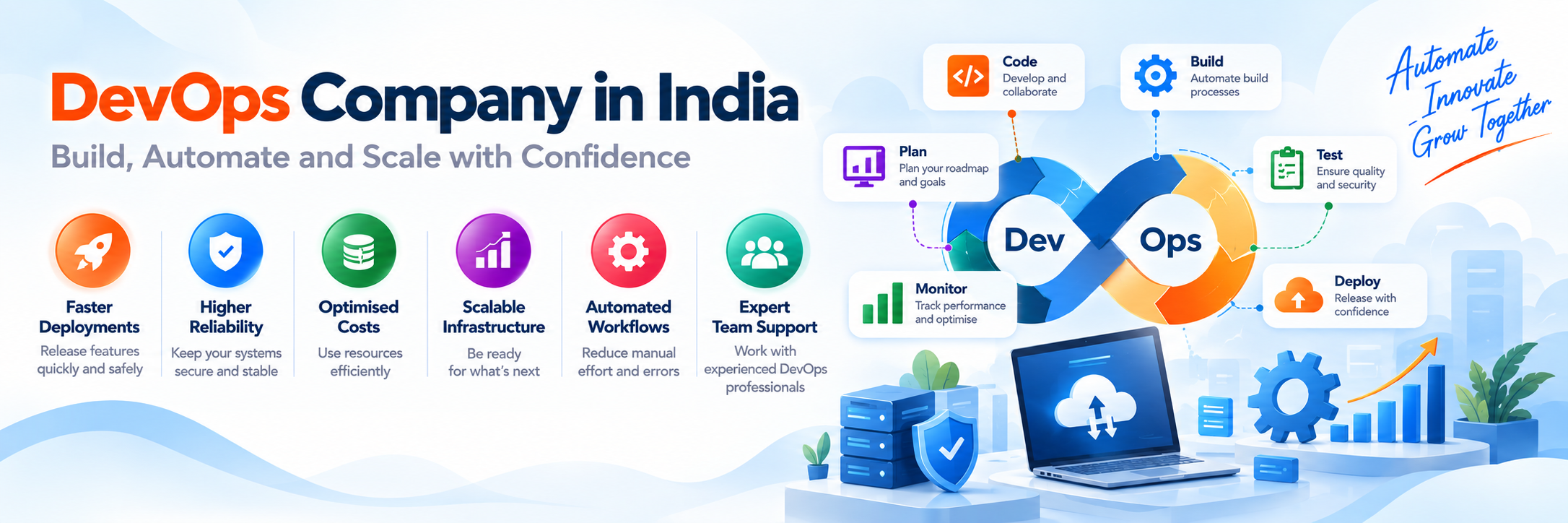
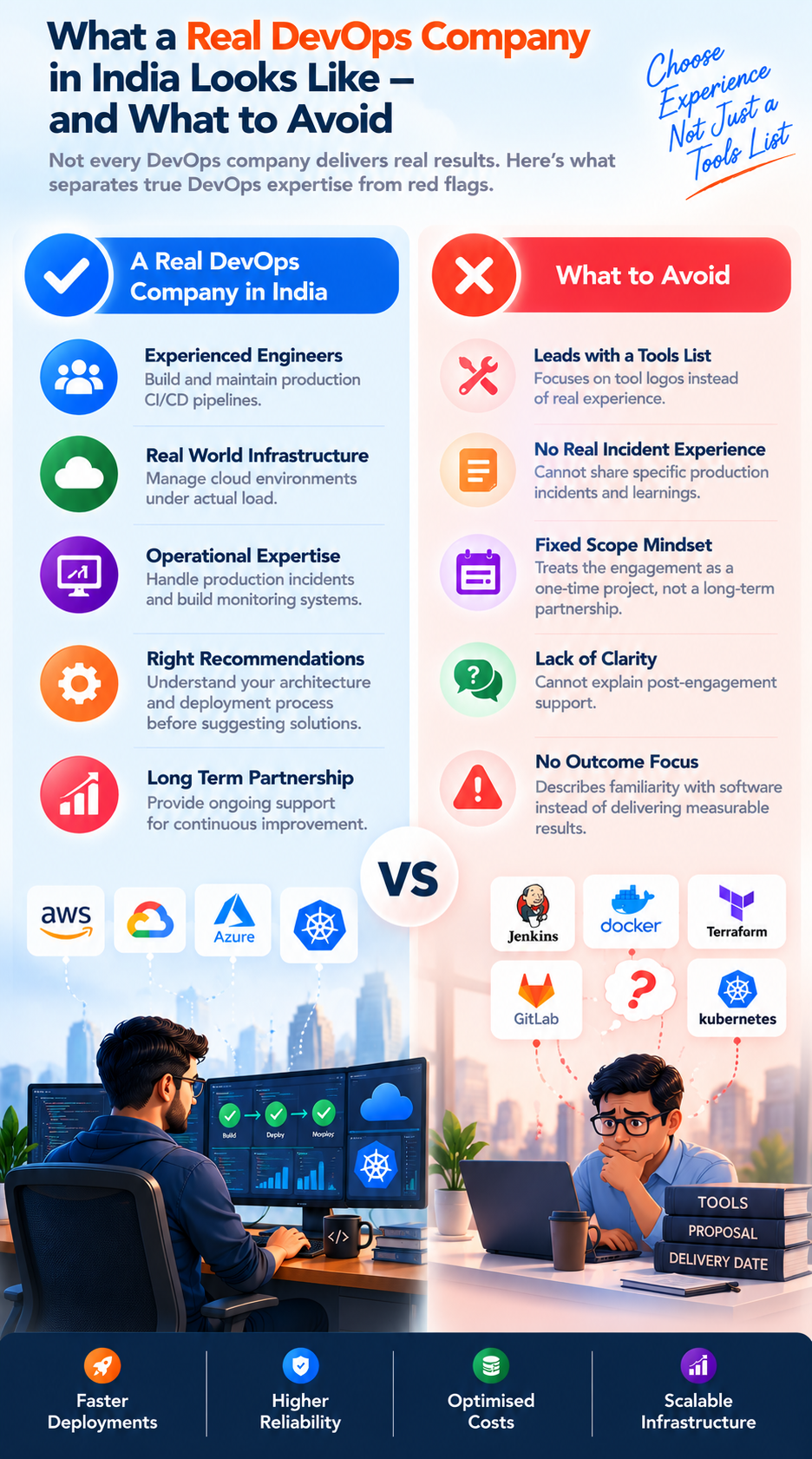
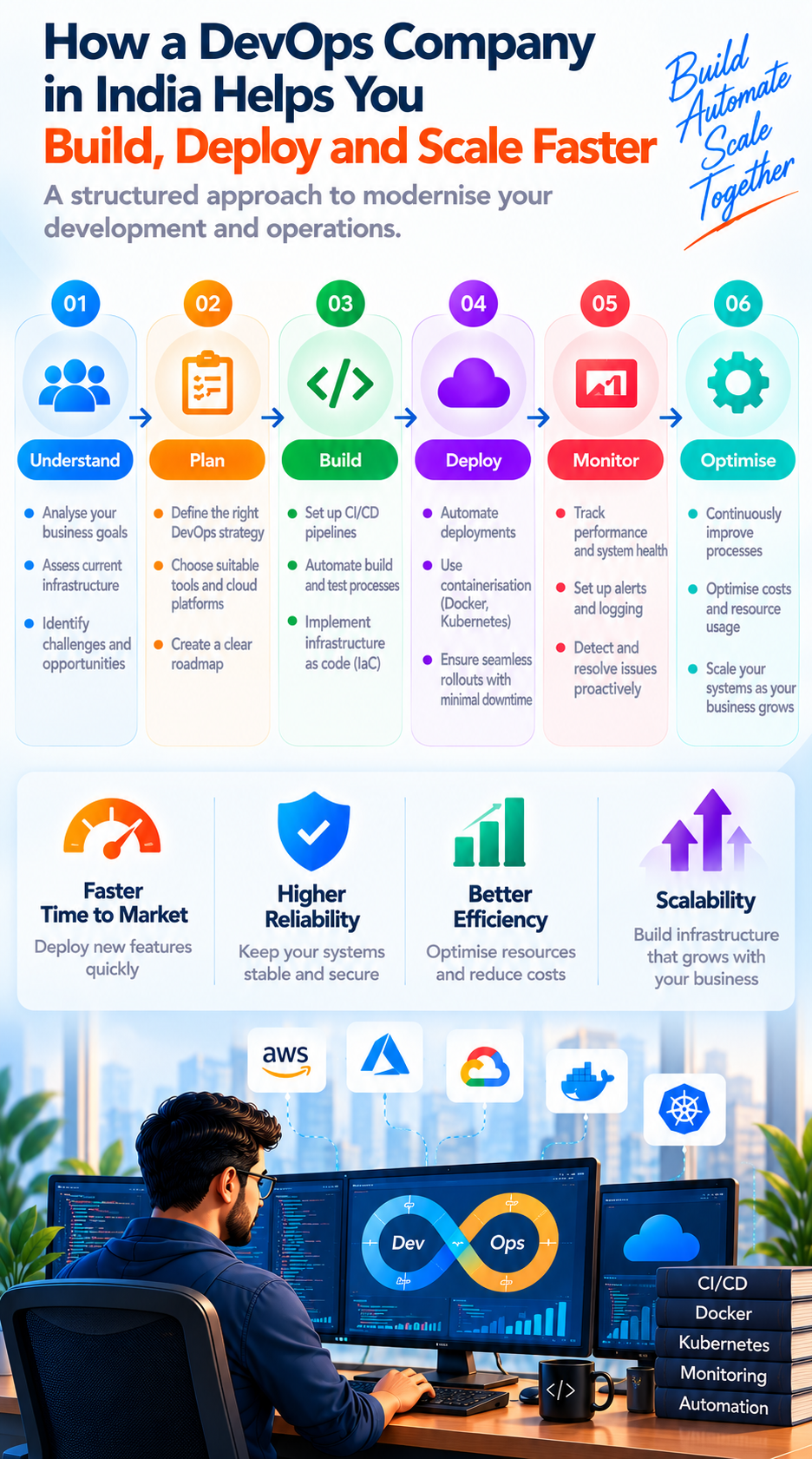
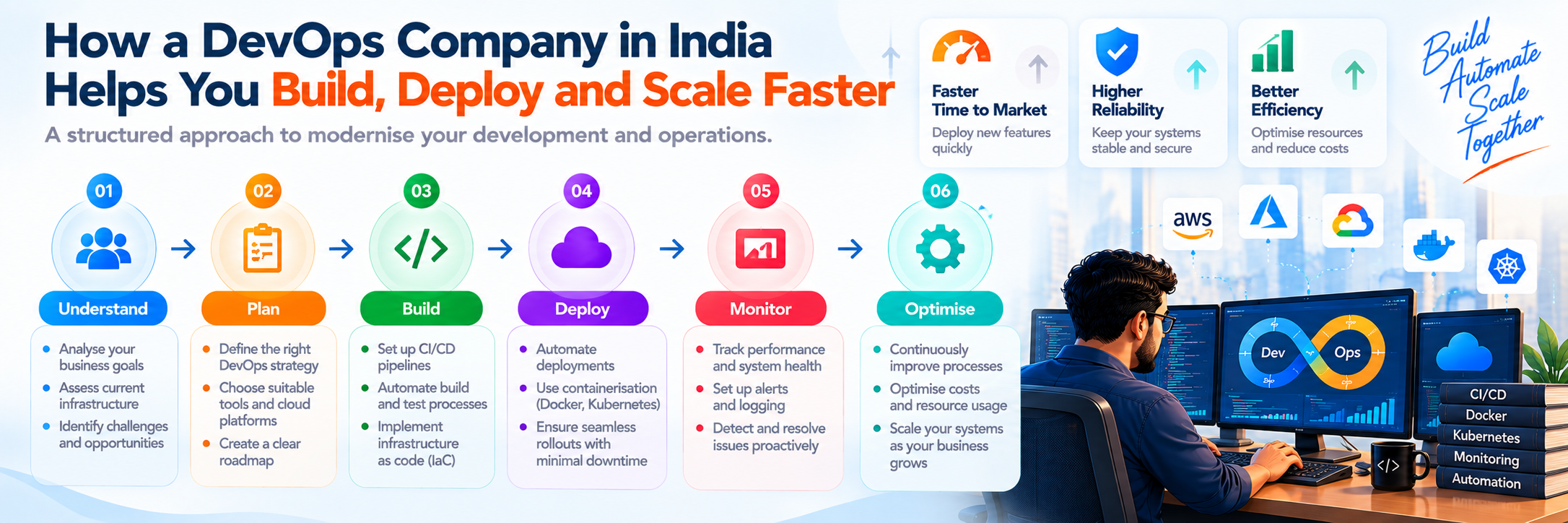
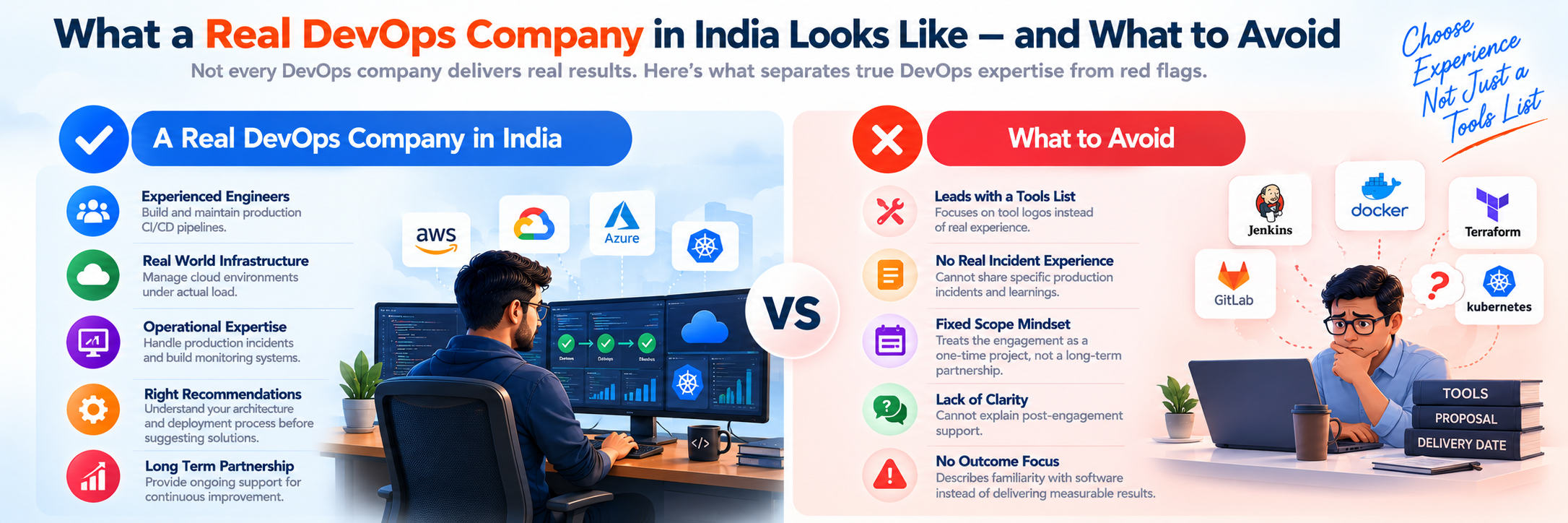 The first thing to understand is that DevOps is not a product. It is not something a company can install and hand over. It is an organisational and engineering discipline that changes how software is built, tested, deployed, and operated – and implementing it properly requires experience across all of those dimensions simultaneously.
A genuine DevOps company in India operates at the intersection of software engineering, infrastructure management, and operational reliability. Their engineers have built and maintained production CI/CD pipelines – not just configured demo environments. They have provisioned and managed cloud infrastructure under real load – not just followed a tutorial. They have dealt with production incidents – and more importantly, they have built the monitoring, alerting, and runbook automation that makes those incidents detectable and recoverable quickly.
The first thing to understand is that DevOps is not a product. It is not something a company can install and hand over. It is an organisational and engineering discipline that changes how software is built, tested, deployed, and operated – and implementing it properly requires experience across all of those dimensions simultaneously.
A genuine DevOps company in India operates at the intersection of software engineering, infrastructure management, and operational reliability. Their engineers have built and maintained production CI/CD pipelines – not just configured demo environments. They have provisioned and managed cloud infrastructure under real load – not just followed a tutorial. They have dealt with production incidents – and more importantly, they have built the monitoring, alerting, and runbook automation that makes those incidents detectable and recoverable quickly.
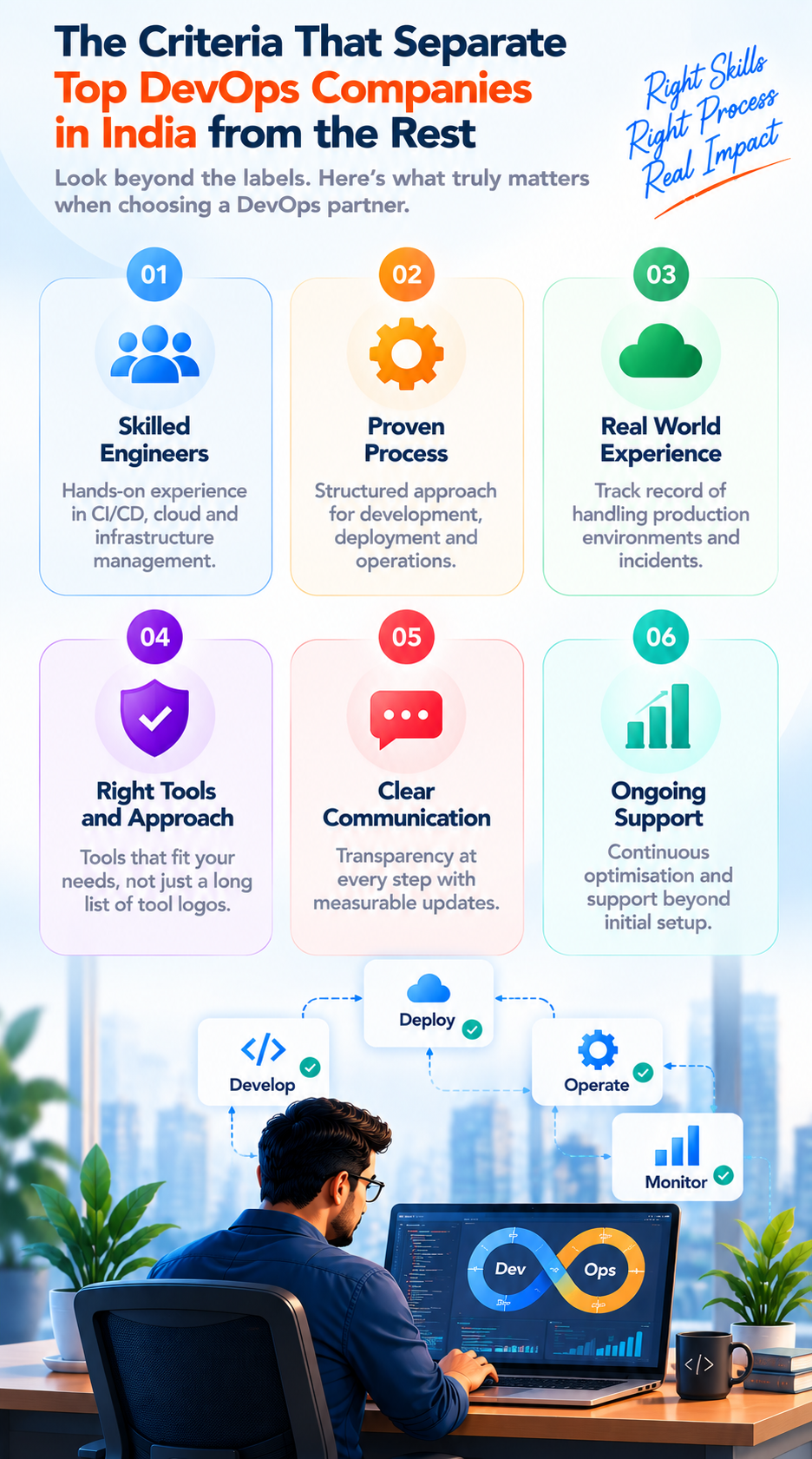
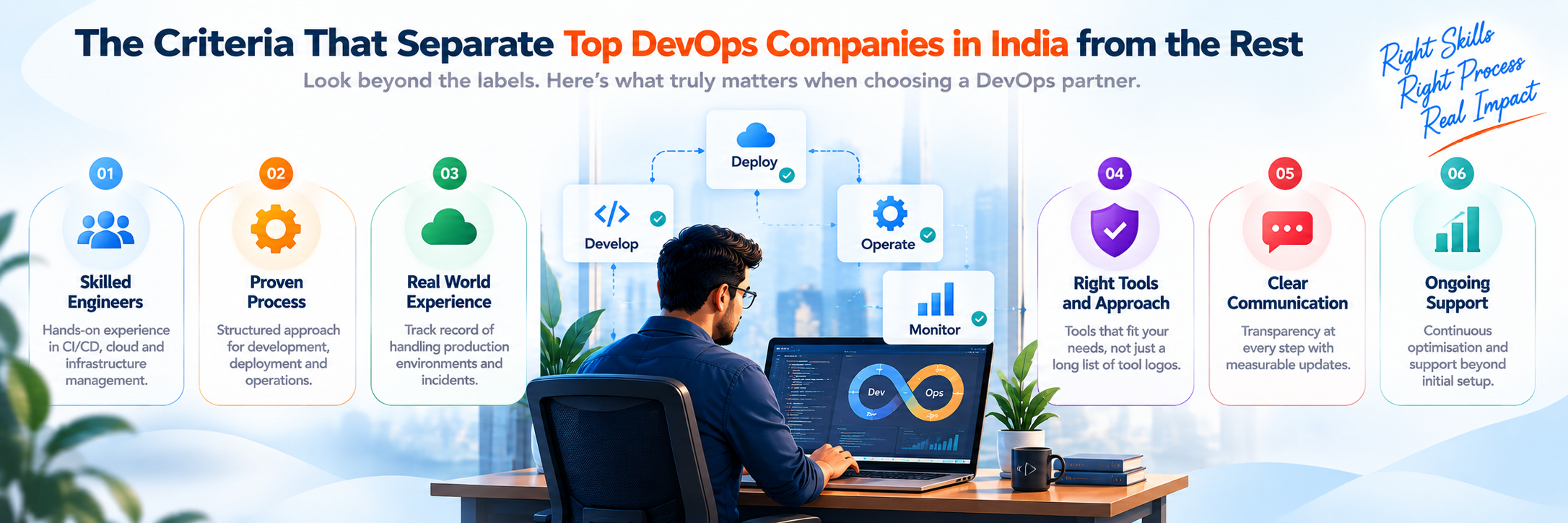 Once you know what genuine DevOps capability looks like, separating the top DevOps companies in India from the ones that are stretching the label becomes significantly easier. These are the criteria that consistently distinguish companies that deliver from companies that describe.