AI Development Company in India — Ahom Technologies

AI Development Company in India — How to Find One That Builds Real AI and Not Just AI-Washed Software

There has never been more noise around artificial intelligence in the technology services market — and never more confusion about what any of it actually means in practice. Every software company in India has added AI to its service list. Every proposal mentions machine learning, large language models, and intelligent automation. Every case study includes a reference to AI-powered capabilities. What has not kept pace with the marketing is the underlying engineering capability. The gap between a company that can genuinely build production AI systems — applications that use machine learning models, large language models, or autonomous agents to solve real business problems at real scale — and a company that wraps a third-party API call in a user interface and calls it an AI product is wider than most businesses realise when they are evaluating their options. This guide is for organisations that need the former. It covers what a genuine AI development company in India actually does, how to identify the difference between real AI capability and AI-washed software, what criteria separate the best from the rest, and how Ahom Technologies approaches every AI engagement we take on.

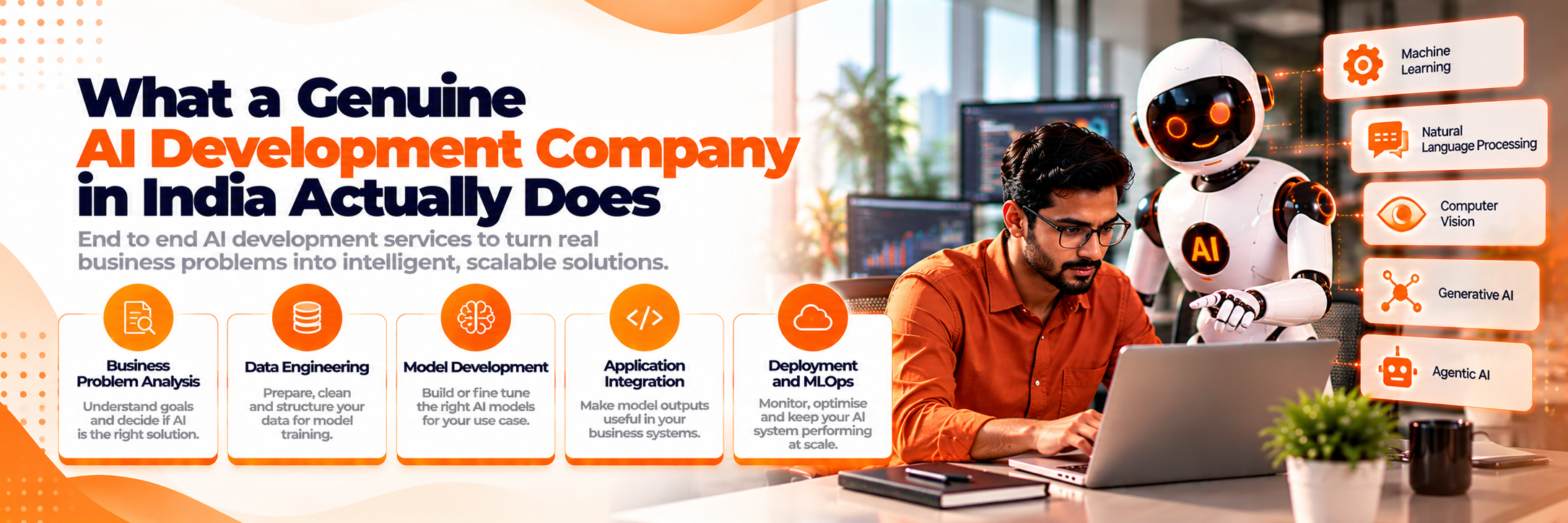
1. What a Genuine AI Development Company in India Actually Does

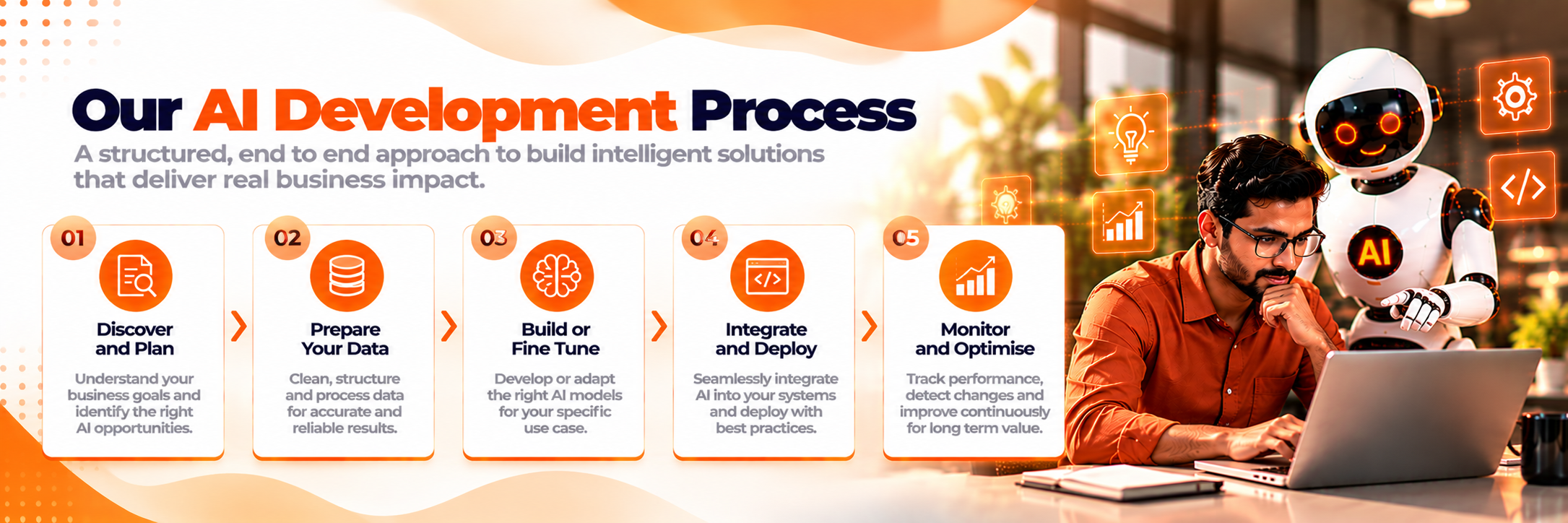
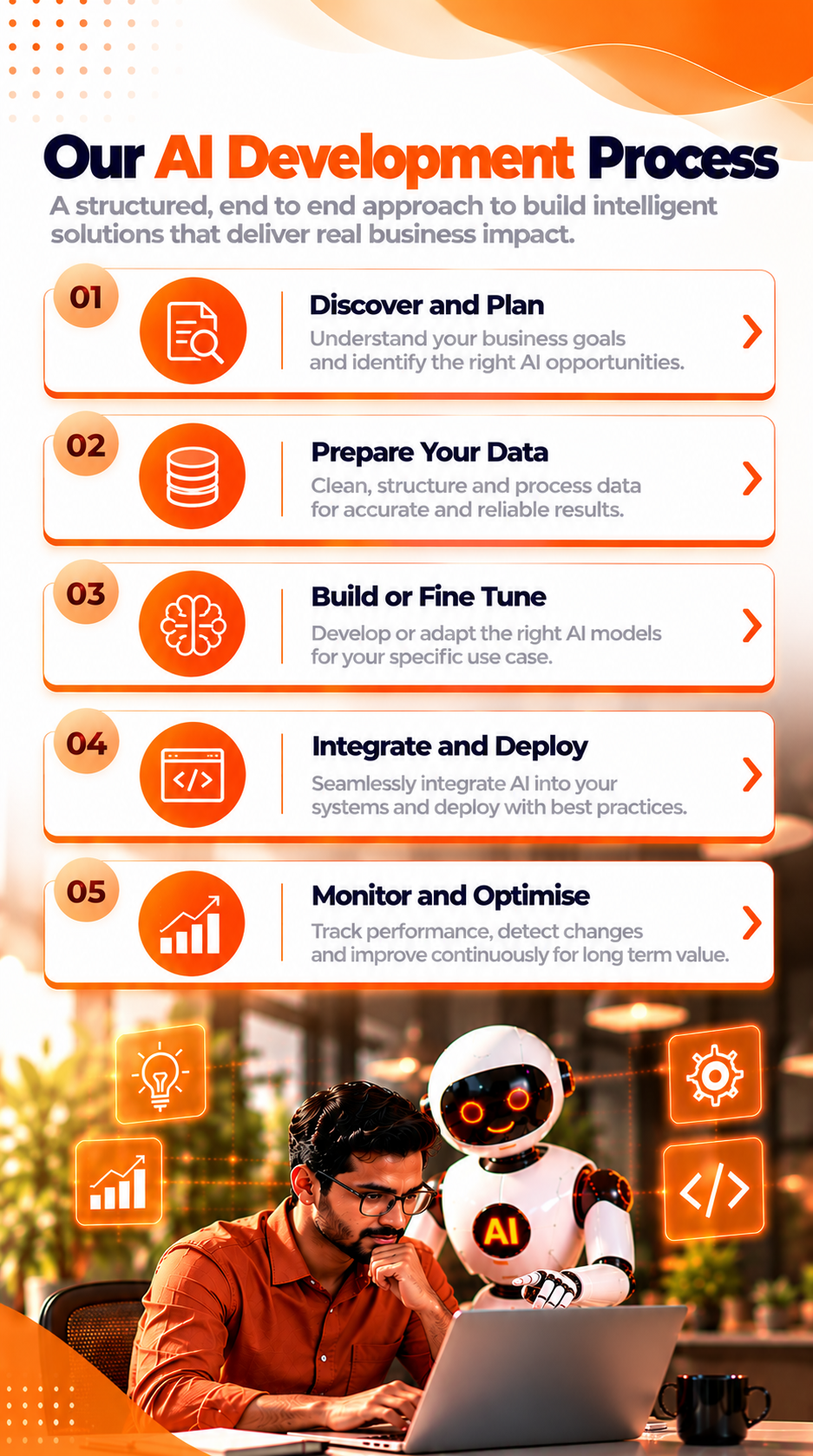
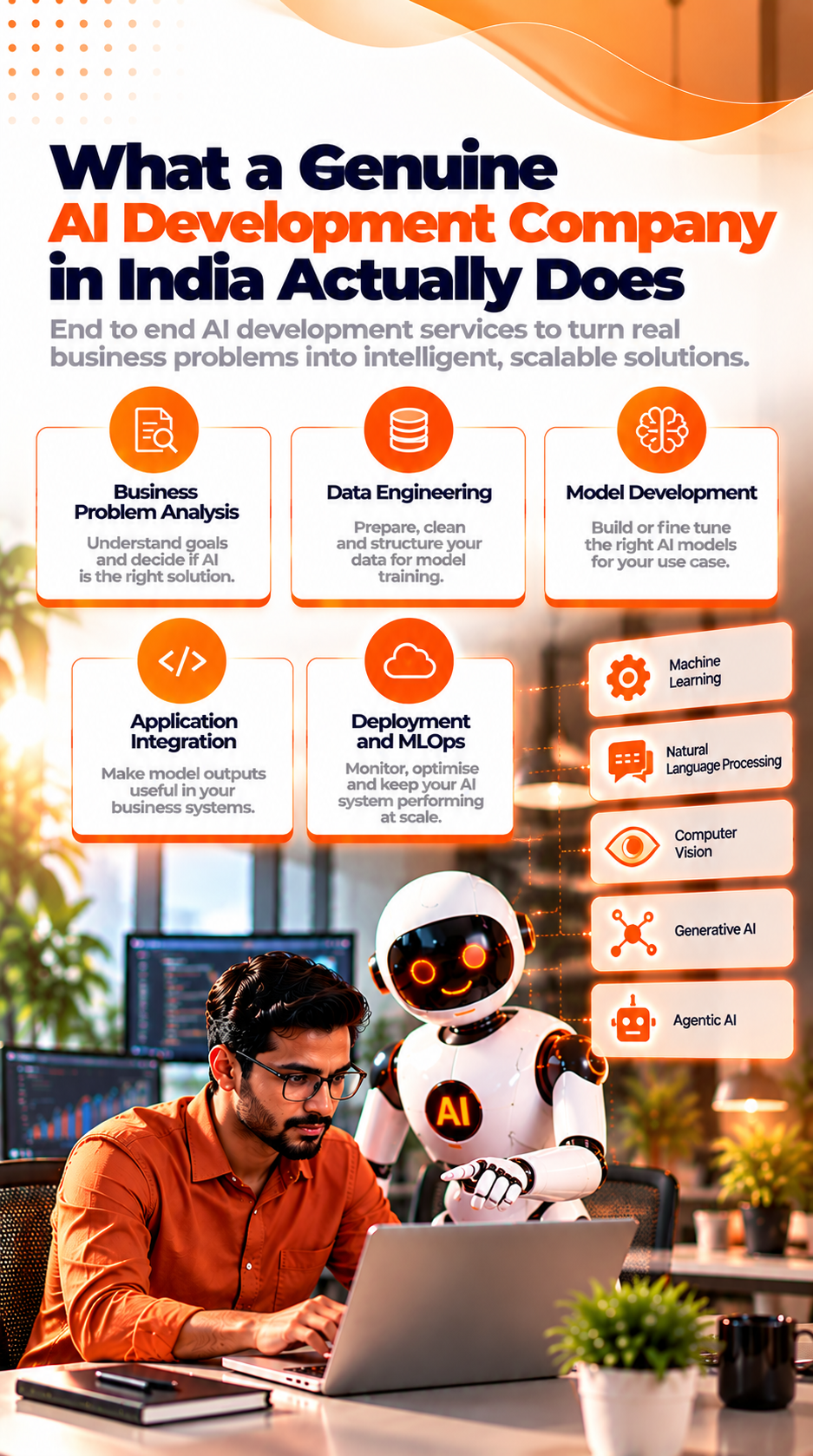
The difference between real AI development and AI-washed software in India The difference between real AI development and AI-washed software in India A genuine AI development company manages the complete lifecycle of building intelligent applications — from the business problem definition that determines whether AI is the right solution, through the data engineering that makes model training possible, to the model development or selection, application integration, deployment, monitoring, and ongoing optimisation that keeps the system performing as the data and business context around it evolve. That lifecycle is significantly more complex than integrating a pre-built AI API. It requires understanding your data — its quality, its volume, its structure, and the preprocessing it needs before it can train or fine-tune a model. It requires selecting or building the right model architecture for your specific task. It requires designing the application layer that makes the model’s outputs useful in your specific business context. And it requires the MLOps infrastructure that monitors model performance, detects drift, and manages the retraining cycles that keep the model accurate as the world it was trained on changes.

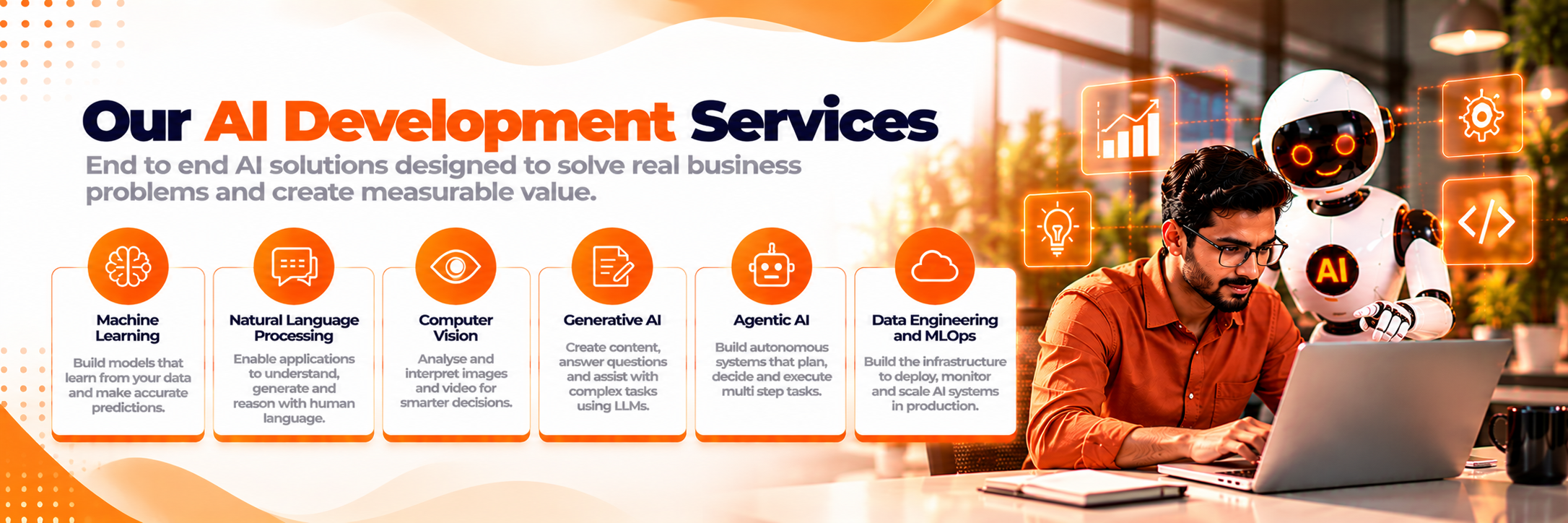
The full scope of AI development services

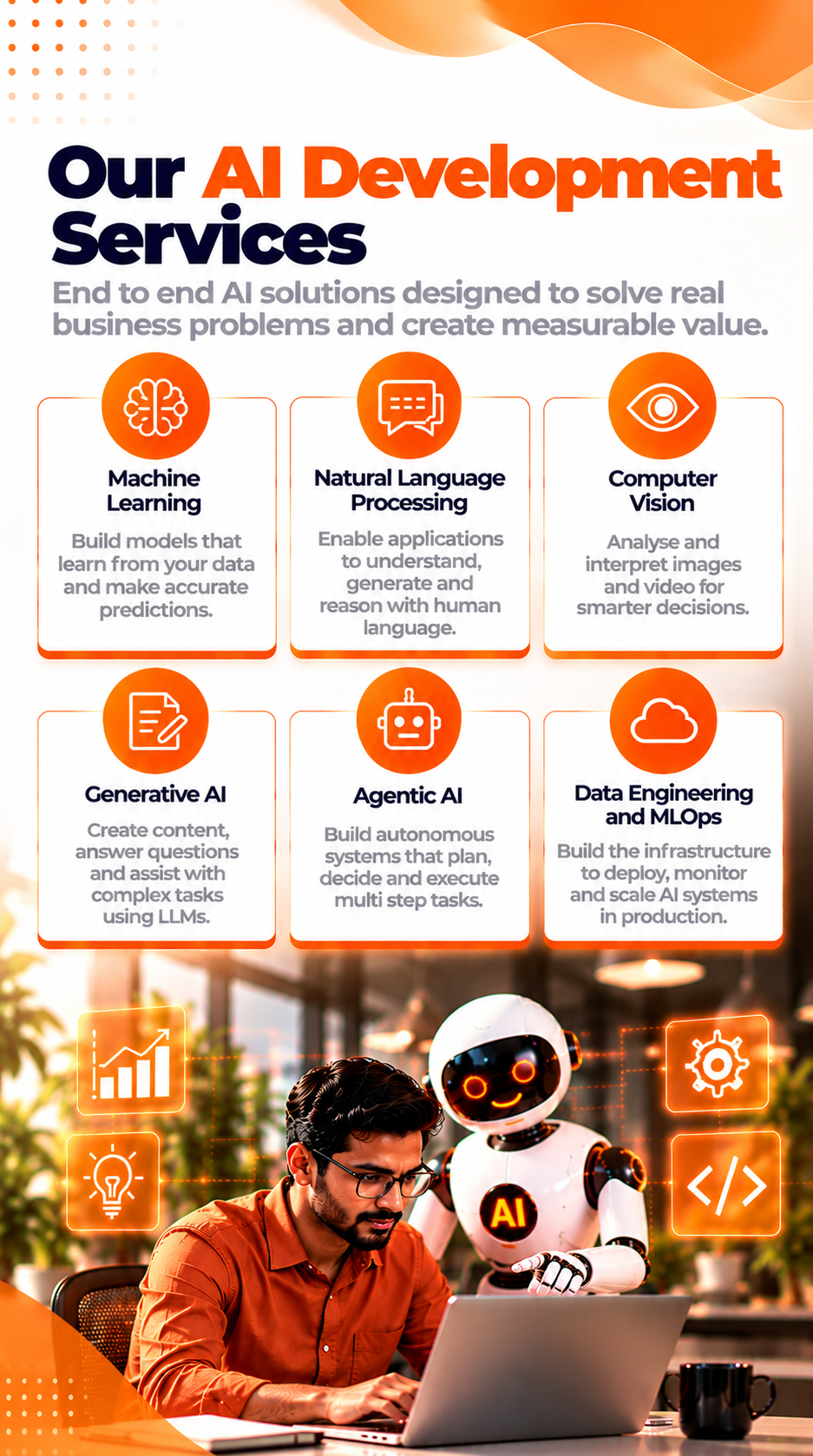
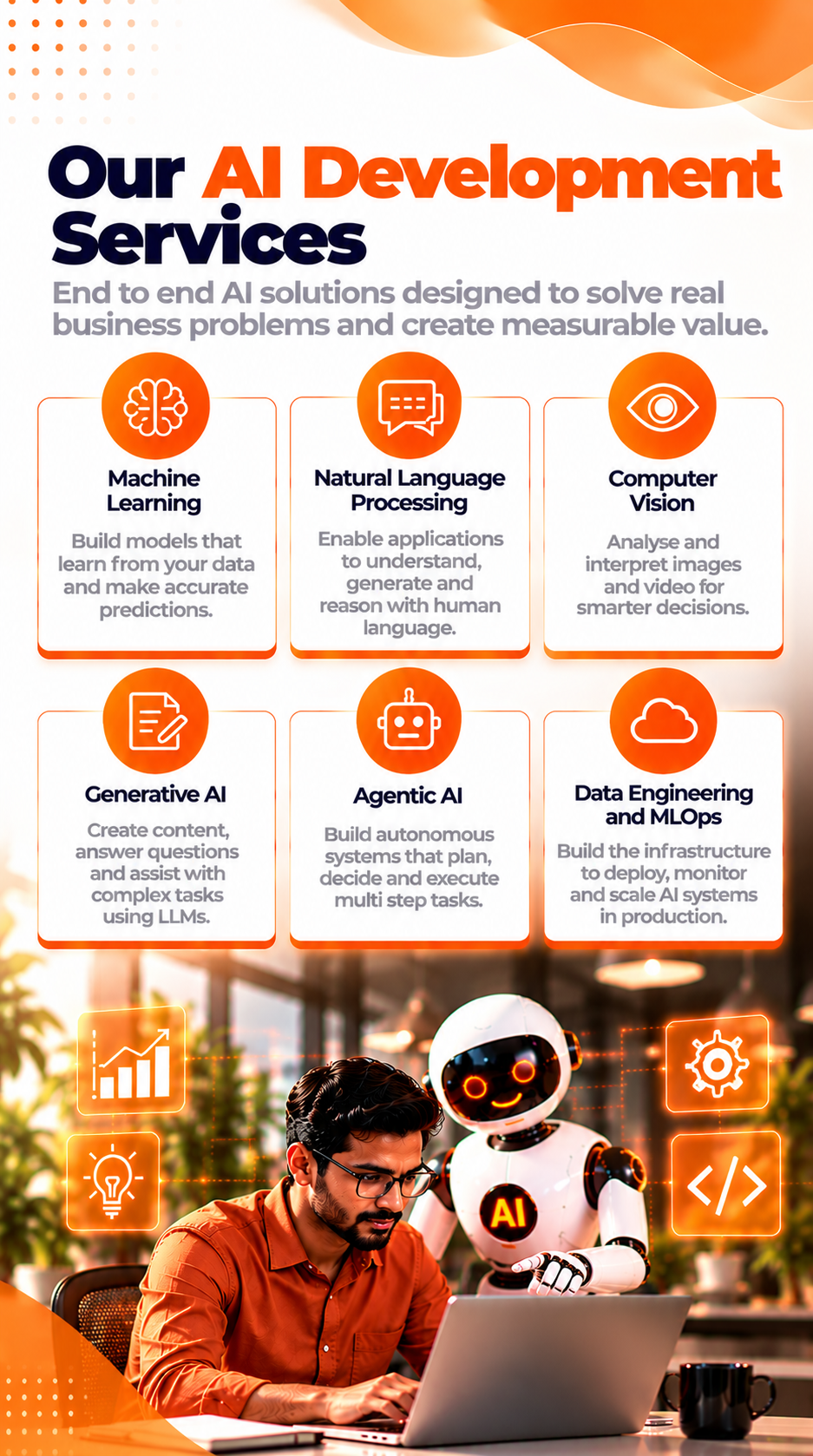
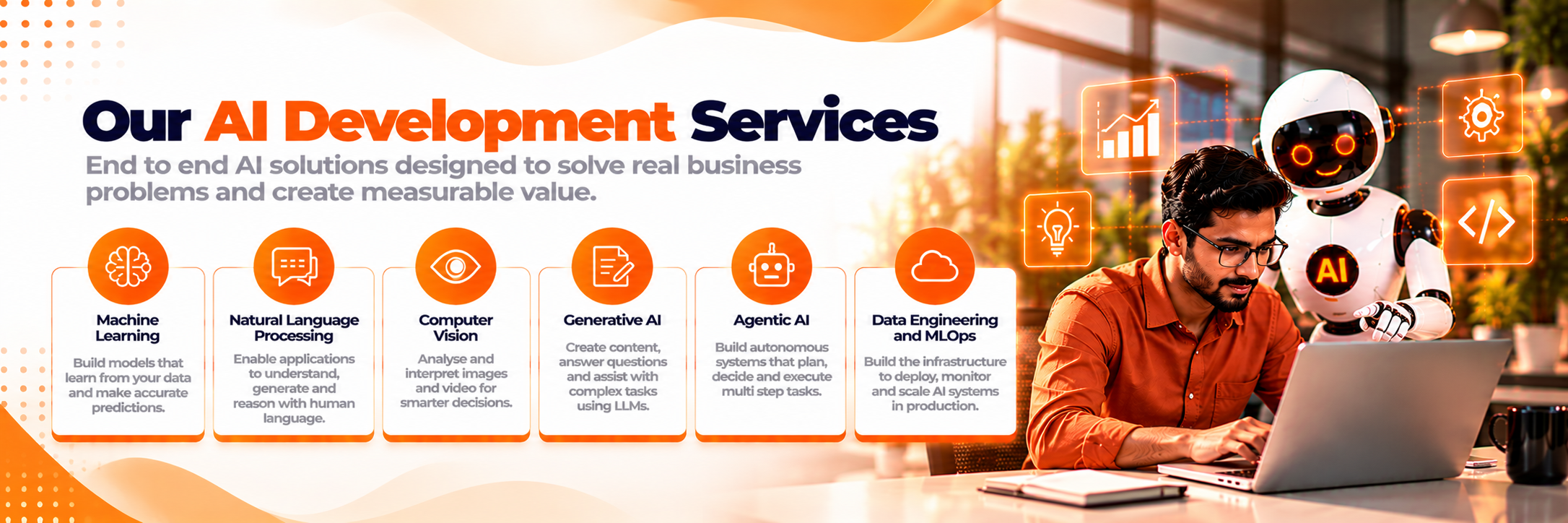
A full-cycle AI development company covers several distinct disciplines that together constitute a complete AI engineering capability. Machine learning engineering — building models that learn patterns from data and make predictions or classifications. Natural language processing — enabling applications to understand, generate, and reason about human language. Computer vision — enabling applications to interpret and analyse images and video. Generative AI — building applications that use large language models to generate content, answer questions, and assist with complex reasoning tasks. Agentic AI — building autonomous systems that plan, make decisions, and execute multi-step tasks with minimal human intervention. And the data engineering and MLOps infrastructure that makes all of these disciplines operationally viable in production.

What it is not

AI development is not connecting your application to the OpenAI API and adding a chatbot widget. It is not running a prompt through GPT-4 and presenting the output as an AI-powered feature. It is not buying a pre-built AI tool and customising its configuration. These things have legitimate uses — but they are not AI development. They are AI integration. Distinguishing between companies that do AI development and companies that do AI integration is one of the most important evaluations a business can make when selecting an AI partner — because the problems they can solve, the outcomes they can produce, and the value they can create are fundamentally different.

2. The Difference Between Real AI Development and AI-Washed Software

Criteria that separate the best AI development companies in India Criteria that separate the best AI development companies in India AI washing — applying the AI label to software that does not use meaningful artificial intelligence — is one of the defining challenges of the current technology services market. Understanding what it looks like in practice protects organisations from investing in engagements that will not produce the intelligent capabilities they are paying for.

The signals of genuine AI capability

A company with genuine AI development capability talks about specific models, specific architectures, and specific trade-offs between them for your use case. They discuss your data — its quality, its volume, the preprocessing it requires, and the implications for model accuracy. They raise the question of model evaluation — how will you know the model is performing well, what metrics matter for your specific task, and what acceptable performance looks like before deployment. They talk about MLOps — how the model will be monitored in production, how drift will be detected, and how retraining will be managed. These are the conversations that real AI development requires and that AI-washed software never reaches.

The signals of AI-washed software

AI-washed software shows up in very specific ways. The proposal mentions AI extensively but never discusses your data. The demo shows impressive outputs from a well-known foundation model without explaining what customisation was done for your use case. The architecture description, when pressed for specifics, resolves to “we use OpenAI” or “we integrate with the leading AI platforms.” The team members listed on the proposal have software engineering backgrounds but no ML engineering, data science, or AI research experience. And the evaluation criteria for success are outputs — “the chatbot will answer questions” — rather than performance metrics — “the model will achieve 90% accuracy on your specific classification task.”

Why the distinction matters for business outcomes

AI-washed software produces outputs that look impressive in a demo and fail under production conditions. A customer service chatbot that performs well on carefully selected example queries but hallucinate confidently on real customer questions. A recommendation engine that recommends popular items regardless of individual user behaviour because it is not actually learning from user data. A document processing tool that works on clean, standard-format documents and fails on the messy, variable-format documents that real business processes produce. The gap between what AI-washed software promises and what it delivers is where most AI project disappointments originate.

3. How to Evaluate an AI Development Company in India
Criteria that separate the best AI development companies in India Criteria that separate the best AI development companies in India Choosing an AI development partner requires a different evaluation framework from choosing a conventional software development company. The technical disciplines involved are different, the failure modes are different, and the criteria that predict successful delivery are different. These are the areas that deserve the most attention during your evaluation.

Evaluate the team’s actual AI engineering experience

Ask specifically about the AI engineers who will work on your project. What models have they built or fine-tuned? What datasets have they worked with? What production AI systems have they deployed, and what happened when those systems encountered real-world data at scale? Look for evidence of hands-on experience with machine learning frameworks, model evaluation, data pipelines, and deployment infrastructure. A team that can discuss these topics in technical detail is demonstrating a different level of capability from one that primarily talks about AI tools and platforms.

Examine production deployments, not just demos

Ask for examples of AI systems the company has deployed in production and maintained over time. A demo demonstrates that a system can work under controlled conditions. A production deployment demonstrates that the team has addressed the harder challenges: data quality, model reliability, latency, infrastructure cost, monitoring, and ongoing performance. Ask what the system was designed to achieve, how success was measured, and what the team learned from operating it in the real world.

Understand their approach to data

Data quality is one of the strongest determinants of AI performance. A credible AI development partner will want to understand your existing data before making detailed promises about what a model can achieve. They should be able to explain how they assess data readiness, handle missing or inconsistent information, prepare datasets, and establish the evaluation process required to measure model performance. Be cautious of providers who promise sophisticated AI outcomes without first asking meaningful questions about the data available to support them.

Look for a clear model evaluation strategy

Every AI application needs a way to measure whether it is working. The right metrics depend on the use case: classification accuracy, precision and recall, retrieval relevance, response quality, latency, or cost per transaction may all matter in different situations. A capable AI development company will define measurable success criteria before development begins and explain how performance will be tested before and after deployment. If the proposed success criteria are limited to whether a feature works in a demo, the evaluation process is not sufficiently rigorous.

Assess security, scalability, and long-term support

AI applications can process sensitive business information, customer data, and proprietary documents. Ask how the provider handles data access, privacy, security, model deployment, and third-party services. Understand how the system will scale as usage grows, how operational costs will be managed, and who will monitor and maintain the application after launch. AI is not a one-time implementation exercise. Models, data, and business requirements change, and your partner should have a clear plan for ongoing support and optimisation.

4. Why Businesses Choose India for AI Development
Questions to ask an AI development company in India before hiring them Questions to ask an AI development company in India before hiring them India has become an important destination for technology development, including artificial intelligence. Businesses looking for an AI development company in India can access a large technology talent pool, experience across different industries, and delivery models that support both dedicated engineering teams and project-based engagements.

Access to a broad technology talent pool

India has a substantial software engineering ecosystem, with professionals working across data engineering, cloud infrastructure, application development, machine learning, and generative AI. This gives businesses the opportunity to find teams with complementary skills rather than relying on a single generalist developer to handle every part of an AI project.

Flexible engagement models

AI projects vary significantly in scope. Some businesses need a complete AI application developed from the ground up, while others need help integrating an AI capability into an existing product or extending an internal engineering team. Indian technology companies may offer project-based development, dedicated teams, or staff augmentation, allowing organisations to select a model that fits their requirements and internal capabilities.

Cost efficiency without compromising engineering quality

Working with an AI development company in India can offer cost advantages compared with building an equivalent team in some other markets. However, cost should not be the only selection criterion. The real value comes from combining an appropriate budget with strong engineering practices, clear communication, reliable delivery, and a solution that produces measurable business outcomes.

Experience working with global businesses

Many Indian technology teams work with clients across international markets. For businesses operating across regions, this experience can help with distributed collaboration, delivery planning, documentation, and coordination between internal stakeholders and external engineering teams. When evaluating a provider, confirm that its communication practices, project governance, and working arrangements suit your organisation.

5. AI Development Services at Ahom Technologies

Ahom Technologies helps businesses explore and build AI-powered solutions aligned with their operational needs and technology goals. From intelligent applications to AI integration, our approach focuses on identifying practical use cases and developing solutions that fit into existing business processes.

AI Application Development

Build AI-powered applications designed around your business requirements. We help businesses identify suitable AI use cases, plan application functionality, and develop solutions that support more efficient workflows and better user experiences.

Generative AI Development

Use generative AI to support content generation, information retrieval, conversational experiences, and other business tasks. Solutions can be designed to help teams access information, automate repetitive activities, and improve how they interact with business data.

Machine Learning Development

Explore machine learning solutions for tasks such as prediction, classification, pattern recognition, and data-driven decision-making. The right approach depends on your business objective, the quality of available data, and the performance requirements of the application.

AI Integration

Integrate appropriate AI capabilities into existing applications and workflows. This can help businesses introduce intelligent features without necessarily rebuilding their entire technology infrastructure.

Intelligent Automation

Identify repetitive and time-consuming business processes that may benefit from AI-enabled automation. Well-planned automation can reduce manual effort, support consistency, and allow teams to focus on higher-value work.

Agentic AI Solutions

Explore AI systems that can work through multi-step tasks, use available tools, and support defined business workflows. The level of autonomy should be designed around the task, with appropriate human oversight, security controls, and evaluation measures.

Frequently Asked Questions

1. What does an AI development company in India do?

An AI development company builds applications and systems that use artificial intelligence to solve business problems. Services may include machine learning, generative AI, natural language processing, computer vision, intelligent automation, and AI integration. A full-cycle provider can also support data preparation, deployment, monitoring, and ongoing optimisation.

2. How do I choose the best AI development company in India?

Evaluate the team’s technical expertise, experience with production AI systems, approach to data quality, model evaluation process, security practices, scalability, and post-deployment support. Ask for relevant project examples and measurable outcomes rather than relying only on demonstrations or marketing claims.

3. What is the difference between AI development and AI integration?

AI development involves building or customising intelligent systems to address specific business requirements. AI integration involves connecting existing AI models, APIs, or tools to an application or workflow. Both can be useful, but the right approach depends on the business problem and the level of customisation required.

4. How much does AI development cost in India?

The cost depends on the project’s complexity, data requirements, model selection, application features, integrations, infrastructure, and ongoing support. A simple AI integration project may require less investment than a custom machine learning platform. Businesses should define their requirements and request a scope-based estimate before committing to a project.

5. What industries can benefit from AI development?

AI can support businesses across industries such as healthcare, finance, retail, education, manufacturing, logistics, and technology. Potential applications include predictive analytics, document processing, customer support, recommendations, workflow automation, and demand forecasting. The value depends on the specific business problem, available data, and implementation approach.

6. Why choose Ahom Technologies for AI development?

Ahom Technologies helps businesses explore AI-powered applications and technology solutions aligned with their operational requirements. Businesses should discuss their objectives, technical needs, expected outcomes, and support requirements with the team to determine the most suitable approach for their project.

Conclusion

Choosing an AI development company in India requires looking beyond the promises of artificial intelligence and examining the engineering capability behind them. Genuine AI development involves understanding business problems, working with data, selecting appropriate models, evaluating performance, and building systems that can operate reliably in real-world conditions.

Before selecting a partner, ask about its team’s experience, production deployments, data preparation process, evaluation methods, security practices, and long-term support. These conversations will help you distinguish between a solution that simply uses AI terminology and one designed to address a meaningful business challenge.

Ahom Technologies works with businesses to explore AI-powered applications, integration, and intelligent automation based on their technology and operational goals. Start with a clear business objective, evaluate the available options carefully, and choose an approach that delivers practical value beyond the initial demonstration.

Tags: No tags

Comments are closed.