
Cloud Migration Services in India – A Practical Guide to Moving Your Business to the Cloud
Cloud migration is one of those initiatives that looks straightforward in a board presentation and reveals its full complexity about three weeks into execution. The concept is simple move your applications, data, and infrastructure from wherever they currently live to a cloud platform. The reality involves a hundred decisions that each affect the others, a sequence that matters enormously, and a set of risks that are entirely manageable if you plan for them and genuinely expensive if you do not. India’s cloud migration services market is growing at a CAGR of over 14% annually – driven by enterprises across BFSI, healthcare, retail, and manufacturing accelerating their shift to cloud platforms to improve agility, reduce infrastructure costs, and support increasingly data-intensive workloads. That growth has produced a large number of companies claiming cloud migration expertise and a much smaller number that have actually migrated production systems of meaningful complexity without significant disruption. This guide covers what a serious cloud migration actually involves, how to choose the right strategy for your specific workloads, what the platform decision looks like across AWS, Azure, and Google Cloud, and how Ahom Technologies manages migrations for clients who need to move without breaking what they have.1. What Are Cloud Migration Services and What Does a Full Migration Actually Involve?
 Cloud migration is the process of moving digital assets applications, data, workloads, and the infrastructure that supports them from on-premise data centres, legacy hosting environments, or one cloud platform to another. That definition covers an enormous range of actual work, from a simple lift-and-shift of a single application to a multi-year programme replacing an entire enterprise technology estate.
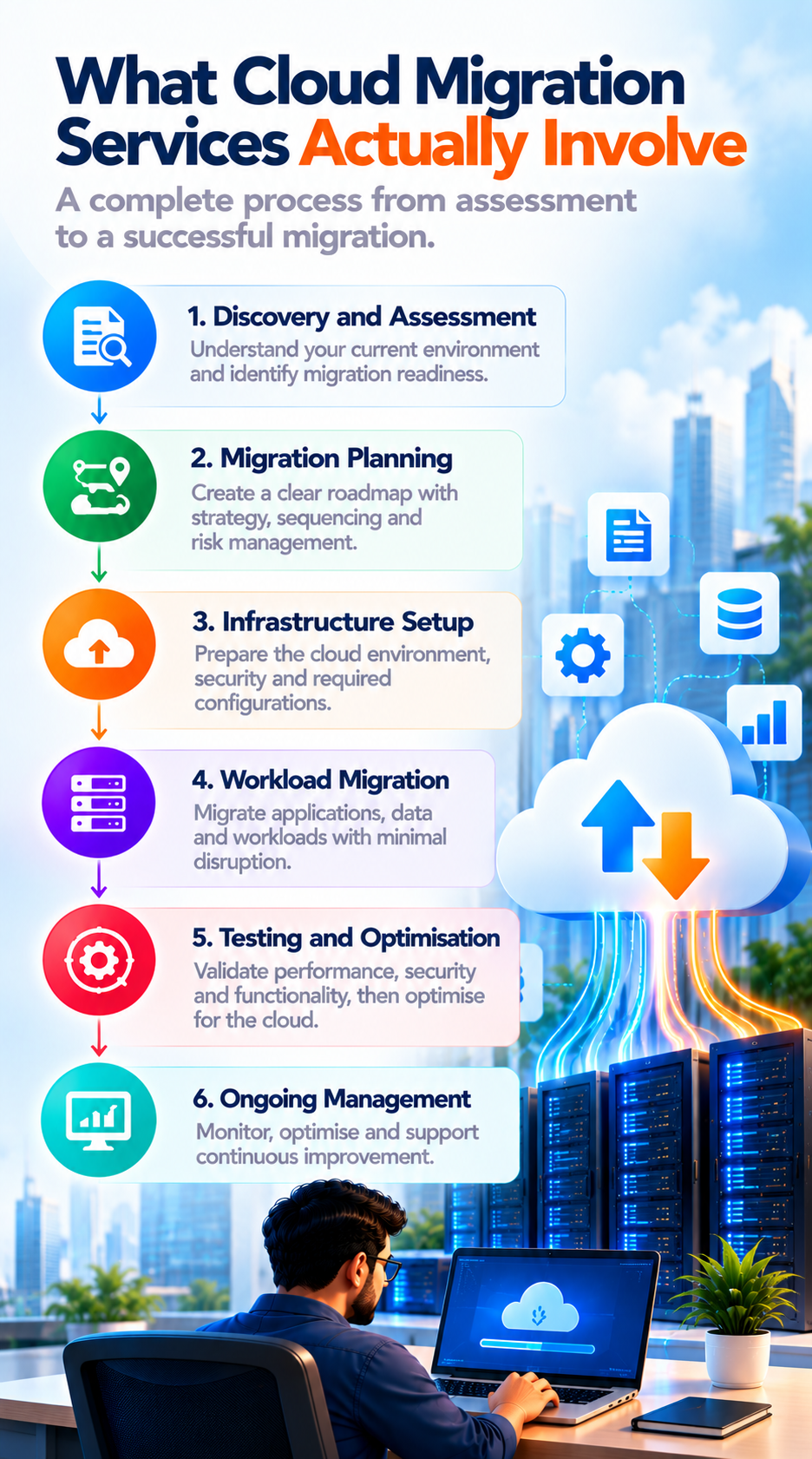
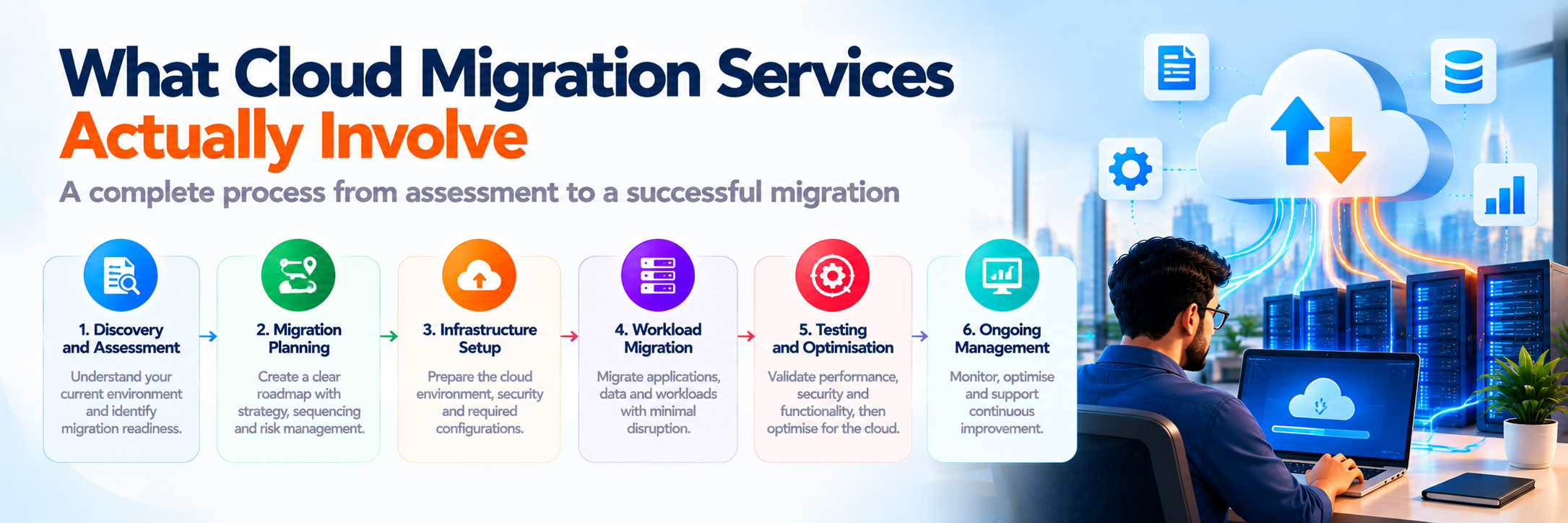
A serious cloud migration services engagement covers several distinct phases – each of which requires its own expertise and produces outputs that feed directly into the next phase.
Cloud migration is the process of moving digital assets applications, data, workloads, and the infrastructure that supports them from on-premise data centres, legacy hosting environments, or one cloud platform to another. That definition covers an enormous range of actual work, from a simple lift-and-shift of a single application to a multi-year programme replacing an entire enterprise technology estate.
A serious cloud migration services engagement covers several distinct phases – each of which requires its own expertise and produces outputs that feed directly into the next phase.
Discovery and assessment
Before any workload moves, a thorough inventory and assessment is essential. This means cataloguing every application, every database, every integration dependency, and every piece of infrastructure in scope – and assessing each one for cloud readiness, migration complexity, and the specific risks that moving it will introduce. This phase answers the question that most organisations cannot answer clearly at the start of a migration: what do we actually have, and what does it depend on? The discovery phase also identifies the sequence in which workloads should move – which applications can migrate independently and which have dependencies that require them to move together. Getting the sequence wrong is one of the most common causes of cloud migration disruption, and it is entirely avoidable with a thorough upfront assessment.Migration planning and roadmap
The assessment outputs feed into a migration roadmap – a prioritised, sequenced plan that groups workloads into migration waves, defines the strategy for each wave, establishes success criteria and rollback procedures, and identifies the infrastructure that needs to be set up in the cloud environment before the first workload moves. A migration roadmap is not a project plan with dates. It is a technical document that reflects the actual dependency structure of your application landscape and the specific risks that need to be managed at each stage. The quality of this document determines the quality of the migration that follows it.2. The Six Migration Strategies – Rehost, Replatform, Refactor and Beyond
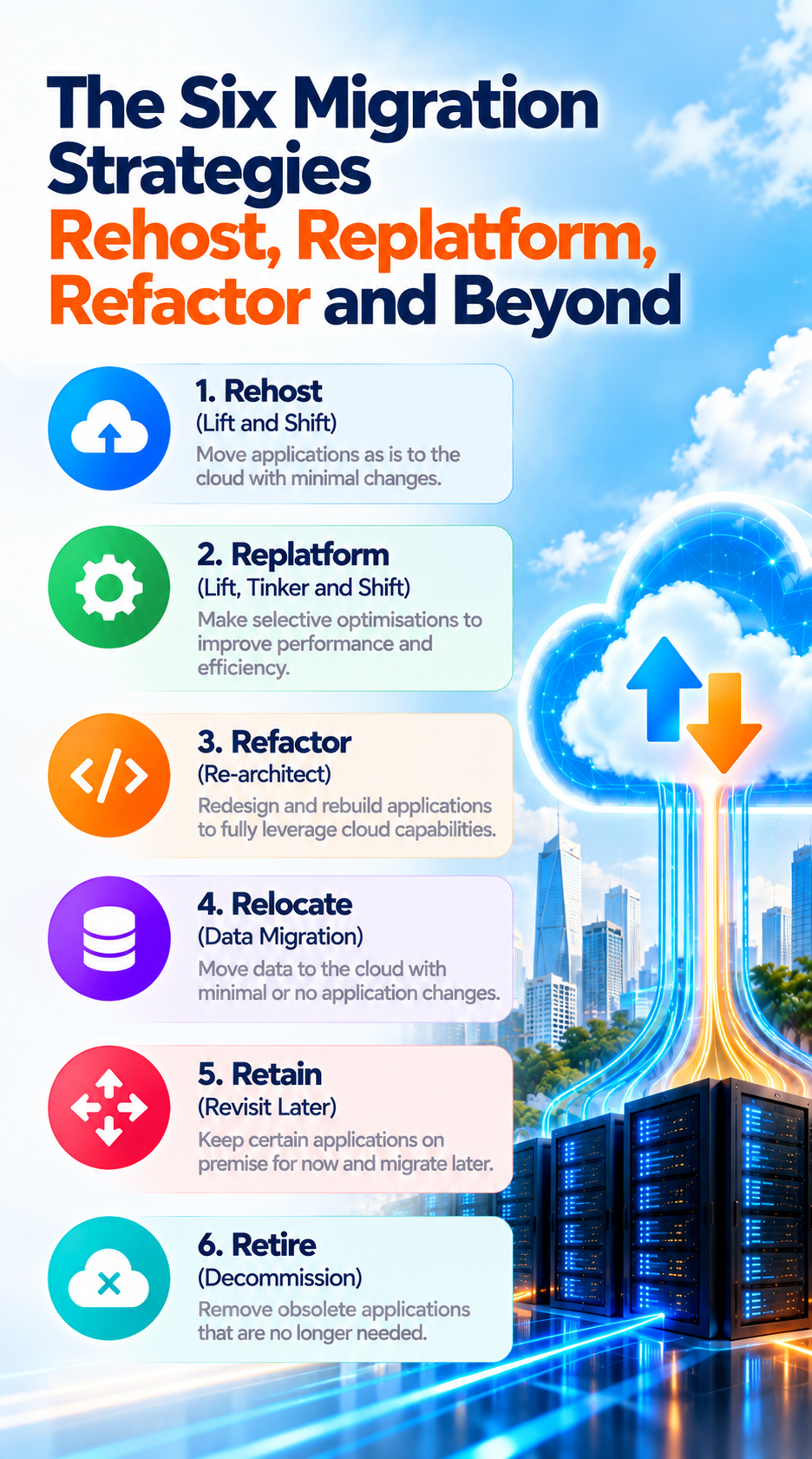
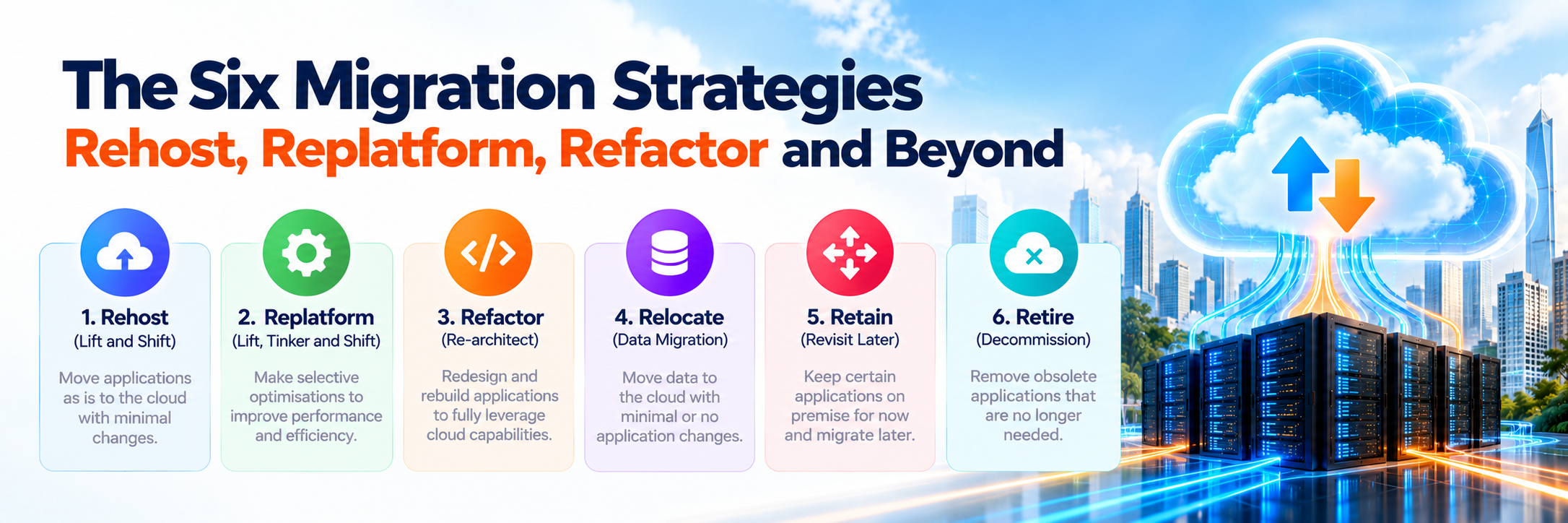 Not every workload should be migrated the same way. The six migration strategies – commonly referred to as the 6 Rs – provide a framework for making the right migration decision for each application based on its architecture, its business criticality, and the value of the cloud capabilities it could use.
Rehost – Lift and Shift
Rehosting moves an application to the cloud without making any changes to the application itself. The server that ran on-premise now runs on a cloud virtual machine. This is the fastest and lowest-risk migration approach – it requires no application code changes and minimal reconfiguration. It does not take full advantage of cloud-native capabilities, but it moves the workload to the cloud quickly and allows cloud optimisation to happen iteratively afterwards. Rehosting is the right strategy for applications that need to migrate quickly, applications that are stable and do not require significant change, and applications where the primary goal is infrastructure cost reduction rather than architectural modernisation.Replatform – Lift, Tinker and Shift
Replatforming makes targeted optimisations during the migration – replacing a self-managed database with a managed cloud database service, or migrating from a physical load balancer to a cloud load balancer – without changing the application’s core architecture. This captures some cloud benefits without the cost and risk of a full re-architecture.Refactor – Re-Architect
Refactoring re-architects the application to take full advantage of cloud-native capabilities – breaking a monolithic application into microservices, redesigning for auto-scaling, or rebuilding around serverless functions. This is the most complex and highest-effort migration approach, but it produces the most cloud-optimised outcome. It is the right strategy for applications where business requirements cannot be met by the existing architecture and where the investment in re-architecture is justified by the long-term operational benefits.Repurchase, Retire and Retain
The remaining three strategies cover workloads that should not be migrated in the traditional sense. Repurchasing replaces an existing on-premise application with a cloud-based SaaS alternative. Retiring decommissions applications that are no longer needed – a cloud migration programme frequently surfaces a significant number of applications that have no active users. Retaining keeps applications on-premise where cloud migration is not yet appropriate – either because of regulatory requirements, technical constraints, or a business decision to migrate later. A mature cloud migration services provider will recommend the right strategy for each workload rather than defaulting to lift-and-shift for everything or proposing a full re-architecture across the board. According to Gartner’s cloud migration guidance, organisations that take a workload-by-workload approach to migration strategy selection consistently achieve better outcomes than those that apply a single strategy across all applications.3. AWS, Azure and Google Cloud – Choosing the Right Platform for Your Migration
 Platform selection is one of the most consequential decisions in a cloud migration programme – and one of the most frequently made for the wrong reasons. Familiarity, vendor relationships, and sales presentations all influence platform decisions that should be driven primarily by technical requirements and workload characteristics.
AWS migration services
AWS is the most mature cloud platform and the default choice for organisations without strong reasons to prefer one of the alternatives. AWS Migration Hub provides a central location for tracking the status of application migrations across AWS and partner migration tools. AWS Application Migration Service automates the rehosting of applications from physical, virtual, and cloud infrastructure. AWS Database Migration Service handles database migrations with minimal downtime across a wide range of source and target database engines. AWS is the strongest choice for organisations with diverse workload types, significant data engineering requirements, or complex networking needs – where the breadth of AWS services provides capabilities that the other platforms do not yet fully match.Azure migration services
Azure Migrate provides a unified hub for discovering, assessing, and migrating on-premise workloads to Azure. For organisations in the Microsoft ecosystem – running Windows Server, SQL Server, Active Directory, or Microsoft 365 – Azure migration frequently offers the most natural path, with hybrid connectivity options and identity integration that reduce migration complexity significantly. Azure’s hybrid cloud capabilities – particularly Azure Arc, which extends Azure management to on-premise and multi-cloud infrastructure – make it the strongest choice for organisations that need to maintain a significant on-premise footprint alongside their cloud migration.Google Cloud migration
Google Cloud’s Migrate to Virtual Machines and Database Migration Service provide the core tooling for workload migrations to GCP. For organisations with significant Kubernetes requirements, data engineering workloads, or machine learning infrastructure, Google Cloud frequently offers the best platform fit – particularly where BigQuery, Vertex AI, or Google Kubernetes Engine are part of the target architecture. Ahom Technologies has managed cloud migrations across all three major platforms and advises on platform selection based on your specific workload profile, your team’s existing familiarity, and your long-term cloud strategy – rather than defaulting to a single platform preference.4. Hybrid Cloud Migration – When You Cannot Move Everything atOnce
Most enterprise cloud migrations do not end with everything in the cloud. Regulatory requirements, application dependencies, data residency constraints, and business decisions about legacy system timelines mean that many organisations operate a hybrid architecture indefinitely – with some workloads in the cloud, some on-premise, and a connectivity and management layer that bridges the two. Hybrid cloud migration is not a compromise or a partial success. For many organisations, it is the right long-term architecture – and planning for it from the beginning of the migration programme produces significantly better outcomes than treating on-premise retention as a temporary exception to be cleaned up later.What hybrid cloud migration requires
A well-designed hybrid cloud architecture requires reliable, low-latency connectivity between on-premise and cloud environments – typically implemented through dedicated network connections like AWS Direct Connect or Azure ExpressRoute rather than public internet VPNs. It requires consistent identity and access management across both environments – so that the same users and service accounts can authenticate across on-premise and cloud resources without maintaining separate identity systems. It requires a unified monitoring and observability layer that surfaces metrics and alerts from both on-premise and cloud infrastructure in a single view – so that the operations team has complete visibility rather than switching between separate tools. And it requires an Infrastructure as Code approach that manages both cloud and on-premise resources through the same version-controlled, automated process – preventing the configuration drift that accumulates when on-premise resources are managed manually while cloud resources are managed through code.The sequencing challenge in hybrid migrations
In a hybrid migration, the sequencing of which workloads move first has an additional dimension beyond technical dependencies. Workloads that have tight integration with systems staying on-premise need either those integration points redesigned for hybrid connectivity, or those workloads moved later in the sequence when the on-premise systems they depend on have also migrated. Getting this sequencing right is one of the most technically demanding aspects of hybrid cloud migration – and it is where the quality of the upfront dependency mapping pays the highest dividend. Ahom’s cloud DevOps services provide the infrastructure automation and CI/CD pipeline capability that makes hybrid cloud environments manageable at scale – ensuring that both the cloud and on-premise components of a hybrid architecture are managed through the same automated, version-controlled process rather than two separate operational disciplines.5. How Ahom Technologies Manages Cloud Migration Projects from Start to Finish
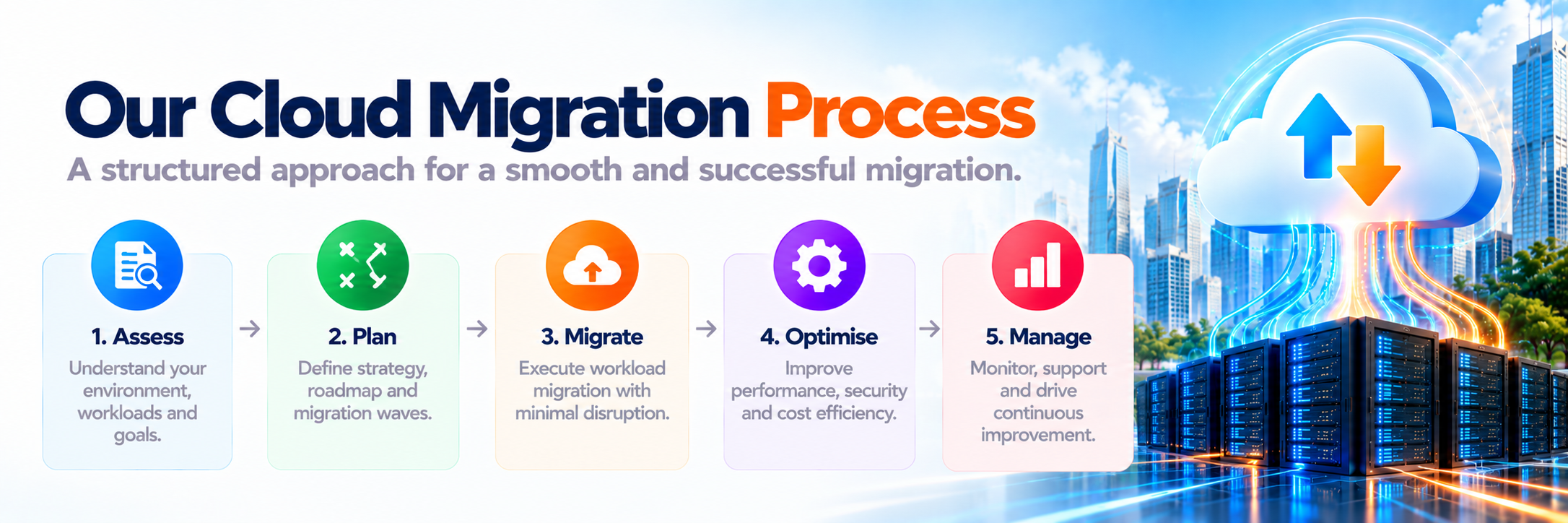
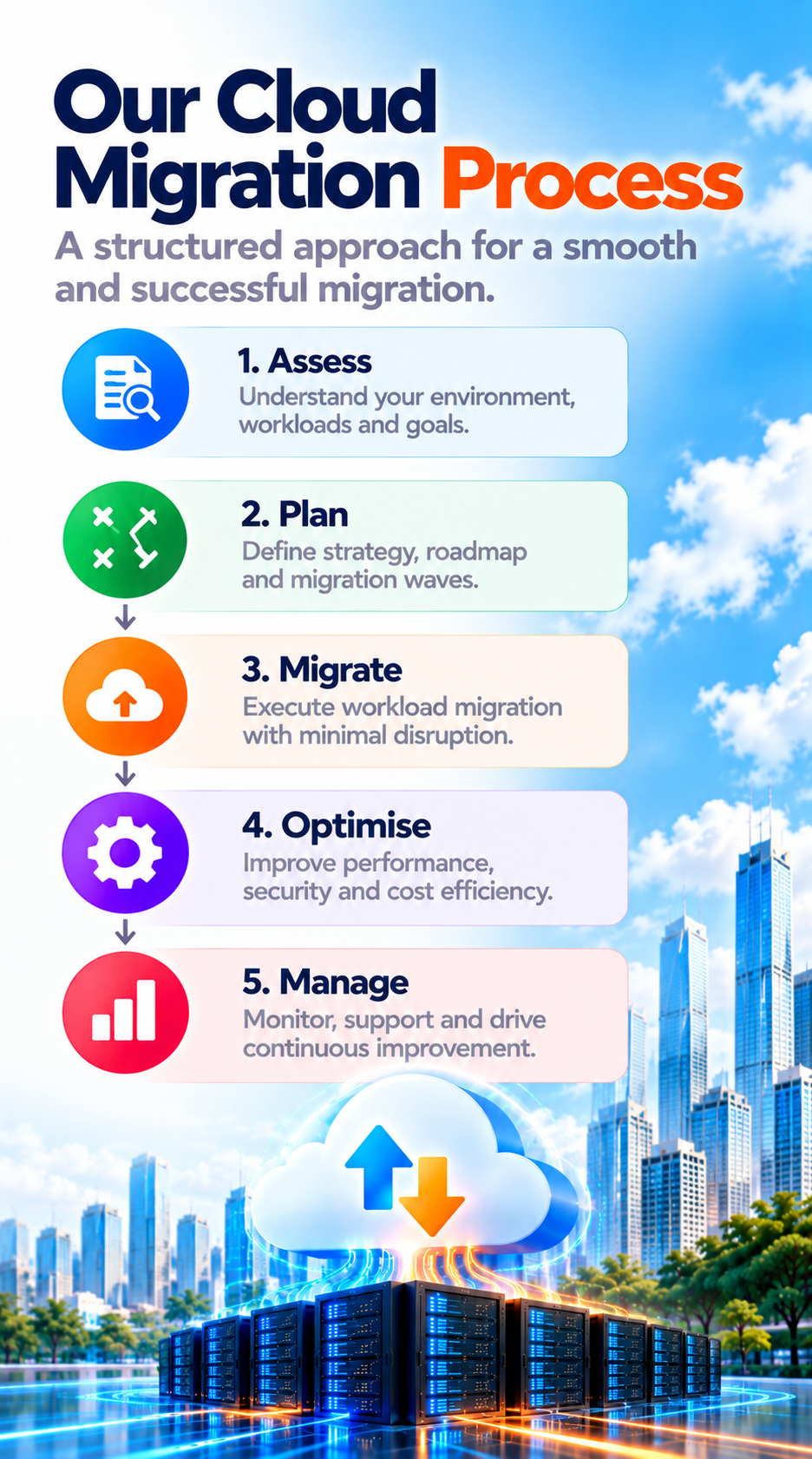 Ahom Technologies has managed cloud migrations for clients across healthcare, fintech, e-commerce, logistics, and SaaS – migrating production environments of varying complexity to AWS, Azure, and Google Cloud without the extended disruption that poorly planned migrations routinely produce.
Every Ahom cloud migration engagement follows the same structured lifecycle – but the decisions within that lifecycle are always specific to your workloads, your architecture, and your operational requirements.
Ahom Technologies has managed cloud migrations for clients across healthcare, fintech, e-commerce, logistics, and SaaS – migrating production environments of varying complexity to AWS, Azure, and Google Cloud without the extended disruption that poorly planned migrations routinely produce.
Every Ahom cloud migration engagement follows the same structured lifecycle – but the decisions within that lifecycle are always specific to your workloads, your architecture, and your operational requirements.
Phase 1 – Discovery and dependency mapping
Our team begins with a comprehensive discovery of your current environment – cataloguing every application, database, integration, and infrastructure component in scope. We map dependency relationships between workloads, assess cloud readiness for each component, and identify the risks that each migration wave will need to manage. This phase typically takes two to three weeks for mid-complexity environments and produces the dependency map and risk register that all subsequent planning is built on.Phase 2 – Migration strategy and platform selection
Based on the discovery outputs, our architects assign a migration strategy to each workload – rehost, replatform, refactor, repurchase, retire, or retain – and confirm the target cloud platform for each wave. Platform selection recommendations are documented with reasoning so your team understands the decisions rather than simply inheriting them. Where multiple platform options are genuinely viable, we present the trade-offs clearly and let your team make the informed choice.Phase 3 – Cloud environment setup
Before the first workload moves, the target cloud environment is fully provisioned through Infrastructure as Code – networking, security, identity, monitoring, and the managed services that migrating workloads will depend on. This phase runs in parallel with migration wave preparation so that the cloud environment is production-ready before it receives production workloads.Phase 4 – Migration execution, wave by wave
Workloads migrate in the sequence defined by the dependency map with each wave tested and validated before the next begins. Rollback procedures are prepared before each wave starts, not improvised when something goes wrong. Performance is validated against pre-migration baselines. Integration points are tested comprehensively before the migrated workload is promoted to production. And the on-premise environment is maintained in parallel until each migrated workload has been stable in production for a defined validation period.Phase 5 – Post-migration optimisation and support
After the migration is complete, Ahom provides post-migration optimisation – right-sizing cloud resources based on actual usage patterns, implementing cost monitoring and anomaly alerting, tuning auto-scaling configurations, and addressing any performance issues that emerge under real production load. Structured post-migration support covers ongoing cloud operations, security patch management, and the DevOps pipeline management that keeps the migrated environment running reliably. Our DevOps services in India team integrates directly with the post-migration environment – ensuring that the CI/CD pipelines, Infrastructure as Code practices, and monitoring frameworks that support ongoing development are in place from the day the migration completes rather than treated as a separate subsequent initiative. For businesses evaluating their overall DevOps company in India options alongside their migration requirements, Ahom provides a single accountable partner for both the migration and the ongoing DevOps practice that follows it – which eliminates the coordination overhead of managing separate migration and DevOps vendors.6. Industries Ahom Has Migrated to the Cloud
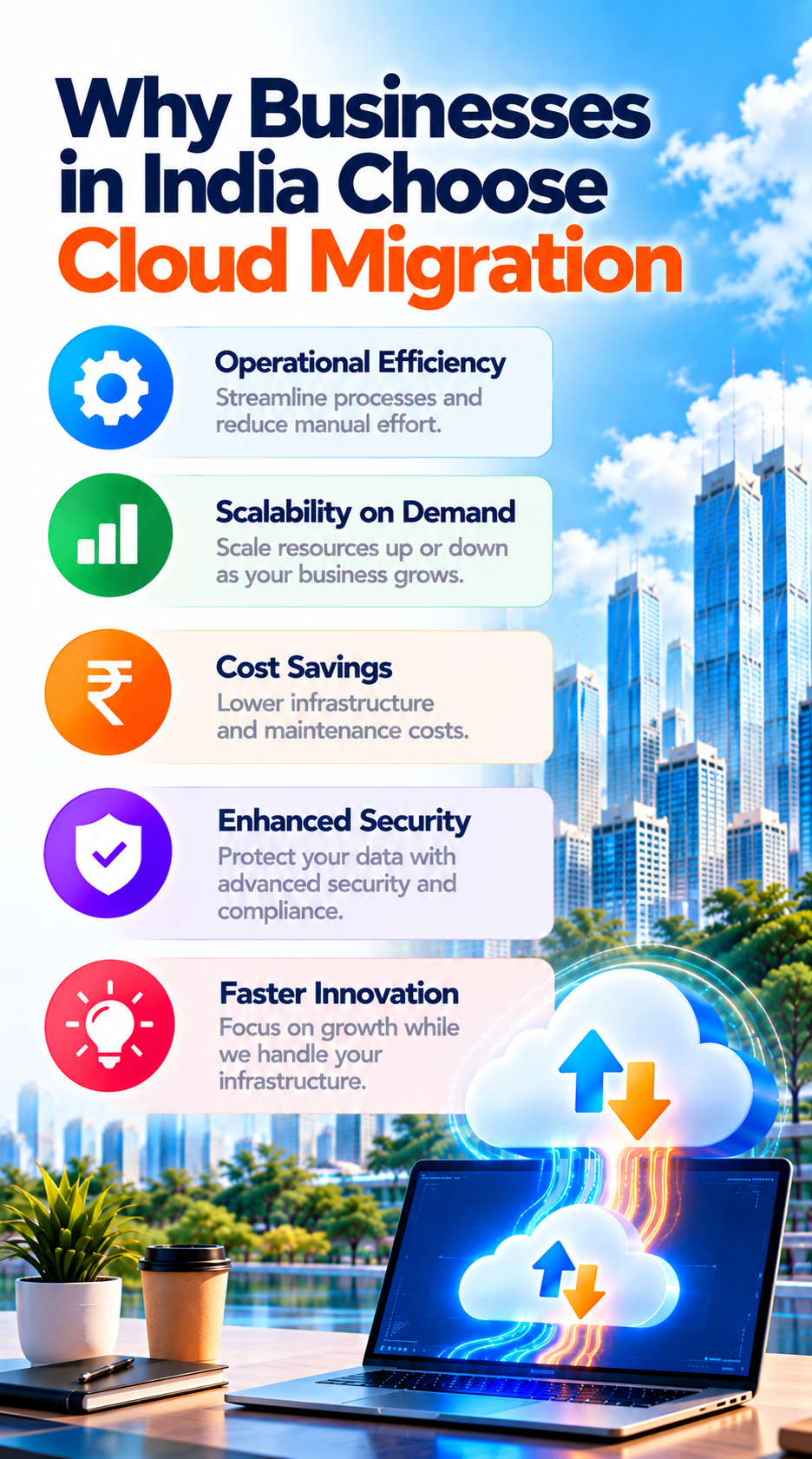
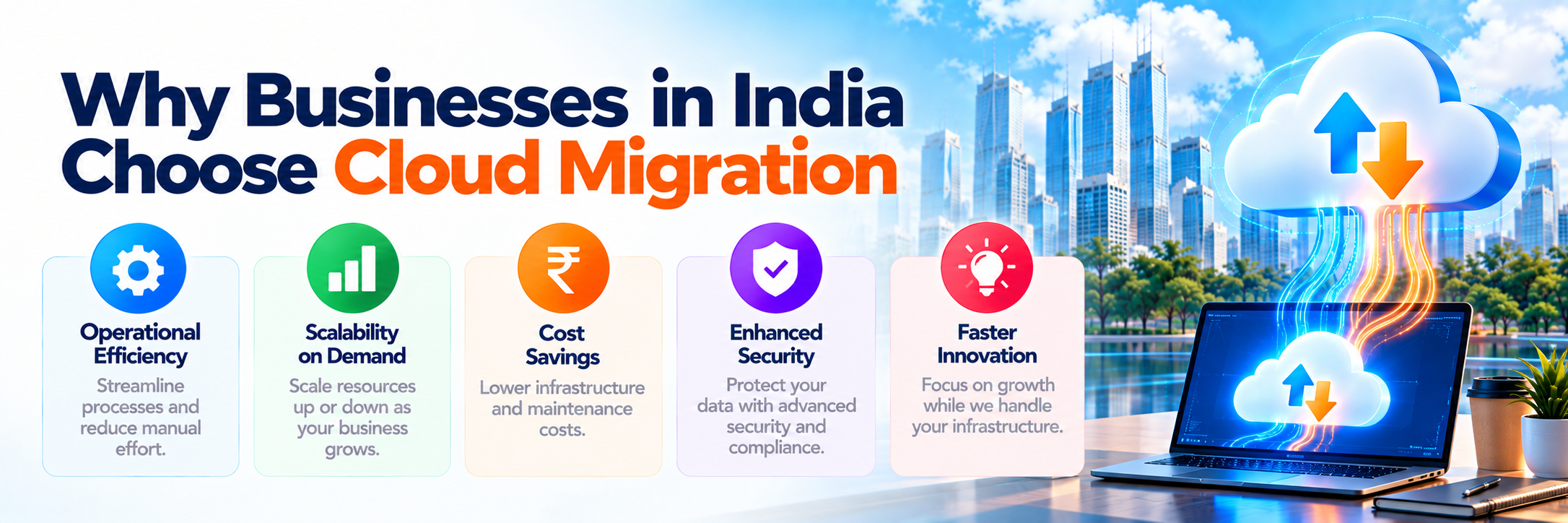 The technical demands of a cloud migration vary significantly by industry – and the domain experience a migration partner brings shapes the quality of every decision made on your programme.
Healthcare – Healthcare cloud migrations involve the most demanding compliance requirements – data residency, access control, audit logging, and encryption standards that vary by jurisdiction and data classification. Ahom has migrated healthcare environments to AWS and Azure with HIPAA-aligned security configurations, validated data encryption at rest and in transit, and the monitoring frameworks that clinical data environments require.
Fintech and Banking – Financial services cloud migrations require PCI DSS compliance for payment data environments, strict network segmentation, comprehensive audit trails, and the reliability engineering that financial applications demand. Ahom has migrated fintech environments with zero-downtime migration approaches, parallel running periods that maintain service continuity throughout the transition, and post-migration security reviews that validate compliance posture against regulatory requirements.
E-Commerce and Retail – E-commerce migrations must be timed around traffic patterns – migrating during low-traffic periods, with rollback procedures tested and ready, and performance validated under realistic load before the migrated environment receives production traffic. Ahom has migrated e-commerce platforms handling significant daily transaction volumes, with load testing before each migration wave and performance benchmarking that confirms the migrated environment meets or exceeds pre-migration performance baselines.
Logistics and Supply Chain – Logistics platforms often have the most complex integration landscapes – connecting to fleet management systems, warehouse management software, carrier APIs, and ERP systems that create a web of dependencies that must be carefully managed through the migration sequence. Ahom’s logistics migration experience covers this integration complexity with dependency mapping granular enough to identify the sequencing constraints that determine what can move when.
SaaS and Technology Companies – SaaS migrations frequently involve the additional complexity of migrating a multi-tenant application without disrupting any of the tenants that depend on it. Ahom has managed SaaS platform migrations with tenant-aware migration approaches, zero-downtime cutover strategies, and post-migration validation that confirms per-tenant data integrity across the migrated environment.
The technical demands of a cloud migration vary significantly by industry – and the domain experience a migration partner brings shapes the quality of every decision made on your programme.
Healthcare – Healthcare cloud migrations involve the most demanding compliance requirements – data residency, access control, audit logging, and encryption standards that vary by jurisdiction and data classification. Ahom has migrated healthcare environments to AWS and Azure with HIPAA-aligned security configurations, validated data encryption at rest and in transit, and the monitoring frameworks that clinical data environments require.
Fintech and Banking – Financial services cloud migrations require PCI DSS compliance for payment data environments, strict network segmentation, comprehensive audit trails, and the reliability engineering that financial applications demand. Ahom has migrated fintech environments with zero-downtime migration approaches, parallel running periods that maintain service continuity throughout the transition, and post-migration security reviews that validate compliance posture against regulatory requirements.
E-Commerce and Retail – E-commerce migrations must be timed around traffic patterns – migrating during low-traffic periods, with rollback procedures tested and ready, and performance validated under realistic load before the migrated environment receives production traffic. Ahom has migrated e-commerce platforms handling significant daily transaction volumes, with load testing before each migration wave and performance benchmarking that confirms the migrated environment meets or exceeds pre-migration performance baselines.
Logistics and Supply Chain – Logistics platforms often have the most complex integration landscapes – connecting to fleet management systems, warehouse management software, carrier APIs, and ERP systems that create a web of dependencies that must be carefully managed through the migration sequence. Ahom’s logistics migration experience covers this integration complexity with dependency mapping granular enough to identify the sequencing constraints that determine what can move when.
SaaS and Technology Companies – SaaS migrations frequently involve the additional complexity of migrating a multi-tenant application without disrupting any of the tenants that depend on it. Ahom has managed SaaS platform migrations with tenant-aware migration approaches, zero-downtime cutover strategies, and post-migration validation that confirms per-tenant data integrity across the migrated environment.