
QA Automation Services – Why Manual Testing Alone Is No Longer Enough and What to Do About It
There is a version of this problem that plays out in engineering teams all over the world. The application worked perfectly in the last release cycle. The manual testing team checked every feature they could think of. The deployment went smoothly. And three days after launch, users started finding bugs that nobody tested for – edge cases, integration failures, browser-specific rendering issues, regression problems introduced by a change that looked unrelated. Manual testing did not fail because the testers were incompetent. It failed because the application had grown complex enough that complete manual coverage was no longer realistic within the available time. Every software product reaches this point eventually. The teams that handle it well are the ones that built QA automation into their testing strategy before the complexity caught up with them. The teams that handle it badly are the ones still trying to close a growing coverage gap with more manual testers. This guide covers what QA automation services actually involve, where automation and manual testing each belong in a serious testing strategy, what the modern tool landscape looks like, and how Ahom Technologies approaches automation for clients who need testing that scales alongside their product.1. What Are QA Automation Services and What Problems Do They Solve?
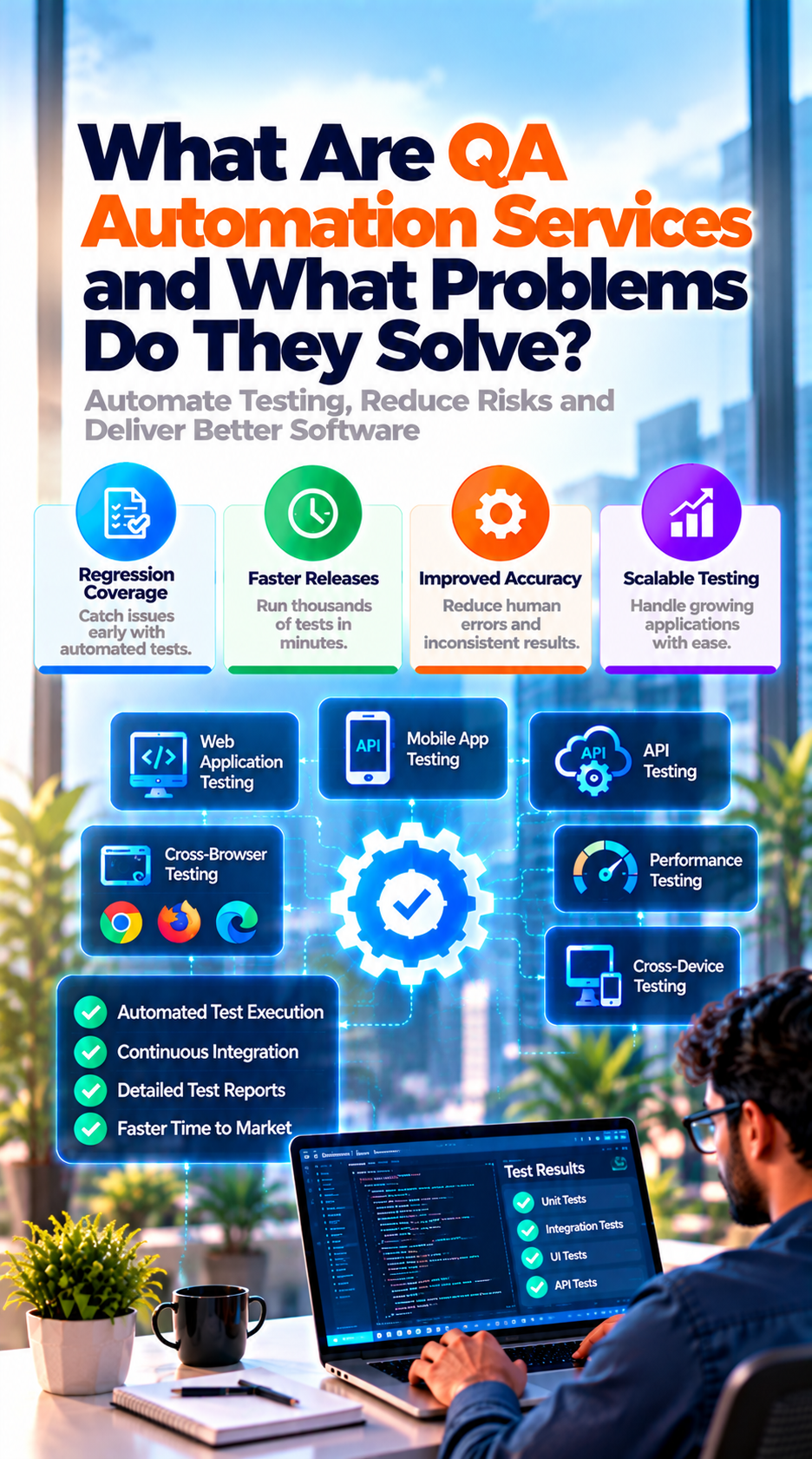
 QA automation services cover the design, implementation, and maintenance of automated testing frameworks – systems that execute predefined test scenarios automatically, without human intervention, at a speed and scale that manual testing simply cannot match.
When a developer commits code, an automated test suite can run thousands of tests across the application within minutes – checking that existing functionality still works, validating that the new change behaves as expected, catching integration failures between components, and flagging performance regressions before they reach a staging environment. This happens automatically, consistently, and without anyone having to manually step through the same test scenarios they ran last sprint and the sprint before that.
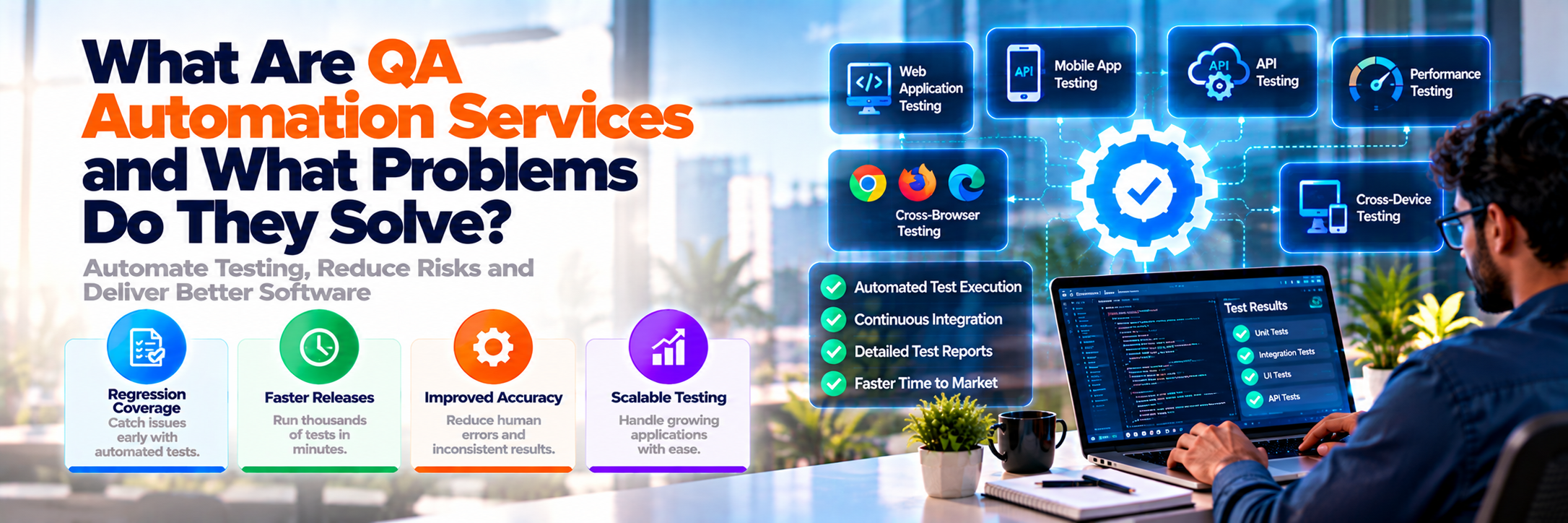
QA automation services cover the design, implementation, and maintenance of automated testing frameworks – systems that execute predefined test scenarios automatically, without human intervention, at a speed and scale that manual testing simply cannot match.
When a developer commits code, an automated test suite can run thousands of tests across the application within minutes – checking that existing functionality still works, validating that the new change behaves as expected, catching integration failures between components, and flagging performance regressions before they reach a staging environment. This happens automatically, consistently, and without anyone having to manually step through the same test scenarios they ran last sprint and the sprint before that.
The gap manual testing cannot close
Manual testing is a human activity – which means it is subject to human constraints. Testers get tired. Repetitive regression testing produces attention fatigue that causes testers to miss things they would catch on a fresh review. Testing time is finite – when a release cycle compresses, manual test coverage is the first thing that gets cut. And as an application grows in complexity, the number of test scenarios that need to be checked on every release grows faster than any manual team can realistically scale. The specific gap that QA automation services close is regression coverage – the confidence that every change to a codebase has not broken something that was working before. In a rapidly evolving product with weekly or bi-weekly releases, that confidence is impossible to maintain through manual testing alone at any meaningful level of coverage.What QA automation services actually automate
A well-implemented QA automation framework automates the repetitive, high-volume parts of the testing process – regression suites, smoke tests, API contract validation, performance benchmarks under defined load conditions, and cross-browser or cross-device compatibility checks. It does not attempt to automate everything – exploratory testing, usability evaluation, and the kind of creative edge-case hunting that experienced testers do instinctively remain human activities. The combination of automated coverage for the repeatable and manual coverage for the exploratory is what produces a testing strategy that is both comprehensive and efficient.2. Manual Testing vs QA Automation – Where Each One Belongs in a Modern Testing Strategy
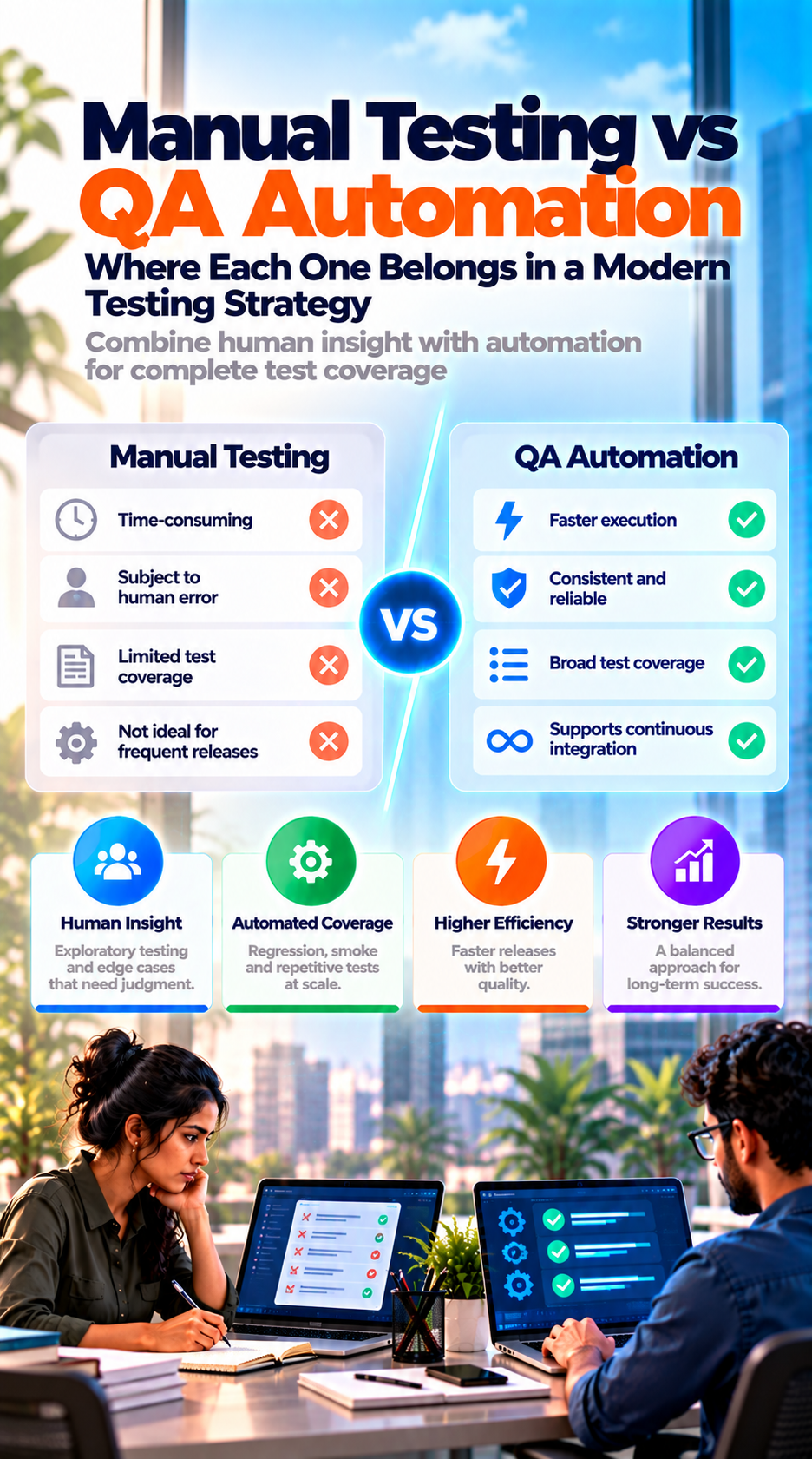
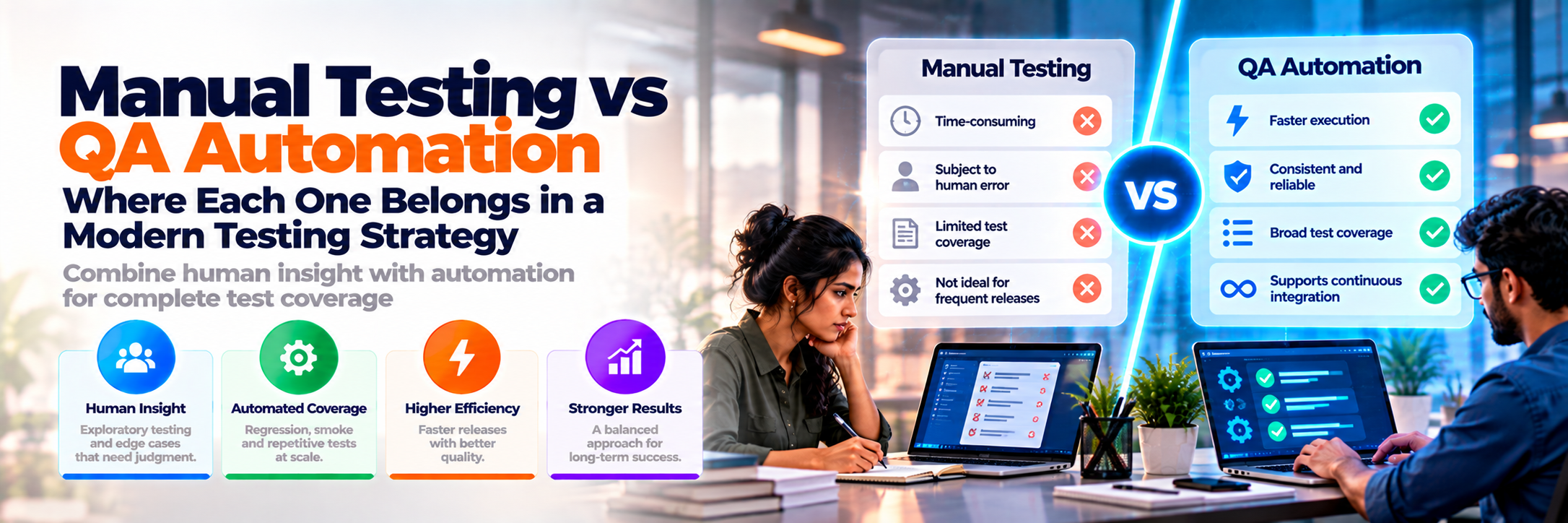 The most common mistake in testing strategy is treating manual testing and QA automation as alternatives rather than complements. They are not competing approaches. They are different tools that excel at different problems – and a serious testing strategy uses both deliberately rather than defaulting to one or the other.
Where manual testing still wins
Manual testing is irreplaceable for exploratory testing – where an experienced tester approaches the application without a predefined script, looking for unexpected behaviour, usability problems, and the kinds of edge cases that nobody thought to write a test case for. It is the right approach for evaluating user experience – whether the application feels intuitive, whether error messages are helpful, whether the visual design is rendering as intended across different screen sizes and devices. Manual testing is also the right choice for new features in early development – where the requirements are still evolving and the cost of maintaining an automated test suite for unstable functionality outweighs the benefit. Writing automation for features that change every sprint produces brittle tests that spend more engineering time being updated than they save in testing time.Where QA automation delivers what manual cannot
Automation is the right approach for regression testing – running the same scenarios on every build to confirm that existing functionality still works after every change. It is the right approach for load and performance testing – generating realistic concurrent user load that no manual team could simulate. It is the right approach for API testing – validating contract compliance and response behaviour across dozens of endpoints simultaneously. And it is the right approach for cross-browser and cross-device compatibility testing – running the same scenarios across multiple browser and device configurations in parallel rather than sequentially.The testing pyramid – how the two work together
The testing pyramid is the framework that most mature engineering teams use to think about test coverage distribution. At the base of the pyramid sit unit tests – fast, numerous, automated, testing individual functions and components in isolation. In the middle sit integration tests automated tests that validate how components interact with each other. At the top sit end-to-end tests – fewer in number, slower to execute, validating complete user journeys through the application. Manual exploratory testing sits outside the pyramid – not replacing any layer but covering the space that structured test cases cannot reach. A QA automation framework that is well-designed covers all three layers of the pyramid with the right balance a large number of fast unit tests, a meaningful set of integration tests, and a focused set of critical-path end-to-end tests – rather than attempting to automate every possible scenario at the most expensive level of the pyramid.3. The QA Automation Tools That Define Professional Testing
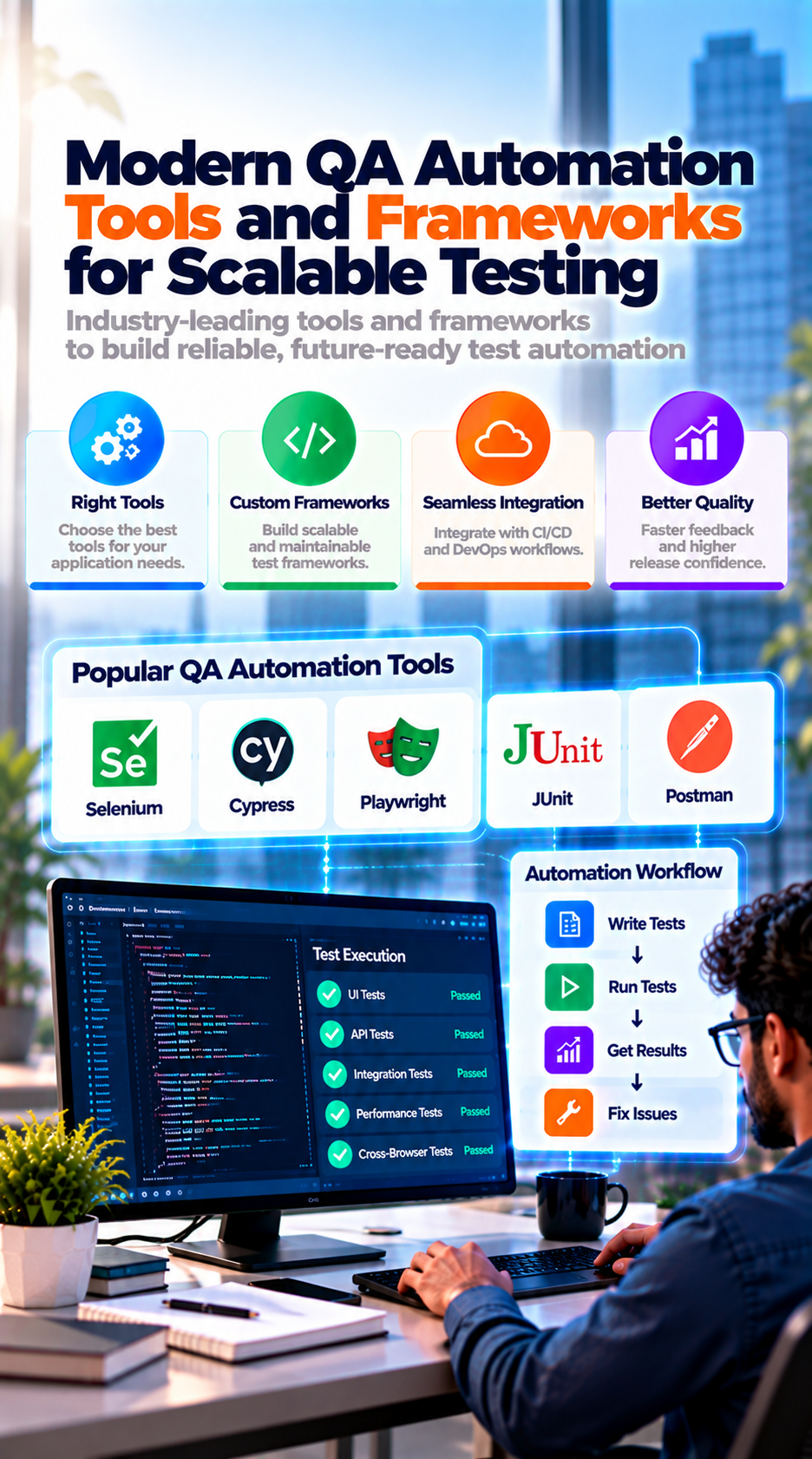
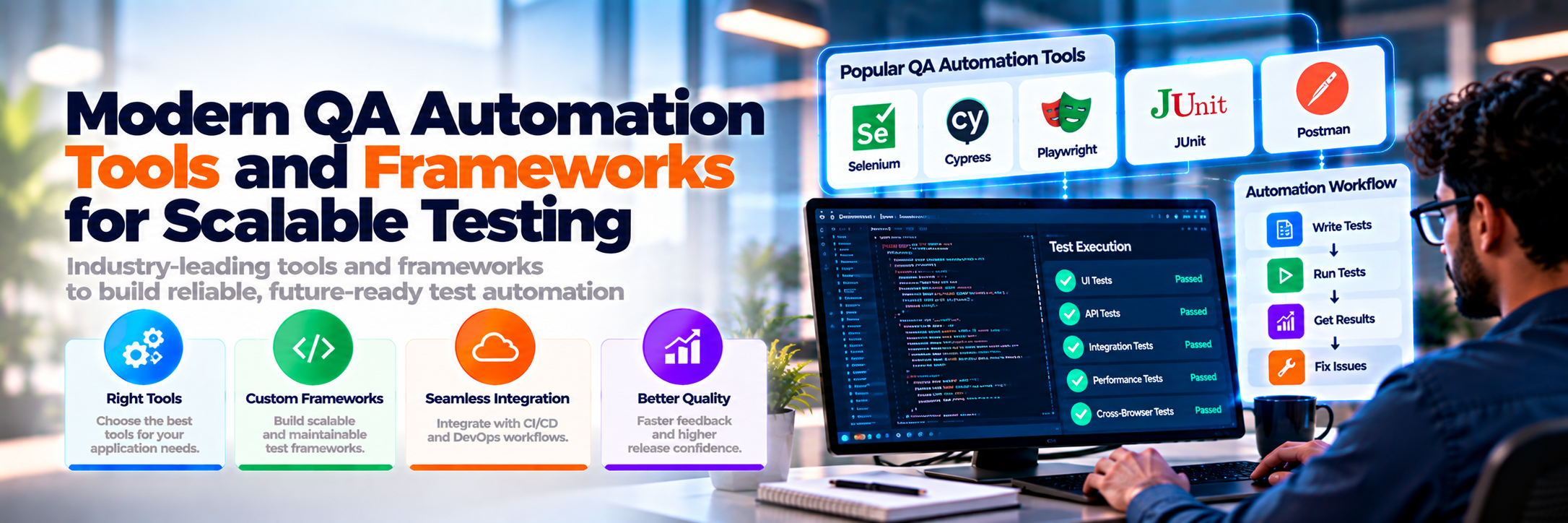 The QA automation tool landscape has matured significantly over the past five years. Understanding what the current professional standard looks like helps you evaluate whether a QA automation services provider is working with current, production-grade tooling or with legacy approaches that produce more maintenance overhead than testing value.
Selenium and Playwright for web application testing
Selenium has been the industry standard for browser automation for over fifteen years – and remains widely used because of its broad browser support, large community, and extensive integration ecosystem. For new automation projects, Playwright has increasingly become the preferred choice – offering faster execution, better async handling, more reliable element selection, and built-in support for multiple browsers including Chromium, Firefox, and WebKit within a single framework. Ahom’s QA automation engineers work with both – recommending Playwright for new automation builds and supporting existing Selenium frameworks for clients with established test suites.Appium for mobile application testing
Appium is the standard framework for mobile application test automation – supporting both Android and iOS applications through a single API, using the same WebDriver protocol that Selenium uses for web automation. For clients with mobile applications that require automated regression coverage, Appium provides the cross-platform automation capability that testing both Android and iOS natively would require two separate frameworks to achieve.Jest and Cypress for frontend component testing
Jest is the most widely used JavaScript unit testing framework – used by React, Angular, and Vue teams for component-level testing that runs fast and provides immediate feedback during development. Cypress has become the preferred choice for end-to-end testing of React and JavaScript-heavy web applications – with a developer-friendly API, excellent debugging tools, and a real browser execution environment that makes tests more reliable and failures easier to diagnose than Selenium-based alternatives for frontend-heavy applications.JMeter and Gatling for performance and load testing
Apache JMeter is the most widely used open-source load testing tool – capable of simulating large numbers of concurrent users against web applications, REST APIs, and database connections. Gatling provides similar capabilities with a code-based test definition approach that integrates more naturally into CI/CD pipelines and version control than JMeter’s XML-based configuration. For clients who need to validate application performance under realistic load conditions – particularly e-commerce platforms before sale events, SaaS applications before major customer launches, and healthcare platforms before clinical go-live – load testing with these tools provides the performance evidence that deployment confidence requires.4. How to Build a QA Automation Framework That Actually Works at Scale
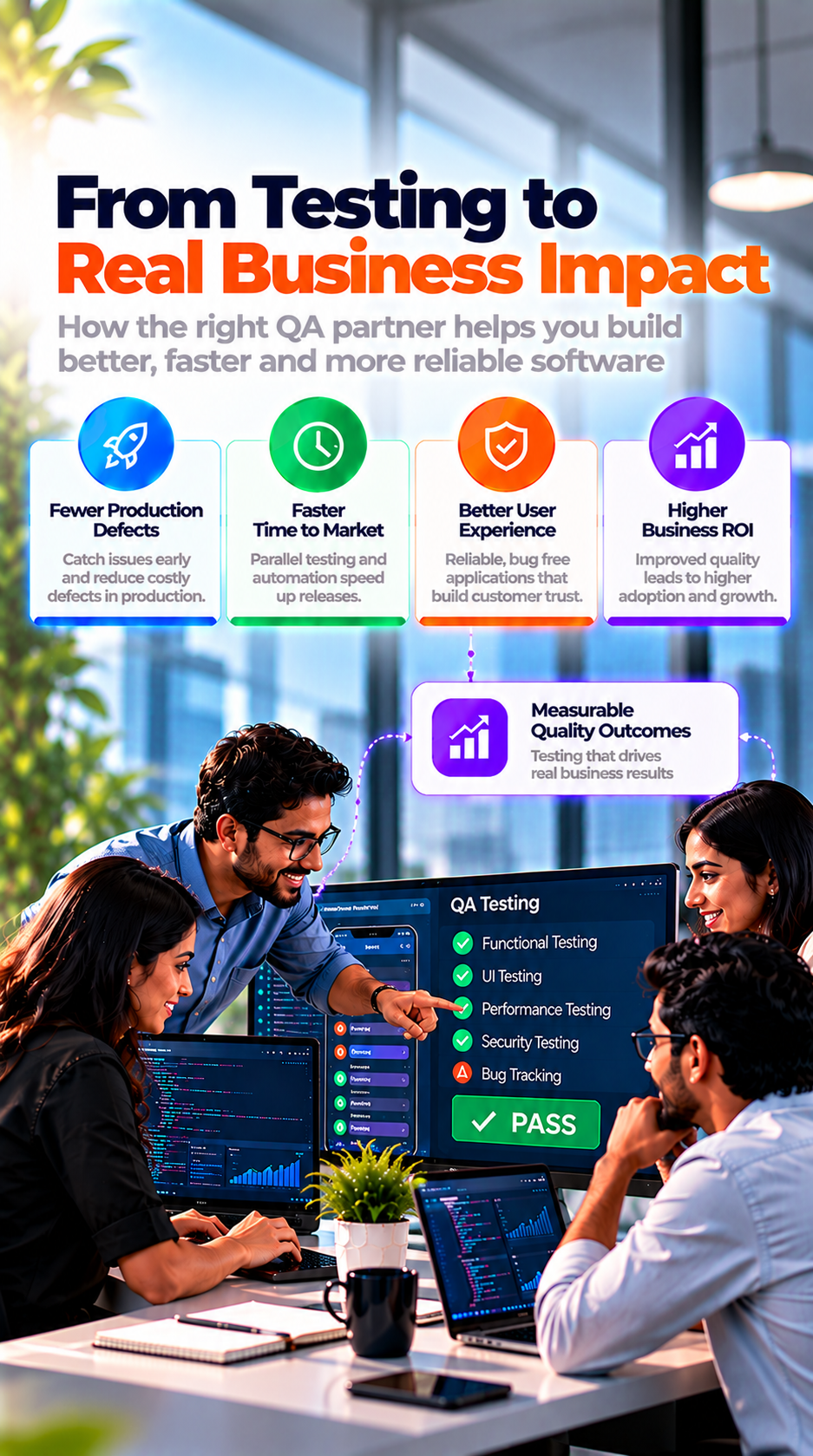
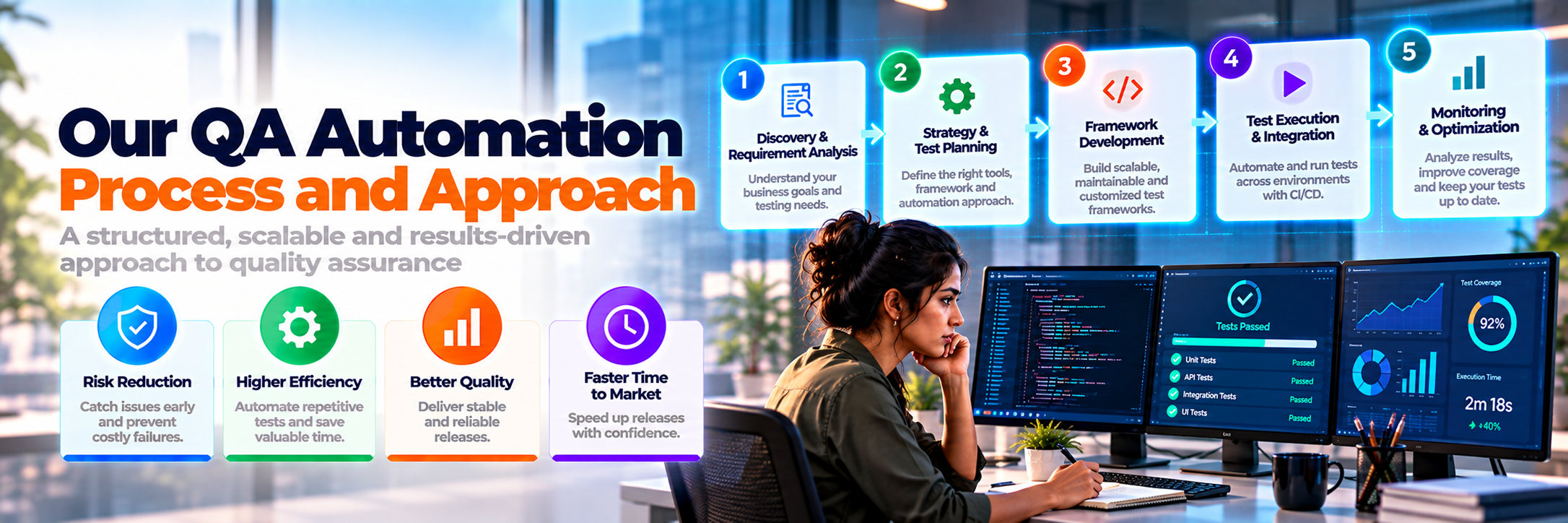 Most QA automation frameworks start well and gradually become liabilities. Tests that were reliable when the application was small become flaky as the application grows. The test suite that ran in five minutes starts taking forty-five. Maintenance overhead accumulates until the engineering team spends more time fixing broken tests than writing new ones. Understanding what separates frameworks that scale from those that do not is as important as understanding the tooling itself.
Start with the right test coverage strategy
The most common mistake in QA automation framework design is starting with the tools rather than the strategy. Before selecting a framework or writing a single test, the right questions are: what are the highest-risk areas of the application the features where a regression would cause the most damage? What user journeys are critical enough that they must work on every release? Where does the existing manual testing process spend the most time on repetitive scenarios that could be automated? The answers to these questions define the automation coverage priorities – which tests are worth automating first because the return is highest, and which tests should remain manual because the cost of automating them exceeds the benefit. A QA automation framework built on clear coverage priorities produces a test suite that gives genuine confidence. One built by automating whatever is easiest to automate produces a test suite that covers the low-risk areas thoroughly and the high-risk areas not at all.Design for maintainability, not just speed
The Page Object Model – a design pattern that abstracts application UI elements into reusable objects rather than embedding element locators directly in test scripts – is the single most important maintainability practice in web application test automation. When an application’s UI changes, updating element locators in one page object propagates the change to every test that uses it rather than requiring manual updates across dozens of individual test files. This pattern sounds like overhead in the early stages of a framework. It becomes the difference between a framework that survives the application’s first major UI redesign and one that needs to be rebuilt from scratch.Integrate automation into your CI/CD pipeline
A QA automation framework that runs on demand in a separate environment produces a different kind of value from one that runs automatically on every commit in the CI/CD pipeline. The on-demand framework provides periodic assurance. The CI/CD-integrated framework provides continuous feedback – catching regressions within minutes of the commit that introduced them rather than at the next scheduled test run. Ahom’s QA automation services always include CI/CD integration as a standard component – because automation that does not run continuously does not provide the continuous confidence that makes deployment safe at modern release frequencies.5. How Ahom Technologies Delivers QA Automation Services for Global Clients
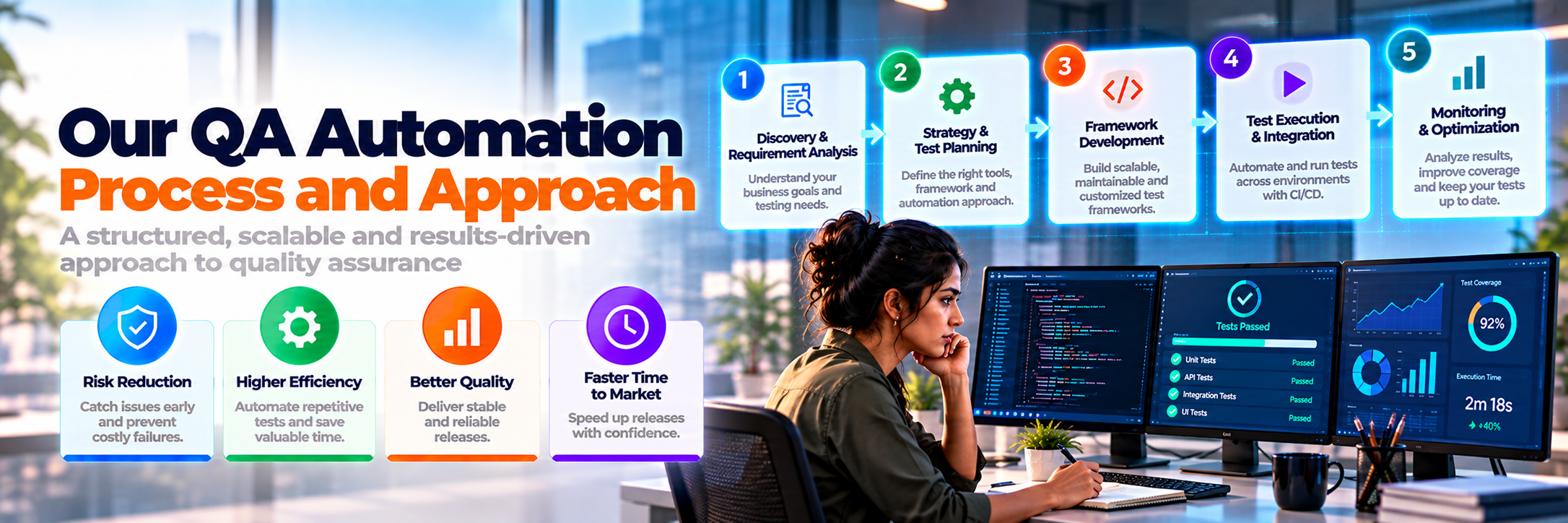
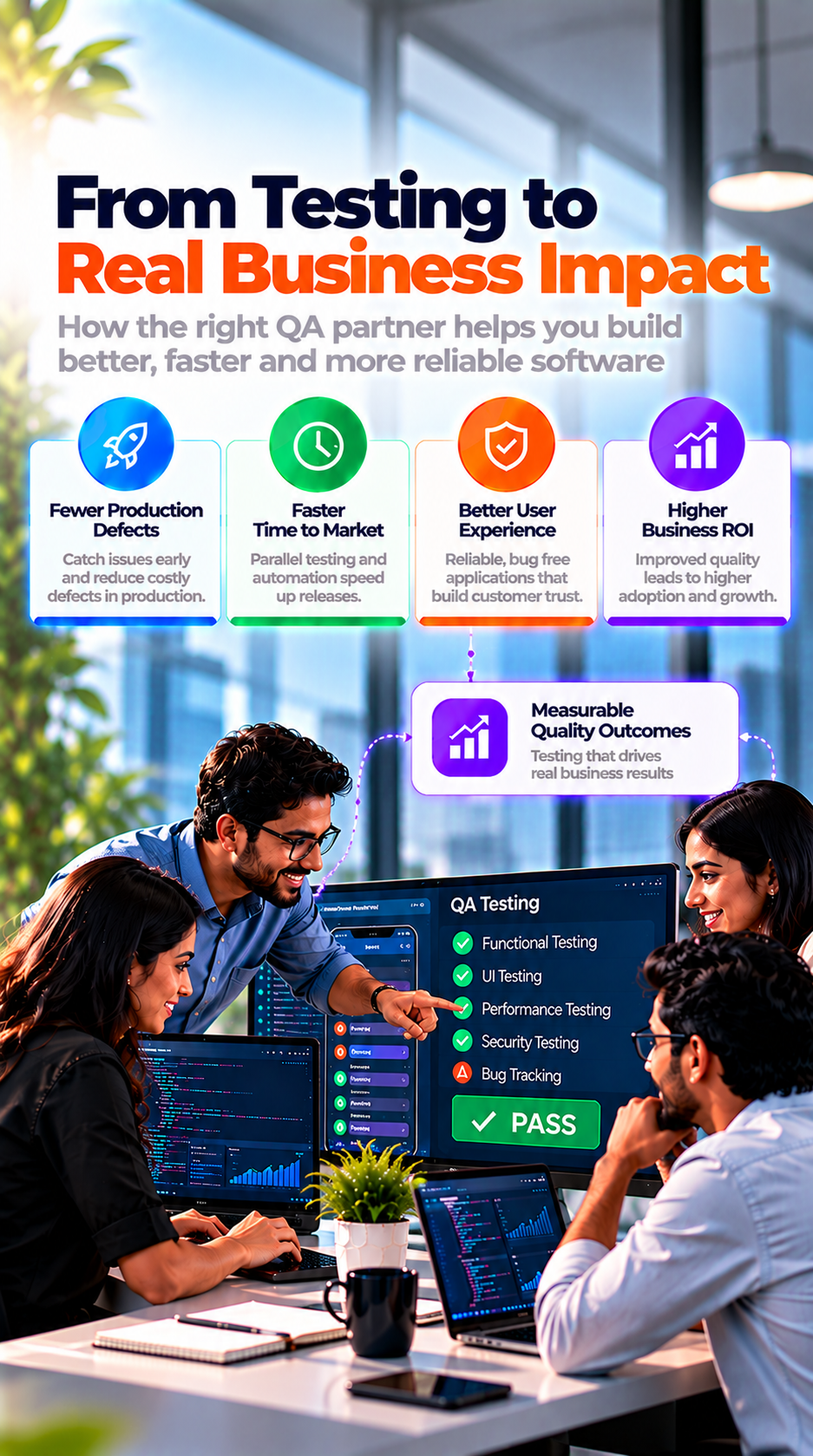
Ahom Technologies has been delivering QA automation services for clients across India, the USA, UK, UAE, and Canada for over a decade. Our QA automation practice has been shaped by the accumulated experience of real production environments – applications that needed to maintain testing coverage while releasing weekly, platforms that needed load testing validated before high-stakes go-live events, and legacy systems that needed automation retrofitted around codebases that were not originally designed with testing in mind.
Discovery and test strategy design
Every Ahom QA automation engagement begins with a structured discovery phase. Our senior QA engineers work with your team to understand your application architecture, your current testing process, your release cadence, your highest-risk functionality, and the specific coverage gaps that automation needs to close. This discovery produces a test strategy document – defining coverage priorities, tool selection with rationale, framework architecture decisions, and the CI/CD integration approach – that is reviewed and approved before any automation code is written.
Framework selection and implementation
Framework selection at Ahom is based on your application architecture and your team’s existing technical context – not on a preferred vendor relationship or a single-stack specialisation. We recommend Playwright for new web automation projects, Appium for mobile, Jest and Cypress for JavaScript-heavy frontends, and JMeter or Gatling for performance testing – but those recommendations are always contextual rather than prescriptive. The framework we implement is the one that will work best for your specific application and team, not the one our engineers are most comfortable with.
Implementation follows the Page Object Model or equivalent abstraction pattern as standard – ensuring the framework is maintainable as the application evolves. Test data management, reporting configuration, and parallel execution setup are all part of the implementation scope rather than afterthoughts added later. And the CI/CD integration – connecting the automation suite to your existing pipeline so tests run automatically on every commit – is delivered as part of the core engagement, not as a separate subsequent project.
CI/CD integration and ongoing maintenance
After the initial framework is implemented, Ahom provides structured ongoing maintenance – covering test suite updates as the application evolves, flaky test investigation and resolution, coverage expansion as new features are added, and performance optimisation as the test suite grows. Our software testing services cover the complete QA lifecycle – from the initial automation framework build through to the long-term maintenance that keeps it delivering value as the application around it changes.
For organisations evaluating their broader automation services requirements – including DevOps automation, infrastructure automation, and workflow automation alongside QA – Ahom provides a single partner across all of these disciplines rather than a fragmented set of specialist vendors.
Our DevOps services team integrates directly with QA automation engagements – ensuring that the CI/CD pipelines that run automated tests are designed alongside the automation framework rather than as a separate concern, which is one of the most common sources of integration friction in QA automation projects. And for organisations building or scaling software development teams through offshore software development, QA automation capability is available as part of the same engagement model rather than requiring a separate vendor relationship.