Android Software Development Company in India – Building Enterprise-Grade Applications with Ahom Technologies
There is a meaningful difference between building an Android app and building Android software. An app solves a user need. Software — enterprise-grade, scalable, secure Android software — solves a business problem at depth. It integrates with existing systems, handles complex data workflows, operates reliably under heavy load, and continues performing as the business around it grows.
Finding an android software development company capable of delivering at that level is a different challenge from finding someone to build a straightforward consumer application. The technical demands are higher, the architecture decisions carry longer consequences, and the margin for error is smaller.
This guide is for organisations that understand that distinction and are looking for a development partner who understands it too. It covers what genuine enterprise Android software development involves, how to evaluate companies properly, and how Ahom Technologies approaches complex Android software engagements.
1. What Separates an Android Software Development Company from a Basic App Builder
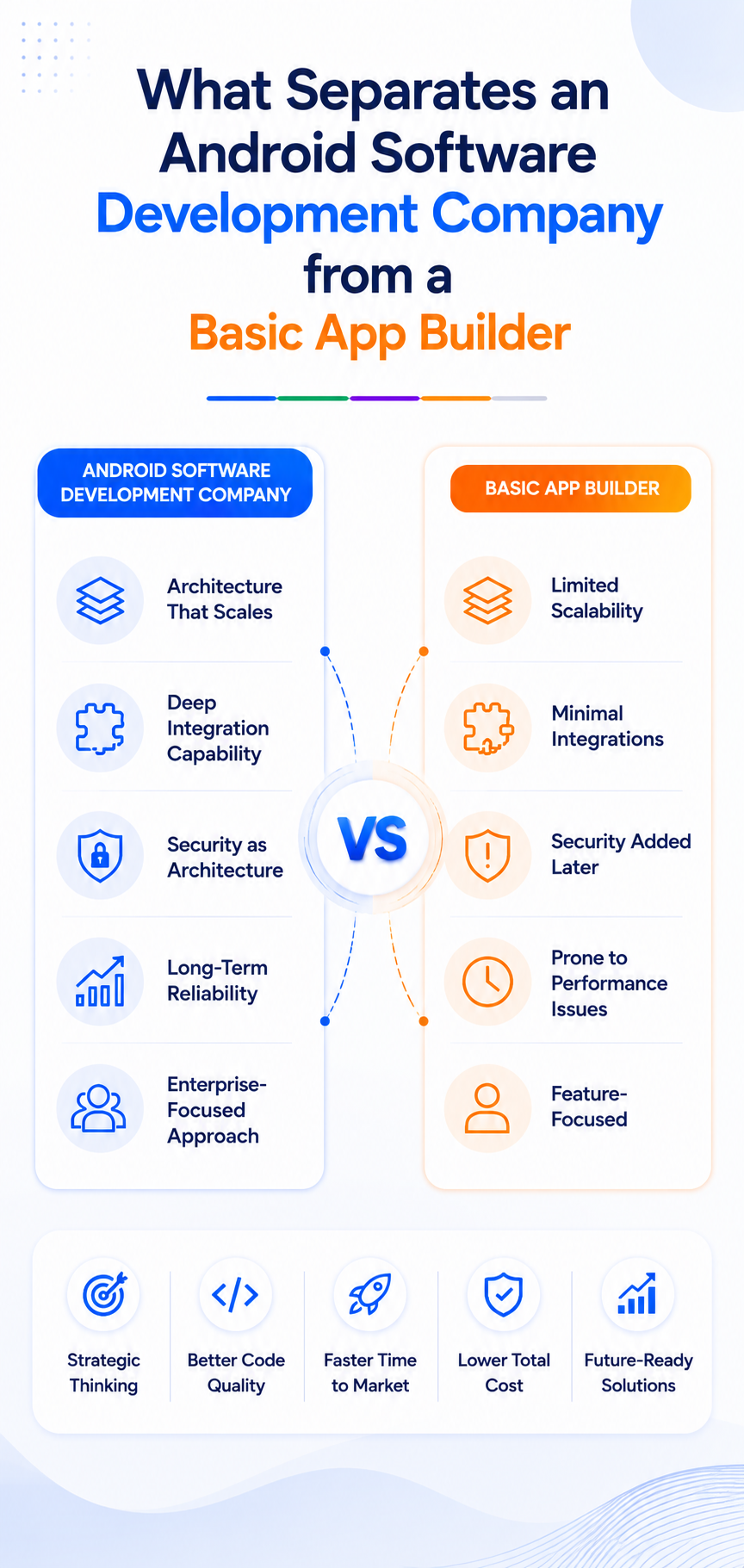
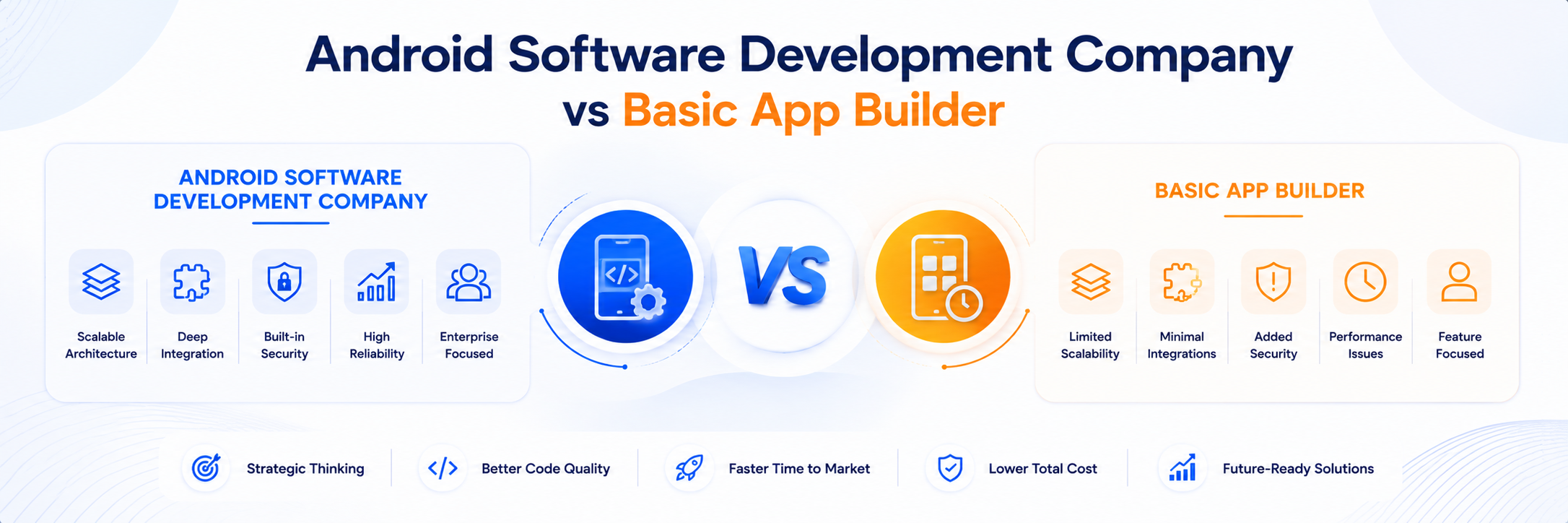
The distinction matters practically, not just semantically. A company that builds consumer-facing apps and a company that builds enterprise Android software are operating at different levels of technical complexity — and choosing the wrong one for your project has real consequences.
Architecture that scales
Enterprise Android software needs to be architected for growth from the beginning. That means modular codebases where individual features can be developed, tested, and deployed independently. It means MVVM or Clean Architecture principles that keep business logic separate from UI concerns and make the codebase testable and maintainable over years, not just months. It means thinking about how the application will behave when your user base doubles or triples — before you have that problem, not after.
A basic app builder may produce something that works today. A serious android software development company produces something that still works well two years from now when the requirements have evolved and the load has increased.
Deep integration capability
Enterprise Android software rarely operates in isolation. It connects to ERP systems, CRM platforms, payment gateways, cloud infrastructure, third-party APIs, IoT devices, and internal databases. Building those integrations reliably — with proper authentication, error handling, data synchronisation, and security — requires a level of backend and systems engineering that goes well beyond basic mobile development.
Security as architecture, not an afterthought
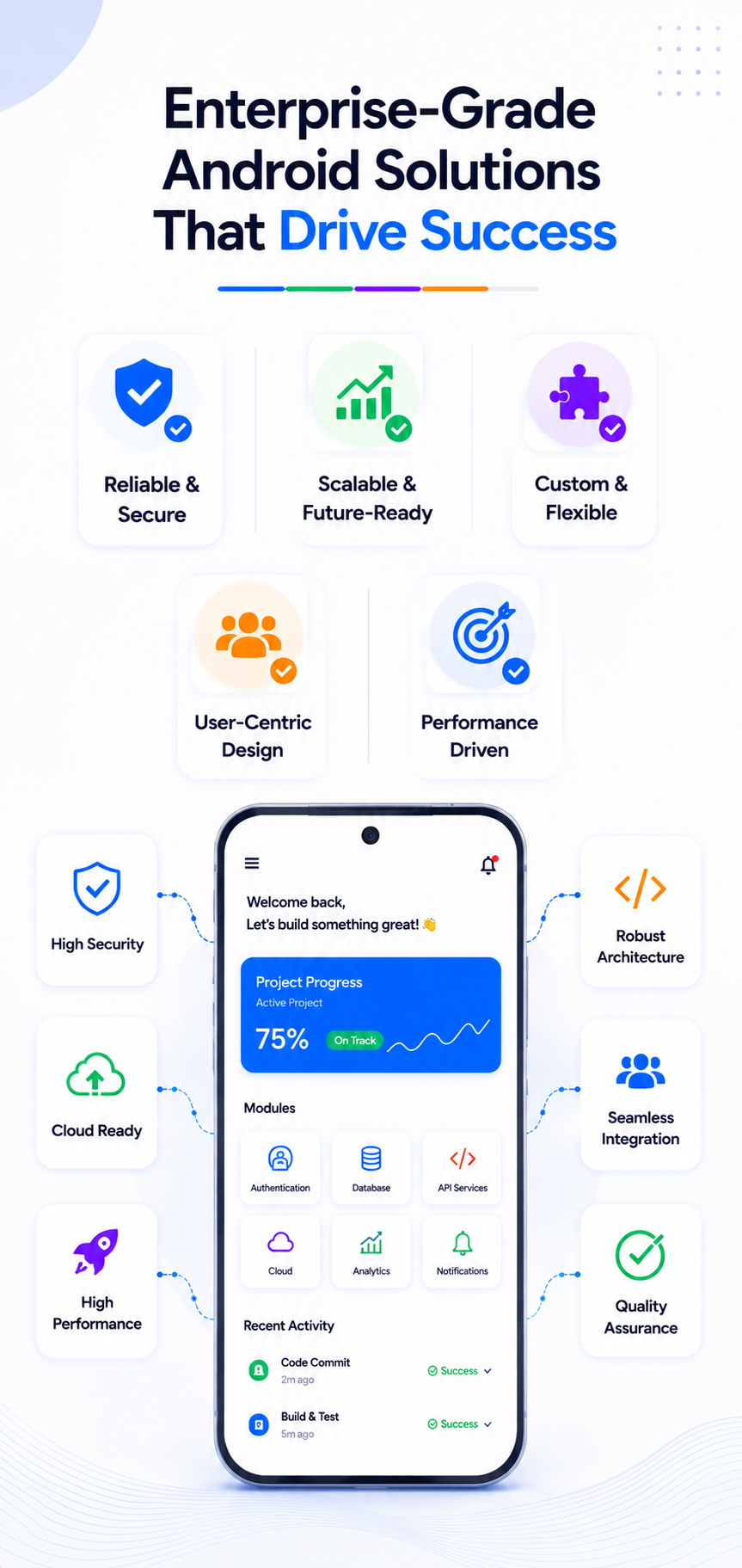
Consumer apps can sometimes recover from security oversights. Enterprise software cannot. An android software development company working at the enterprise level embeds security into the architecture from the first line of code — encrypted data storage, secure API communication, proper authentication and authorisation frameworks, and compliance with relevant data protection regulations. This is not a feature added at the end. It is a design principle applied throughout.
2. The Technical Foundations of Enterprise Android Software
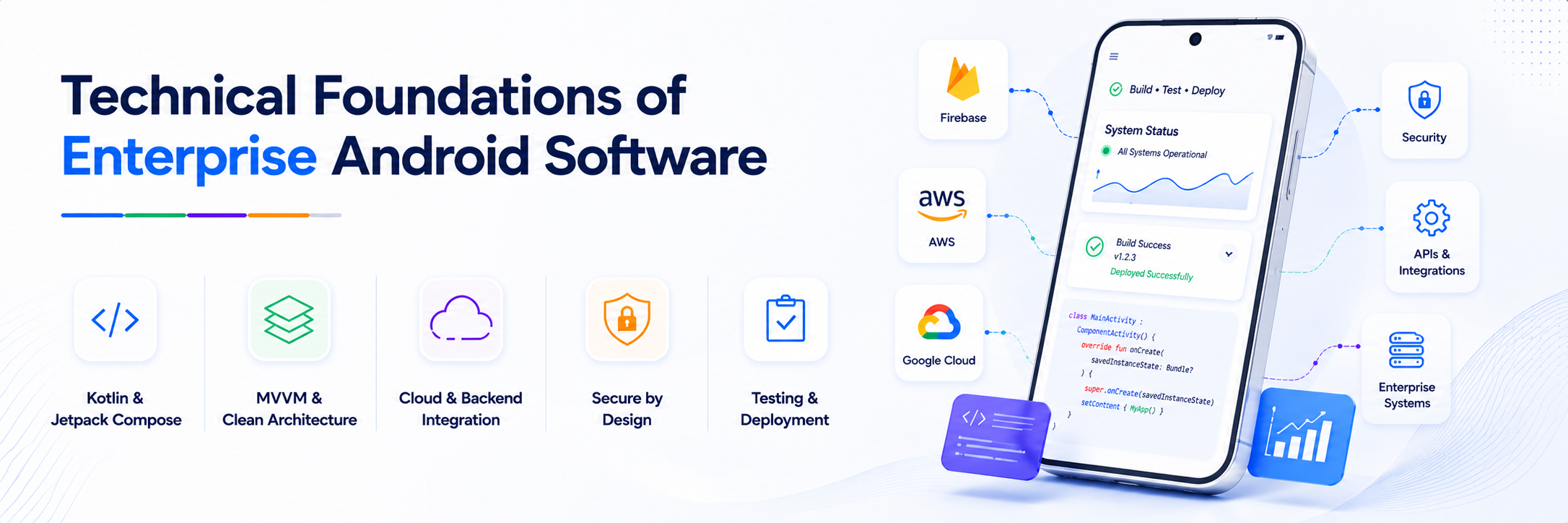
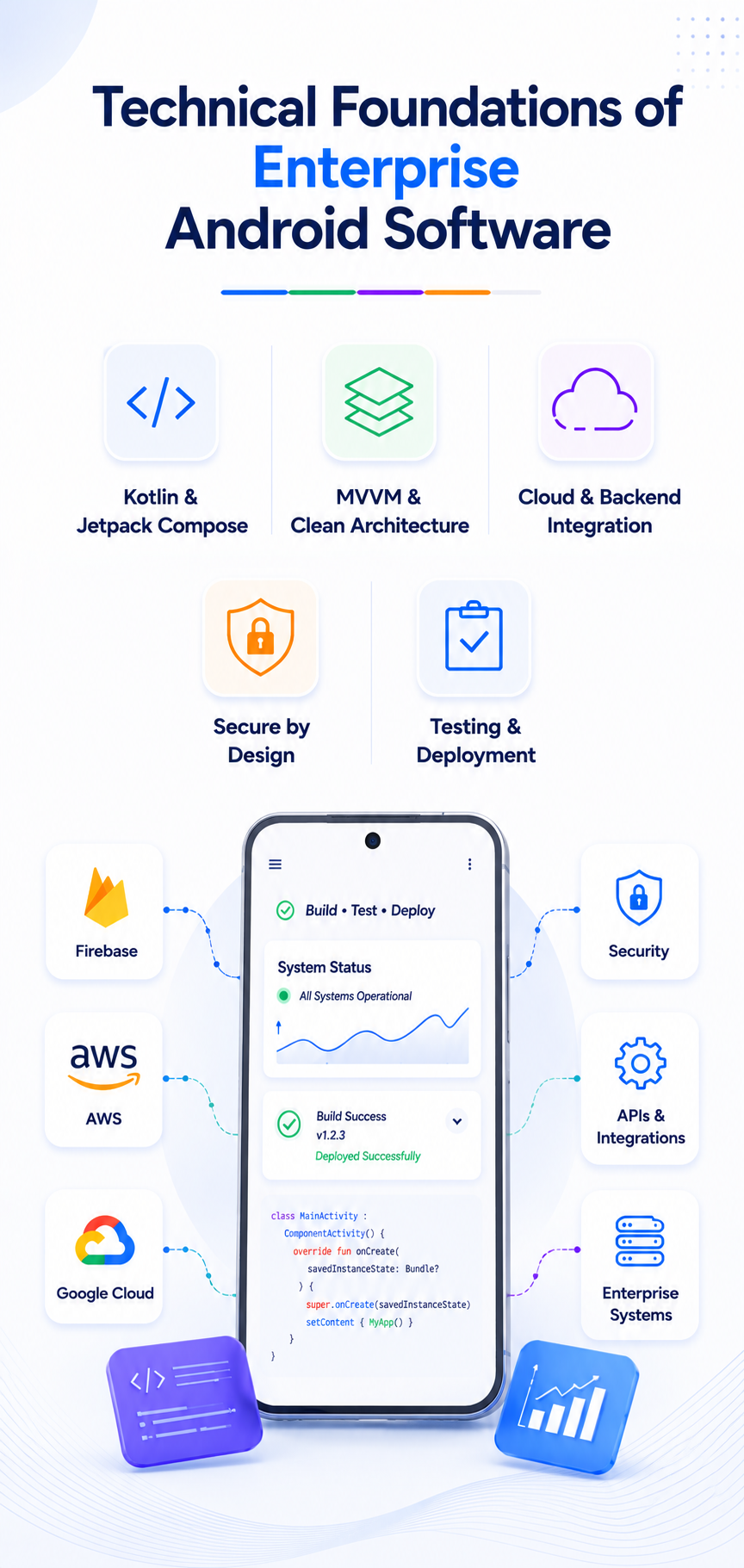
Understanding the specific technologies that define quality enterprise Android development helps you evaluate whether a company you are considering is genuinely equipped for the work.
Core development language and UI framework
Kotlin is Google’s officially recommended language for Android development — concise, safe, and fully interoperable with existing Java codebases where legacy systems require it. For UI, Jetpack Compose represents the current state of the art: a declarative UI toolkit that produces cleaner, faster, and more maintainable interfaces than the older XML-based View approach. At Ahom Technologies, both are standard on every new Android project we take on.
Architecture patterns that matter
MVVM — Model-View-ViewModel — is the architectural pattern that Google recommends for Android applications and that Ahom applies as standard. It cleanly separates UI rendering from business logic, making applications easier to test, easier to maintain, and easier to extend. For larger enterprise projects, Clean Architecture principles are layered on top — creating clear separation between the application’s core domain logic and its infrastructure dependencies.
Backend, cloud, and integration
Enterprise Android software typically requires a robust backend. Ahom builds on Firebase, AWS, and Google Cloud depending on project requirements — using each platform for what it does best. API design follows RESTful and GraphQL approaches, with proper versioning and documentation so integrations remain maintainable over time. Where enterprise system integration is required — ERP, CRM, IoT platforms — our team has the systems engineering experience to build those connections reliably.
Testing and deployment infrastructure
Automated testing is not optional for enterprise software. Ahom uses JUnit and Espresso for unit and UI testing, Mockito for dependency mocking, and maintains comprehensive test coverage across all critical application paths. CI/CD pipelines automate the build, test, and deployment process — ensuring that every release goes through the same rigorous validation regardless of how fast the development team is moving.
These are the specific technologies that define what serious Android development looks like in 2025, and they are what Ahom brings to every software engagement as standard.
3. How to Evaluate an Android Software Development Company Properly
The evaluation process for an android software development company should be more rigorous than it would be for a simple app project. The stakes are higher, the technical complexity is greater, and the consequences of choosing poorly are more significant.
Look for enterprise-relevant case studies
Consumer app portfolios do not demonstrate enterprise software capability. Ask specifically for case studies involving system integrations, high-volume data handling, security-sensitive applications, or complex backend architectures. A company with genuine enterprise experience will have examples that reflect those challenges — and will be able to talk about the specific technical decisions they made and why.
Assess their architecture conversations
How a company talks about architecture in early conversations reveals a great deal about their technical depth. Do they ask about your scalability requirements before recommending a stack? Do they raise security considerations unprompted? Do they discuss data modelling and API design as part of the scoping conversation? Companies that lead with “we’ll build it in Kotlin with Firebase” without understanding your requirements first are not thinking at the right level for enterprise work.
Verify their integration experience concretely
Ask directly: which enterprise systems have you integrated Android software with? What authentication frameworks have you implemented? How do you handle data synchronisation between mobile and backend in low-connectivity environments? The answers to these specific questions will quickly separate companies with genuine enterprise experience from those extrapolating from consumer app work.
Confirm IP ownership and NDA as standard
For enterprise software — which often encodes proprietary business logic, sensitive operational data, and competitive advantage — IP protection is non-negotiable. Full ownership of all source code and intellectual property should transfer to you upon project completion, stated explicitly in the project agreement. Ahom Technologies signs a comprehensive NDA before any project discussions begin and transfers 100% IP to every client as a standard term.
For organisations also evaluating iOS app development alongside Android, finding a company with genuine capability across both platforms removes the coordination complexity of managing two separate development partners.

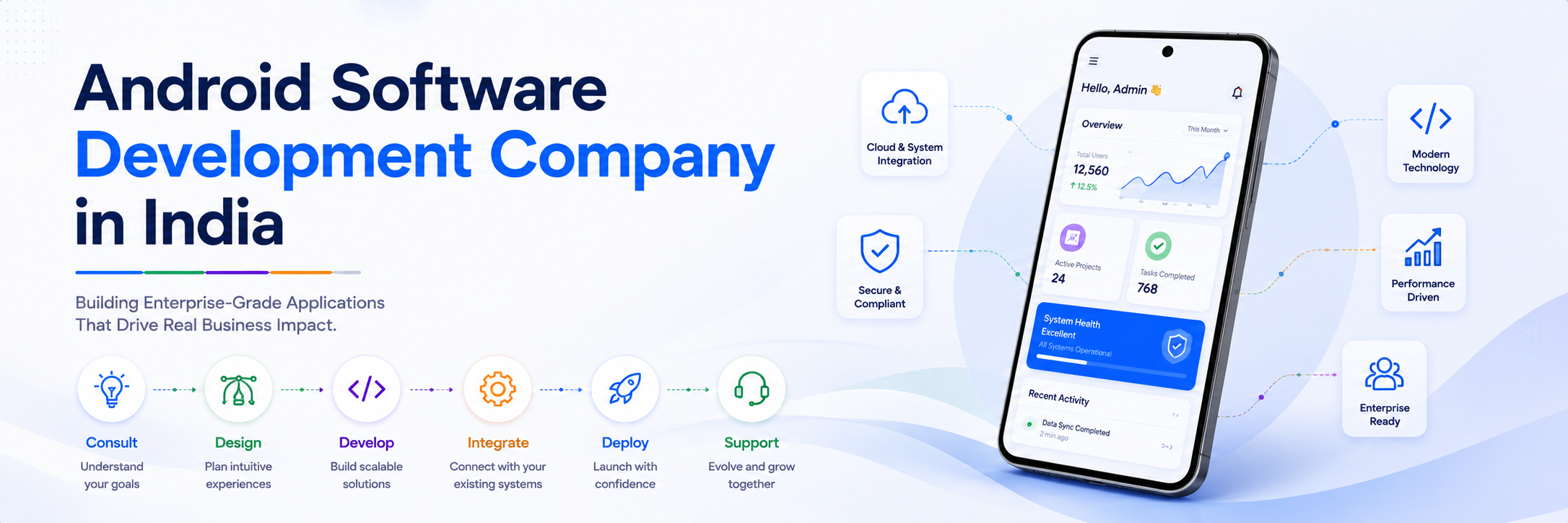
 Ahom Technologies has spent over a decade building Android software for clients across healthcare, fintech, logistics, e-commerce, agriculture, and infrastructure — sectors where the technical demands go well beyond basic mobile development.
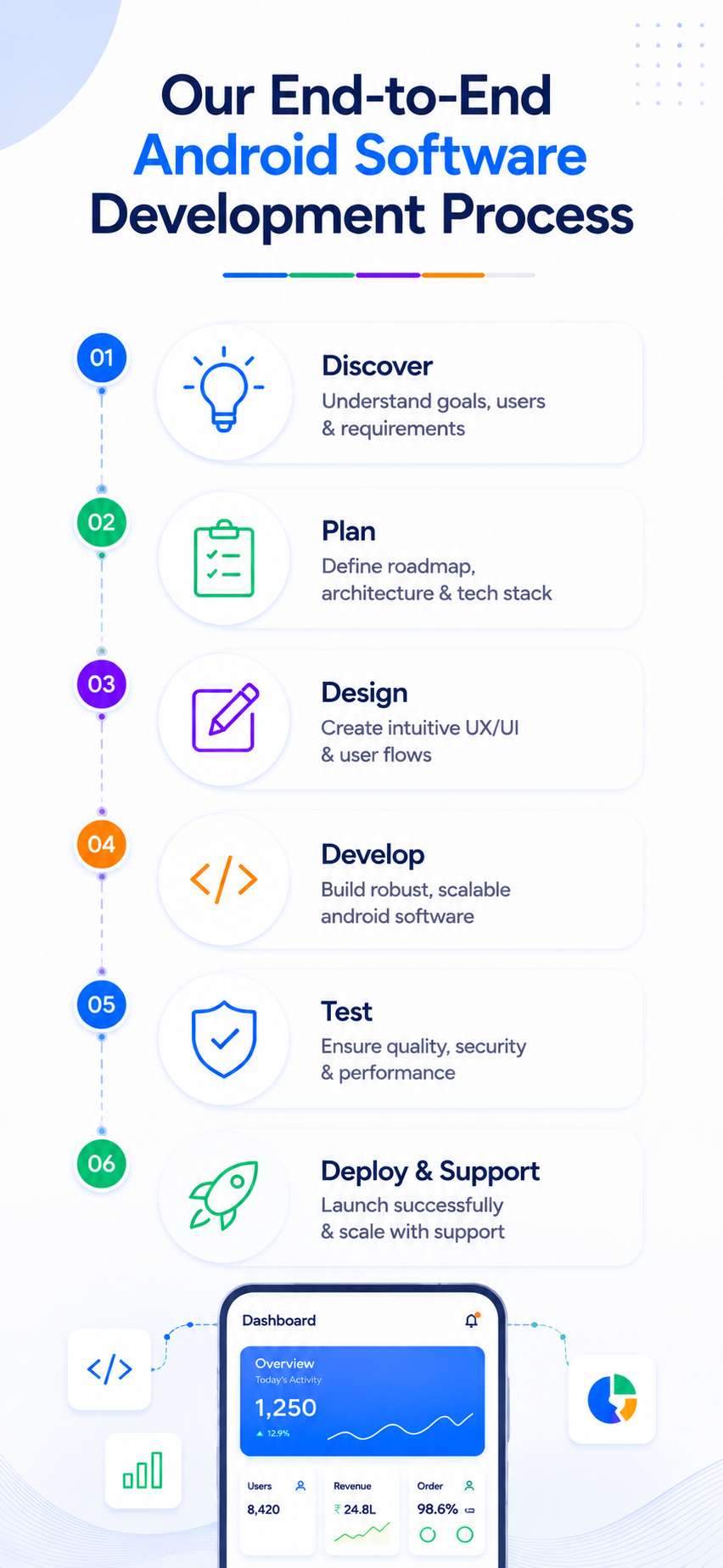
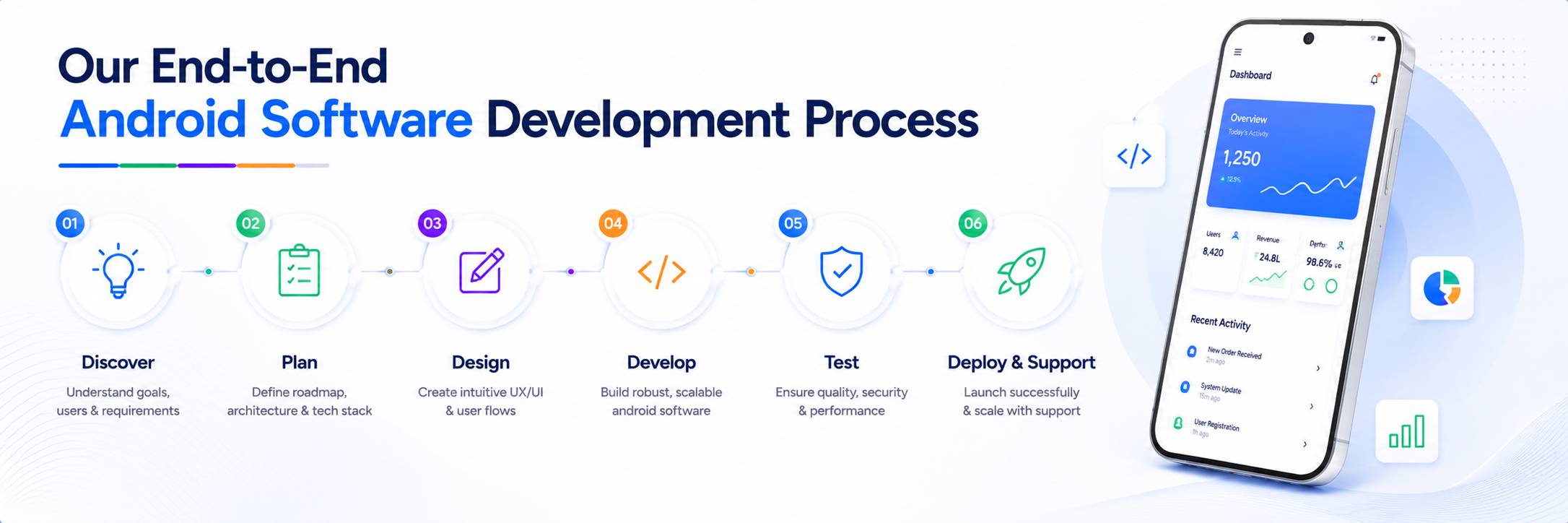
Every engagement begins with a structured discovery phase. Before any architecture decisions are made, our senior engineers and business analysts work with your team to understand the business problem in depth — the workflows being supported, the systems being integrated, the data being handled, the security requirements in play, and the scalability expectations over time. This phase produces a detailed technical specification that every subsequent decision is anchored to.
Development runs in agile sprints with working software delivered for client review every one to two weeks. QA operates in parallel throughout — automated testing running on every build, manual testing covering exploratory scenarios and edge cases, and performance benchmarking validating behaviour under realistic load conditions. Nothing reaches the Play Store without passing Ahom’s full validation cycle.
What does not change across engagements is team continuity. The senior engineers who scope your project are the same engineers who build it. There are no handoffs to junior teams mid-project and no loss of the institutional knowledge that accumulated during discovery. One of the most consistent pieces of feedback Ahom receives from clients is that this continuity — the sense that the team genuinely understands the project and cares about getting it right — makes a material difference to the outcome.
After launch, Ahom remains the technical partner for the software we build. OS compatibility updates, security patches, performance optimisation, and new feature development are all part of a structured post-launch arrangement agreed upfront — not an open-ended conversation after the fact.
The full scope of what Ahom delivers as an app development partner goes beyond any single platform — but Android software development sits at the core of what our engineering team does best.
Ahom Technologies has spent over a decade building Android software for clients across healthcare, fintech, logistics, e-commerce, agriculture, and infrastructure — sectors where the technical demands go well beyond basic mobile development.
Every engagement begins with a structured discovery phase. Before any architecture decisions are made, our senior engineers and business analysts work with your team to understand the business problem in depth — the workflows being supported, the systems being integrated, the data being handled, the security requirements in play, and the scalability expectations over time. This phase produces a detailed technical specification that every subsequent decision is anchored to.
Development runs in agile sprints with working software delivered for client review every one to two weeks. QA operates in parallel throughout — automated testing running on every build, manual testing covering exploratory scenarios and edge cases, and performance benchmarking validating behaviour under realistic load conditions. Nothing reaches the Play Store without passing Ahom’s full validation cycle.
What does not change across engagements is team continuity. The senior engineers who scope your project are the same engineers who build it. There are no handoffs to junior teams mid-project and no loss of the institutional knowledge that accumulated during discovery. One of the most consistent pieces of feedback Ahom receives from clients is that this continuity — the sense that the team genuinely understands the project and cares about getting it right — makes a material difference to the outcome.
After launch, Ahom remains the technical partner for the software we build. OS compatibility updates, security patches, performance optimisation, and new feature development are all part of a structured post-launch arrangement agreed upfront — not an open-ended conversation after the fact.
The full scope of what Ahom delivers as an app development partner goes beyond any single platform — but Android software development sits at the core of what our engineering team does best.
 The sectors where enterprise Android software creates the most significant business impact tend to share a common characteristic — complex operational workflows that benefit enormously from mobile access, real-time data, and system integration.